

Legitimate U.S. sweepstakes must let people enter without spending a dime, through a valid alternate method of entry (AMOE) that carries the same odds as a purchase-based entry. That requirement exists because the law treats prize plus chance plus consideration as an illegal lottery, and dropping consideration is what keeps a promotion legal. The FTC and state attorneys general are the two bodies that police this, and both have shut down promotions that hid or complicated free entry.
TL;DR:
- An authentic no purchase necessary entry requires offering an equally accessible and timed alternative method that matches the odds of purchase entries.
- State registration and bonding are mandatory for sweepstakes exceeding specific prize thresholds in Florida, New York, and Rhode Island, and must be arranged before launch.
- Official rules must clearly state the no purchase necessary condition, provide detailed entry procedures, and include odds, eligibility, and prize information, with transparency on registration requirements.
- Regulators like the FTC, state attorneys general, and USPS enforce these rules, and violations can result in fines, injunctions, or reputational damage, especially if free entries are hidden or uneven.
- Conducting pre-launch testing of all entry paths, maintaining detailed records, and ensuring equal prominence of all entry options help sponsors stay compliant and protect against legal or regulatory disputes.
Table of Contents
- What "No Purchase Necessary" Actually Means Under the Law
- How AMOE Entries Have to Match Purchase Entries
- State Registration and Bonding: What Triggers It
- The Official Rules Checklist Every Sweepstakes Needs
- Who Enforces These Rules and What Happens If You Break Them
- Best Practices That Keep Sweepstakes Out of Trouble
- How Online and Social Sweepstakes Apply These Rules in Practice
- Why Treating AMOE as a Real Option, Not an Afterthought, Protects Everyone
- Where to Verify the Rules Yourself
- Sources
What "No Purchase Necessary" Actually Means Under the Law
The legal test behind every sweepstakes in the country comes down to three elements: prize, chance, and consideration. Combine all three and you have an illegal lottery in most states, since lotteries are regulated activities reserved for state governments and licensed operators. Remove any one leg, and the promotion becomes a legal sweepstakes or contest instead.
Sponsors almost always solve this by eliminating consideration, since prize and chance are usually the point of the promotion. Consideration is not limited to cash. It includes anything a court might view as a "detriment" to the entrant or a "benefit" to the sponsor.
- Monetary consideration: buying a product, paying an entry fee, or paying for a subscription to enter.
- Non-monetary consideration: tasks that demand real time or effort, like writing a 500-word essay just to qualify, when a free alternative doesn't exist.
- Indirect consideration: requiring an internet purchase or a data plan just to access the entry form, with no offline or free-access alternative.
Edge cases trip up a lot of sponsors. A pre-existing membership, like a loyalty program you joined months earlier for unrelated reasons, generally doesn't count as consideration for a later sweepstakes tied to that program. But a purchase required specifically to unlock entry into a current promotion almost always does. The distinction lives in the timing and the purpose of the transaction, not just whether money changed hands somewhere in the relationship.
How AMOE Entries Have to Match Purchase Entries
An AMOE isn't a token gesture buried in paragraph 40 of the rules. It has to be genuinely equal to the purchase path, in odds, timing, and access, or the "free entry" language becomes deceptive on its own.
Sponsors typically offer one or more of these methods:
- Mail-in postcard entry. The entrant hand-writes name, address, and any required code onto a 3x5 card and mails it to a specified P.O. box during the entry period.
- Free web form entry. A no-cost online form collects the same information a purchase-based entry would generate, with no fee, subscription, or app download required to submit it.
- SMS or text entry. Entrants text a keyword to a designated number, standard message rates aside, with no premium charge tied to entering.
- Phone-in entry. A toll-free number lets entrants call and register verbally, useful for reaching entrants without reliable internet access.
Equal odds is the part sponsors get wrong most often. Every AMOE entry has to draw from the same prize pool, on the same schedule, with the same probability of winning as an entry generated through a purchase. If ten purchase entries get someone into a random draw of 10,000 total entries, a single mail-in postcard needs to carry that exact same one-in-10,000 shot, not a separate, smaller drawing with worse odds.
Pro Tip: Run a dry test of your own AMOE before launch. Mail a postcard to your own P.O. box, fill out your own web form, and time how long each takes. If the free method takes ten minutes to locate and complete versus thirty seconds for a purchase entry, a regulator or a plaintiff's attorney will call that unequal dignity, even if the odds on paper are identical.
Document your AMOE processing procedure internally, including who logs incoming postcards, how entries get merged with online submissions before the drawing, and how you'll prove parity if a state attorney general's office ever asks. Mail-in AMOEs remain one of the most durable ways to serve entrants who don't have internet access, so don't treat the postcard option as a formality you can quietly phase out.
State Registration and Bonding: What Triggers It
Federal law sets the baseline three-element test, but several states layer on their own registration and bonding requirements once a prize pool crosses a certain dollar threshold. Skipping these steps is one of the more expensive compliance mistakes a sponsor can make, since penalties can apply on top of the underlying federal exposure.
- Florida generally requires sweepstakes exceeding a certain prize value threshold to file rules and a bond with the Department of Agriculture and Consumer Services before the promotion launches.
- New York requires registration and bonding for sweepstakes with total prizes above a defined threshold, filed with the New York Secretary of State.
- Rhode Island applies a similar registration trigger, requiring filings for promotions above its prize-value threshold.
Compliance guides note that these three states are the ones sponsors trip over most often, largely because national promotions rarely check state-by-state thresholds before launch. If your sweepstakes runs in all 50 states and your total prize package clears those dollar amounts, you likely owe a filing in each of the three, not just the one where your company is headquartered.
Bonding works like insurance for entrants: the sponsor posts a bond guaranteeing that advertised prizes actually get awarded and fulfilled. Registration paperwork and bond approval can take several weeks depending on the state, so build that lead time into your campaign calendar rather than trying to file the week before launch.
If your prize pool is modest and confined to a handful of states, you can often handle registration in-house with a compliance checklist. Once you're running a national promotion with a prize value in the tens of thousands of dollars or higher, bring in a registered sweepstakes administrator or outside counsel who tracks these thresholds for a living. The cost of that expertise is small compared to the fines and reputational hit from a botched filing.
The Official Rules Checklist Every Sweepstakes Needs
Every legally sound sweepstakes publishes a full set of official rules, not just a short disclaimer in the ad. At minimum, your rules document should include:
- A clear "no purchase necessary" statement, stated plainly and not buried in legal boilerplate.
- Eligibility requirements: age, residency, and any employment exclusions.
- Start and end dates for the entry period, stated with specific times and time zones.
- Step-by-step AMOE instructions, given equal visual weight to the purchase-entry instructions.
- Odds of winning, or the information needed to calculate them once entries close.
- Sponsor name, mailing address, and contact information.
- A full prize description, including approximate retail value.
- The winner selection and notification process, including the deadline for claiming a prize.
- Any registration or bonding disclosures required in states like Florida, New York, or Rhode Island.
Prizes valued at $600 or more trigger IRS Form 1099 reporting, which means sponsors need a system to collect winner tax information before handing over the prize, not after. Get the specifics right in your sweepstakes tax reporting obligations so winners aren't surprised come tax season.
On conspicuity, the rule of thumb is simple: if an ad or landing page mentions the sweepstakes at all, it needs a visible "no purchase necessary, see official rules" line, not just a hyperlink in eight-point font at the bottom of the page. FTC guidance on advertising is explicit that any promotional claim has to be truthful and not misleading, and a hidden AMOE disclosure can qualify as misleading on its own. Privacy compliance matters here too: if your entry form collects personal data, your rules need to disclose how that data gets used, consistent with your privacy policy.

Who Enforces These Rules and What Happens If You Break Them
Three agencies do most of the enforcement work in this space, each with a different jurisdiction. The Federal Trade Commission handles deceptive advertising and unfair trade practice claims nationally, and it's the agency most likely to act on a sweepstakes that hides its AMOE or overstates the odds of winning. State attorneys general enforce their own state's consumer protection and lottery statutes, which is where registration and bonding violations typically get punished. The U.S. Postal Inspection Service steps in whenever a promotion uses the mail, whether for entry or for prize notification, and mail fraud carries its own separate federal penalties.
Consumers who suspect a fraudulent or deceptive sweepstakes have a few direct paths to report it:
- File a complaint at Reportfraud, which feeds directly into FTC investigations.
- Check with the National Association of Attorneys General to find the right state AG complaint portal.
- Use the general Usa for a broader federal reporting option.
Penalties for sponsors who get this wrong range widely. Regulators can seek injunctions that halt a promotion mid-run, civil fines, disgorgement of revenue tied to the violation, and consumer restitution. Beyond the legal exposure, a sweepstakes that gets flagged publicly for hiding its free entry option tends to do lasting damage to a brand's credibility, the kind that outlasts whatever the promotion was supposed to generate in engagement.
Best Practices That Keep Sweepstakes Out of Trouble
A short pre-launch routine catches most of the problems that get sponsors in trouble later.
- Test your own AMOE end to end before the campaign goes live, timing it against the purchase path.
- Publish the complete official rules on a stable, linkable page, not just a summary in a footer.
- Confirm parity between AMOE and purchase entries: same odds, same prize pool, same entry deadline.
- Document winner selection with a timestamped, auditable process you can produce if ever asked.
The mistakes that show up again and again: AMOE instructions hidden behind extra clicks, purchase entries that quietly get better odds through bonus-entry promotions, AMOE steps so convoluted they discourage free entrants, and rules that read differently across the website, the app, and the print ad for the same promotion.
Pro Tip: Keep entry records for at least three years after a sweepstakes closes, longer if your legal counsel recommends it for your state. If a regulator or a disappointed entrant ever challenges your winner selection, having a clean, timestamped record is the difference between a five-minute phone call and a drawn-out investigation.
Recordkeeping matters as much for privacy as for prize disputes. If your entry form collects data covered under the CCPA or similar state privacy laws, loop in counsel or a registered sweepstakes administrator early rather than after a complaint lands.
How Online and Social Sweepstakes Apply These Rules in Practice
Picture a typical online promotion: entrants can join by purchasing a product bundle, or by mailing in a postcard, or by filling out a free web form. The compliance work is documenting that all three paths lead into the same drawing, on the same schedule, with the same odds, and that the rules page states that clearly rather than implying the purchase path is faster or better.
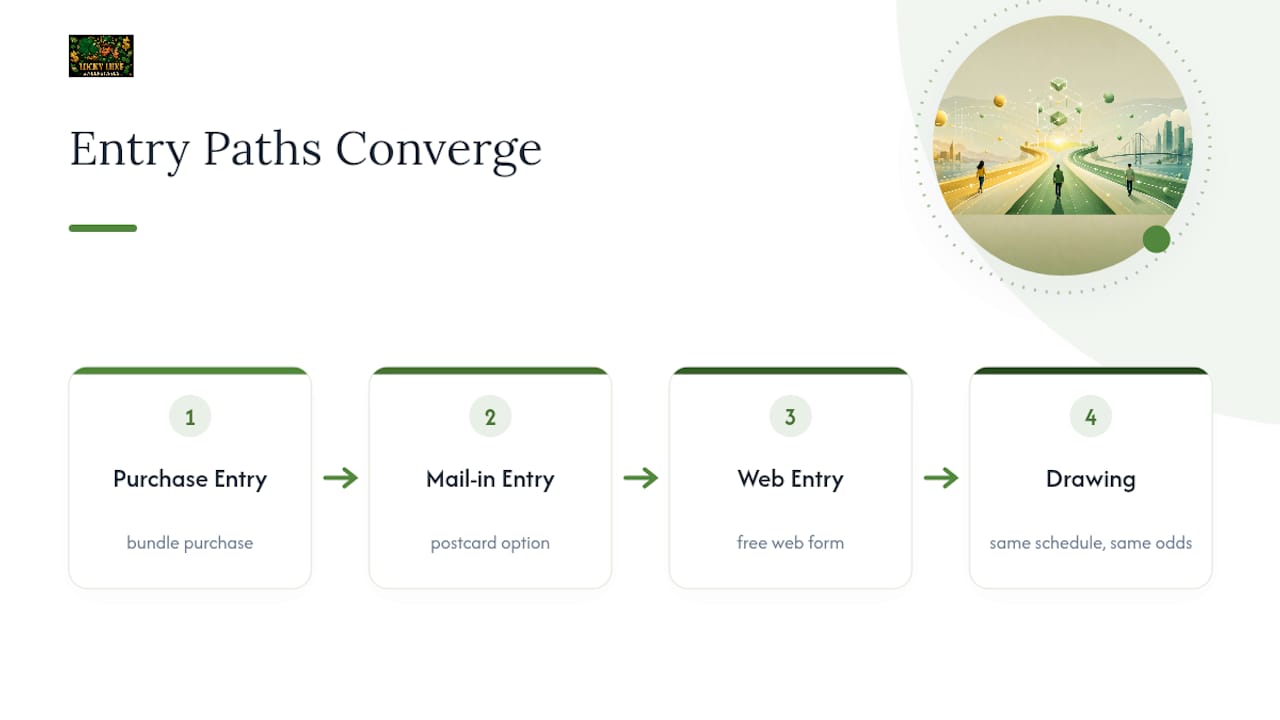
Accessibility deserves specific attention here. Not every entrant has reliable internet access, so a purely digital AMOE isn't enough on its own. Pairing a free web form with a mail-in postcard option covers both audiences, and the step-by-step instructions for each need to sit at the same visual weight on the rules page, not with the web form up top and the mail-in option buried in a footnote.
Platforms that run promotional entries alongside gameplay often post official rules and AMOE guidance directly alongside the offer itself rather than routing entrants through several pages to find them. That kind of placement is itself a small compliance signal: the easier the free option is to find, the less exposure the sponsor carries if a regulator ever looks closely. Players curious about how virtual currencies intersect with sweepstakes eligibility can see the mechanics laid out in how Gold Coins and Sweeps Coins differ.
Why Treating AMOE as a Real Option, Not an Afterthought, Protects Everyone
Sponsors who bury their AMOE usually aren't trying to break the law. They're trying to nudge more people toward the purchase path, and the free option becomes an afterthought that gets less design attention and less prominence. That's exactly the pattern regulators flag first, because it's the easiest one to prove with a side-by-side screenshot.
Treating the AMOE as a genuine, equally weighted entry path costs a sponsor almost nothing operationally and removes most of the regulatory risk in one move. It also does something less obvious: it signals to entrants that the sweepstakes is run in good faith, which matters more than most marketing teams give it credit for.
— Skyline
Where to Verify the Rules Yourself
Check federal guidance directly rather than relying on secondhand summaries. Start with the FTC's advertising guidance for small businesses, its consumer prize-scam warnings, and USPIS guidance on mail-based sweepstakes. To report a suspicious promotion, use Reportfraud or find your state's office through NAAG.
Sources
- Advertising and marketing guidance for small businesses — FTC
- Reportfraud
- National Association of Attorneys General (NAAG)
- Contest and sweepstakes scams — United States Postal Inspection Service (USPIS)