

Online arcade games get a bad reputation for being harder or more time-consuming than they actually are. If you've ever assumed that jumping into this space means grinding through tutorials or mastering complex controls, you're not alone. But the reality is almost the opposite. The types of online arcade games dominating the web right now are built for quick sessions, zero learning curve, and instant fun. This guide breaks down every major category, from hypercasual and puzzle formats to challenge modes and social party games, so you can find exactly what fits your mood and schedule today.
Table of Contents
- Key takeaways
- Types of online arcade games: hypercasual and puzzle
- Challenge modes and how they refresh classic games
- Popular subgenres you'll actually encounter
- How simple games stay engaging over time
- Choosing the right type for your mood and time
- My take on where online arcade gaming stands right now
- Try arcade-style games at Luckyluxe
- FAQ
Key takeaways
| Point | Details |
|---|---|
| Hypercasual games lead the pack | Hypercasual titles hold nearly 79% of all web browser gaming time, making them the most accessible entry point. |
| Puzzle games are a close second | Match-3 and block-clearing games account for over 20% of browser playtime and suit short, satisfying sessions. |
| Challenge modes add variety fast | Modes like Score Attack and Survival let you replay the same game with fresh objectives and no long campaigns. |
| Social arcade games are underrated | Party-style games like those from Jackbox bring group fun to online arcades without requiring solo skill. |
| Free play is the norm | Most popular online arcade games run in your browser with no download, no account, and no cost. |
Types of online arcade games: hypercasual and puzzle
Before going further, it helps to understand what online arcade games actually are. The industry term is "browser-based casual games," though most players and platforms simply call them online arcade games. They cover any game you can play instantly in a browser or on mobile without a major time investment. Think short loops, simple controls, and immediate payoff.
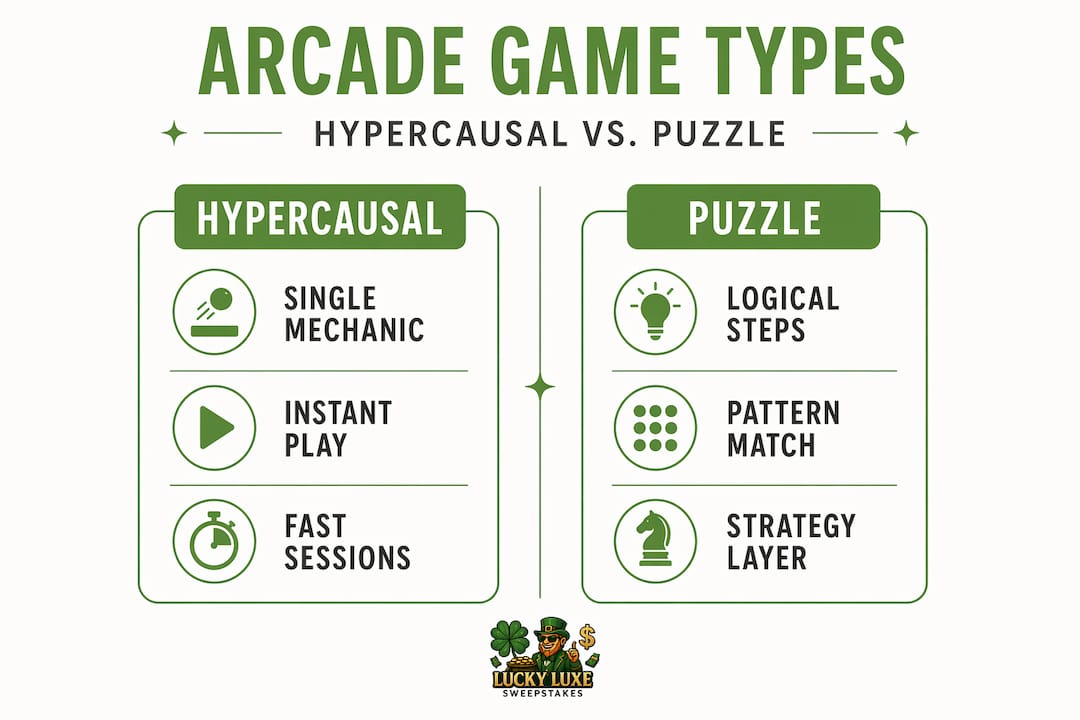
Two categories dominate this space by a massive margin. Hypercasual games hold 78.8% of tracked web browser playtime in 2026, and puzzle games account for another 20.6%. Together, they make up more than 99% of what people actually play online. That's not a trend. That's a near-total takeover.
What makes hypercasual games different
Hypercasual games strip gameplay down to a single mechanic. You tap to jump. You swipe to dodge. You hold to charge. There's no inventory, no story, and no skill tree. The appeal is that you can pick one up in five seconds and put it down three minutes later without losing any progress that matters.
These games also favor instant access with no accounts, no downloads, and no tutorials longer than one screen. For casual players squeezing in a break between tasks, that frictionless entry is the whole point.
What puzzle arcade games offer
Puzzle arcade games add one layer of thinking to the hypercasual formula. Match-3 games, block-clearing challenges, and spatial reasoning puzzles all fall here. The satisfaction comes from solving something, not just reacting to it. Games like Jewel Crush and Jewels Blocks Puzzle are textbook examples. You see a board, you spot a pattern, you clear it. Done in two minutes. Ready for another round.
Pro Tip: If you're new to online arcade games, start with a puzzle format. The slightly slower pace gives you time to understand what's happening without feeling overwhelmed.
The combination of these two categories explains why casual players keep coming back. Neither type demands anything from you except a few minutes and a willingness to play.
Challenge modes and how they refresh classic games
Here's something most casual players don't realize: a single arcade game can become five completely different experiences depending on the challenge mode you choose. This is one of the most underappreciated features in online arcade gaming.
Challenge mode taxonomy breaks down like this:
- Score Attack — Hit the highest score possible within a set number of lives or turns.
- Time Attack — Clear a level or reach a goal as fast as you can.
- Survival — Last as long as possible against escalating difficulty.
- Pacifist — Complete the game without using certain mechanics, like weapons or power-ups.
- Boss Rush — Face only the hardest enemies or obstacles back to back.
- Collection Run — Grab every item or objective in a single playthrough.
- Speed Run — Finish the entire game in the shortest time on record.
Antstream Arcade offers 600+ unique challenges across a library of over 1,300 retro games, complete with global leaderboards. It's a good example of how challenge modes turn a five-minute game into something you can replay dozens of times without it ever feeling stale.
The key insight here is that challenge modes extend arcade gaming without requiring long campaigns. You don't need to invest hours to feel like you've accomplished something. A two-minute Survival run with a personal best score is genuinely satisfying on its own.
| Mode type | Best for | Time needed |
|---|---|---|
| Score Attack | Competitive players | 2 to 5 minutes |
| Survival | Reflex-focused players | 1 to 3 minutes |
| Time Attack | Speed-oriented players | Under 2 minutes |
| Boss Rush | Challenge seekers | 5 to 10 minutes |
| Speed Run | Dedicated replay fans | Varies |
Pro Tip: When you find a game you enjoy, check if it offers a Survival or Score Attack mode before moving on. You might already have your new favorite without downloading anything new.
Antstream has logged over 31 million sessions and 10 million challenges played. That scale tells you casual players aren't just trying challenge modes once. They're coming back to them repeatedly.
Popular subgenres you'll actually encounter
Once you move past the broad categories, you start running into specific game types that have their own loyal followings. Here's what you'll find most often when browsing popular online arcade games:
- Brick-breaking games like Bricked put you in control of a paddle bouncing a ball to destroy blocks. Simple physics, satisfying destruction, and naturally escalating difficulty. One of the oldest arcade formats and still one of the most played.
- Jewel and block puzzle games like Jewel Crush and Jewels Blocks Puzzle challenge you to match colors or fit shapes into a grid. These browser and mobile-ready titles are among the most downloaded casual arcade formats worldwide.
- Reflex and rhythm games like Piano Tile Reflex test how fast your fingers can respond to visual cues. They're short, intense, and genuinely addictive once you start chasing your own high scores.
- Parkour and obstacle games like Megacity Hop and Hop Stars combine platform mechanics with arcade speed. You're jumping, dodging, and reacting. No story required.
- Modern pinball games like Speed Pinball take a classic format and add faster physics, combo systems, and leaderboard hooks that make it feel current.
- Party and social arcade games like those from Jackbox Games bring a completely different energy. Titles like Quiplash and Fibbage mix trivia, drawing, and social interaction for group play. These aren't solo skill tests. They're built for laughing with friends online or in person.
The variety here is genuinely wide. You can go from a silent, focused puzzle session to a chaotic group trivia game without leaving your browser. That range is what makes online arcade game categories so appealing to casual players.
How simple games stay engaging over time
One of the smarter things casual arcade game designers do is reward skill without requiring a story. This inverts how most console games work. Instead of unlocking the next chapter, you're chasing a better score or a longer survival streak.
Casual arcade games reward skillful play through leaderboards and difficulty tiers rather than narrative advancement. Lamp Smash is a clean example. It's a free browser game with four difficulty levels, including a "Secret VIP Level" and a "Legend" tier. There's no plot. But the escalating challenge and global leaderboard give you a real reason to keep playing.
The design principles that keep casual players engaged without heavy commitment include:
- Micro-goals: Beat your last score, survive five seconds longer, clear the board faster.
- Instant reset: Fail and restart in under two seconds. No loading screens, no menus.
- Global leaderboards: Social leaderboard competition adds stakes without requiring multiplayer infrastructure.
- Escalating difficulty: The game gets harder at a pace that feels fair, not punishing.
- Zero friction entry: Free to play, no account needed, works in any browser.
"The best casual arcade games make you feel like you're getting better at something real, even if the whole session lasted four minutes."
Pro Tip: Look for games with visible leaderboards or personal best tracking. That one feature turns a throwaway game into something you'll return to for weeks.
Choosing the right type for your mood and time
Knowing the categories is useful. Knowing which one fits your situation right now is even better. Here's a practical way to match game type to your available time and energy:
- Under 3 minutes, low focus: Pick a hypercasual game. Tap-to-jump, swipe-to-dodge, or anything with a single mechanic. No thinking required.
- 5 to 10 minutes, want a small win: Go for a puzzle arcade game. Match-3 or block puzzles give you a clear goal and a satisfying finish.
- Want competition without a full match: Try a Score Attack or Survival challenge mode. Two minutes, a leaderboard, and a personal best to chase.
- Playing with others: Social party games are your best bet. They work over video calls or in the same room and need no gaming experience to enjoy.
- Want to explore free options: Most of the best online arcade games run directly in your browser. Search for browser-based versions of any genre above before downloading anything.
Device matters too. Reflex and rhythm games often feel better on mobile where tapping is natural. Brick-breaking and pinball games tend to work better with a mouse or trackpad. Puzzle games work equally well on both.
My take on where online arcade gaming stands right now
I've watched the online arcade space shift dramatically over the past several years, and what strikes me most is how much better it has gotten for casual players specifically.
The rise of hypercasual and puzzle formats wasn't an accident. It was a direct response to what players actually wanted: something fun, fast, and forgiving. I've seen people dismiss these games as shallow, but that misses the point entirely. Shallow entry, deep replay. That's the design goal, and the best games in this space nail it.
What I find genuinely surprising is how much challenge modes have extended the life of games that would otherwise feel exhausted. A retro arcade title from 30 years ago becomes fresh again when you're chasing a Survival record against players from around the world. That's not nostalgia. That's good game design applied to old material.
Social party arcade games are the most underestimated category in this whole space. I've seen groups of people with zero gaming background have an absolute blast with Jackbox titles. The barrier isn't skill. It's just awareness that these games exist.
My practical advice: don't commit to one type. The best free online arcade games are built for exactly that kind of casual exploration. Spend ten minutes with a puzzle game, five with a challenge mode, and then pull in a friend for a party round. The variety is the experience.
— Skyline
Try arcade-style games at Luckyluxe
If you're ready to put any of this into practice, Luckyluxe is worth a visit. The platform offers a curated selection of arcade-style and casual games that fit exactly the low-commitment, instant-play model described throughout this guide.
Luckyluxe makes it easy to jump in without any prior gaming experience. The game library is built for variety, with options that suit quick solo sessions and more engaged play alike. High-quality visuals, fair play standards, and regularly updated game highlights mean you're always finding something worth trying. Whether you're new to online gaming or just looking for a fresh destination, Luckyluxe gives you a solid starting point with no pressure and no heavy commitment required.
FAQ
What are online arcade games?
Online arcade games are browser or mobile games designed for short, low-commitment play sessions. They typically feature simple mechanics, instant access, and no download requirements.
What types of online arcade games are most popular?
Hypercasual and puzzle games dominate, accounting for over 99% of tracked web browser gaming time. Brick-breaking, match-3, and reflex games are among the most common subtypes.
Are there free online arcade games I can play right now?
Yes. Most popular online arcade games are completely free and run directly in your browser with no account or download needed. Hypercasual and puzzle games especially follow this model.
What is a challenge mode in arcade games?
A challenge mode changes the objective of a game without changing its core mechanics. Examples include Score Attack, Survival, and Time Attack, all designed for short, repeatable sessions.
Can I play online arcade games with friends?
Yes. Social party arcade games like those from Jackbox Games are specifically built for group play, mixing trivia, drawing, and social interaction in an arcade-style format that works online or in person.