

If you've ever wondered whether a slot game is rigged against you, you're not alone. Understanding why fair play matters in slot gaming is the difference between playing with confidence and walking away frustrated by something you can't explain. The truth is, modern slot games operate under strict technical and regulatory standards designed to protect you. This article breaks down how fairness actually works, why it matters beyond just the math, and how you can use that knowledge to choose platforms and games worth your time and money.
Table of Contents
- Key takeaways
- Why fair play matters in slot gaming: RNG, RTP, and certification
- How fair play builds trust and meets legal requirements
- Common misconceptions about slot fairness
- How to identify fair slots and choose trusted platforms
- Why fair play benefits everyone in the long run
- My honest take on fair play and player trust
- Play fair games you can actually trust at Luckyluxe
- FAQ
Key takeaways
| Point | Details |
|---|---|
| RNG drives every spin | Certified Random Number Generators make every spin independent and unpredictable, with no pattern to exploit. |
| RTP is a long-run average | A 96% RTP means roughly $96 back per $100 over millions of spins, not a guaranteed session return. |
| Certification seals signal trust | Look for eCOGRA or iTech Labs seals to confirm a game's fairness has been independently verified. |
| Variance explains losing streaks | Cold streaks are not evidence of rigging. They are normal statistical variance in a random system. |
| Licensed platforms protect you | Regulated casinos must pass ongoing audits, keeping games fair and your money safer. |
Why fair play matters in slot gaming: RNG, RTP, and certification
Most slot players never see the engine running beneath every spin. Two technical concepts sit at the core of slot gaming fairness: the Random Number Generator (RNG) and the Return to Player (RTP) percentage.
The RNG is software that produces thousands of random number sequences every second, even when nobody is playing. Each spin pulls a result from that sequence, making outcomes statistically random and unpredictable. Slot outcomes are verified by independent labs to confirm genuine randomness before a game ever reaches players. No pattern exists to exploit. No memory of your last spin carries into the next.
RTP works differently. Think of it as a long-term promise, not a session guarantee. A 96% RTP slot returns roughly $96 for every $100 wagered across millions of spins. In any single session, you might win big or lose your entire budget. That's not unfairness. That's variance doing exactly what it should.
Here's where it gets interesting. Certification connects both of these concepts.
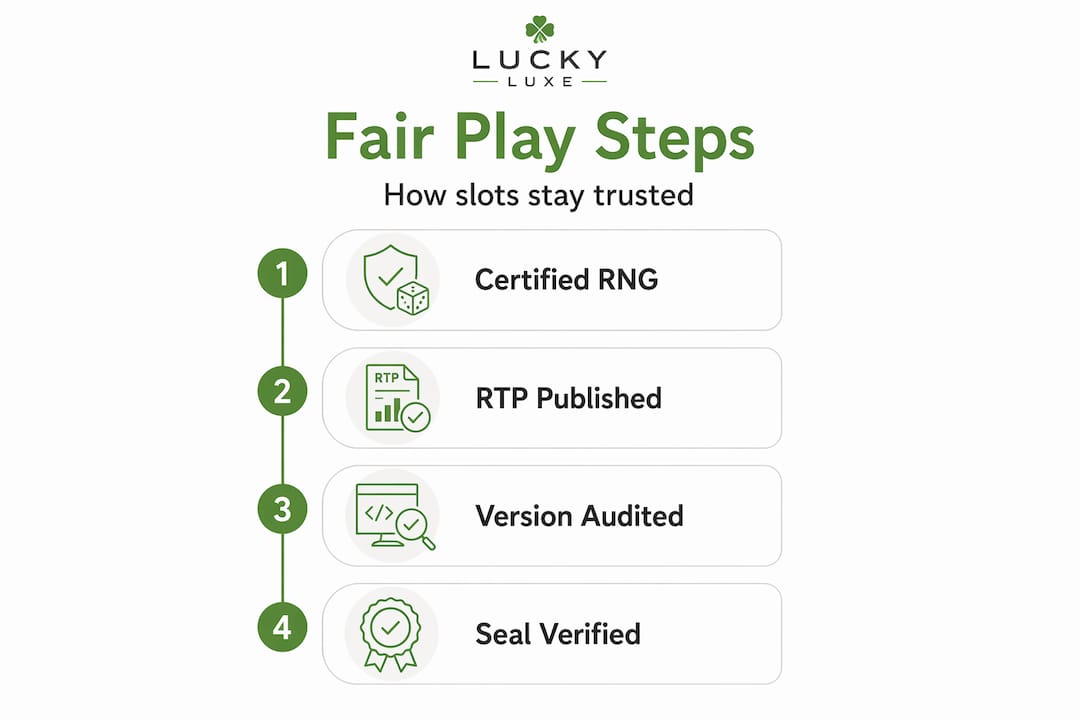
- Independent testing labs like eCOGRA and iTech Labs run games through millions of simulated spins to confirm that the RNG output is genuinely random and that the actual payout rate matches the published RTP.
- Game-specific certification means the approval is tied to a specific version of the software. If a developer changes the math model or code after certification, re-testing is required before the updated game can go live.
- Volatility also plays a role in how you experience fairness. A high-volatility slot pays out less often but in larger amounts. A low-volatility slot pays smaller amounts more frequently. Understanding volatility alongside RTP helps you pick games that match your bankroll and risk tolerance.
Pro Tip: Before you play any slot, look up the published RTP in the game's info panel or paytable. Most reputable platforms display it clearly. If a platform hides or omits RTP information, that's a signal worth taking seriously.
How fair play builds trust and meets legal requirements
Fair play is not just a technical checkbox. It shapes how players feel about a platform and whether they stay.
Players abandon platforms they perceive as rigged, even when the games are mathematically sound. The psychology matters as much as the math. When a platform publishes RTP clearly, displays certification seals, and explains game rules transparently, players feel respected. That trust translates directly into loyalty.
Here's how the chain of protection actually works for you as a player:
- Certified RNG prevents manipulation. Once a game is certified and live, no operator can alter the outcome probabilities without triggering a re-certification process. You're protected from behind-the-scenes tampering.
- Encryption and anti-cheating systems add another layer. Fair play commitments in gambling software include digital security measures that protect your data and prevent external manipulation of game results.
- Regulatory compliance keeps platforms accountable. Authorities like the UK Gambling Commission enforce technical standards, and licensed platforms must pass audits regularly or risk losing their license. That's not a small consequence. It's a powerful incentive to stay honest.
"Players' trust in fairness is as much psychological as technical. Verified fairness reduces player churn beyond just mathematical checks." — SDLC Corp
This is the part most players miss. Ethical gaming practices are not just good for the industry. They are a direct, practical benefit to you every time you sit down to play.
Common misconceptions about slot fairness
The most damaging belief in slot gaming is the idea that machines run hot or cold. You've probably heard someone say a machine "hasn't paid in a while, so it's due." That's not how any of this works.

Every spin is completely independent. The RNG does not remember your last 50 spins. It doesn't track how long since the last jackpot. The probability of any outcome is identical on every single spin, regardless of what came before. Believing otherwise is a cognitive bias called the gambler's fallacy, and it leads players to make poor decisions.
A few other misconceptions worth clearing up:
- "I'm losing because the casino turned down my payout rate." Operators on certified platforms cannot adjust individual game RTPs after certification. The math is locked in.
- "This slot pays better at certain times of day." RNGs run continuously and produce random results 24 hours a day. Time of day has zero effect on outcomes.
- "A big jackpot just hit, so this game is cold now." Again, each spin is independent. A jackpot on spin 1,000 has no influence on spin 1,001.
The reality is that variance and cognitive bias account for nearly every claim of rigging. Short sessions with bad results feel unfair because humans are wired to find patterns. Slots are designed to be random, and randomness sometimes produces long losing streaks.
Pro Tip: Set a session budget before you play and treat it as the cost of entertainment. When you frame losses as the price of a fun experience rather than evidence of cheating, you make smarter decisions and enjoy the game more.
How to identify fair slots and choose trusted platforms
Knowing that fair play mechanisms exist is useful. Knowing how to verify them before you deposit money is better.
| What to check | Why it matters |
|---|---|
| Certification seal (eCOGRA, iTech Labs) | Confirms an independent lab has tested the RNG and RTP for that specific game version |
| Published RTP percentage | Lets you compare games and choose higher-value options; a 96% RTP slot saves about $20 per 1,000 spins versus a 94% RTP slot |
| Active gambling license | Proves the platform is regulated and subject to ongoing audits |
| Transparent game rules | Shows the platform is not hiding payout structures or bonus conditions |
| Volatility rating | Helps you match the game to your bankroll and playing style |
Beyond the table above, here are the practical steps to apply before playing:
- Open the game's info or help panel and look for the RTP figure. Reputable games display it clearly.
- Check the platform's footer or "About" page for licensing information. A valid license from a recognized authority is non-negotiable.
- Search for the certification seal on the platform's homepage. eCOGRA and iTech Labs logos are typically linked to verification pages you can click through.
- Read the bonus terms. Platforms committed to ethical gaming practices write clear, fair terms without buried conditions that make bonuses impossible to redeem.
Slot fairness certification tied to specific game versions is key. Any mismatch between the certified version and the live game erodes confidence even when the RTP looks good on paper.
Why fair play benefits everyone in the long run
The benefits of fair gaming extend well beyond any single session. When fairness is built into the foundation of slot gaming, the entire ecosystem becomes more sustainable and enjoyable.
- You're protected from cheating and manipulation. Certified RNGs and regulated platforms remove the possibility of operators tilting outcomes against you.
- Transparency increases your enjoyment. When you understand how RTP and volatility work, a losing session stops feeling like a personal attack and starts feeling like a normal part of a random system.
- A level playing field builds long-term confidence. Independent verification means every player faces the same probabilities. Nobody gets a worse version of the game.
- Fair play keeps the industry legal and reputable. Platforms that cut corners on fairness lose their licenses. The ones that survive long-term are the ones that earn trust by playing it straight.
Slot gaming fairness is not a marketing promise. It's a verifiable, regulated, technically enforced standard that protects you every time you play.
My honest take on fair play and player trust
I've spent years watching players lose confidence in platforms that were actually running fair games. The frustration wasn't caused by rigged software. It was caused by a gap in understanding.
What I've learned is that the technical side of slot gaming fairness is genuinely solid. Certified RNGs, independent audits, and regulatory oversight create a system that's harder to manipulate than most players realize. The real vulnerability is on the player side. When you don't understand variance, every cold streak feels like evidence of fraud.
The moment I started checking RTP before choosing a game and verifying certification seals before depositing, my experience changed. Not because I started winning more. Because I stopped second-guessing every outcome. I knew the system was working as designed, and that clarity made the game enjoyable again.
What I find most underrated is the role of platform transparency. A casino that displays RTP clearly, links to its certification reports, and writes honest bonus terms is telling you something important about how it operates. A platform that buries that information is also telling you something. My advice: pay attention to both signals equally.
Player education on fair play is not just about protecting yourself from bad actors. It's about getting the most out of every session by understanding what you're actually playing. That's a shift worth making.
— Skyline
Play fair games you can actually trust at Luckyluxe
If you've made it this far, you now know more about slot gaming fairness than most players ever will. The next step is putting that knowledge to work by choosing a platform that takes fairness as seriously as you do.
Luckyluxe is built around exactly the principles covered in this article. Games are selected for quality and transparency, RTP information is accessible, and the platform's design makes it easy to find what you need before you play. Whether you're into slots, fishing games, or arcade titles, you'll find a library of options backed by the kind of fairness standards that give you real confidence. Check out what's available and see how a platform committed to ethical gaming practices actually looks in practice.
FAQ
What is an RNG and why does it matter for slot fairness?
An RNG is software that generates random, unpredictable outcomes for every spin. Independent labs certify that the RNG is genuinely random before a game goes live, making it impossible for operators to manipulate results.
What does RTP mean in slot gaming?
RTP stands for Return to Player and represents the theoretical percentage a slot pays back over millions of spins. A 96% RTP means roughly $96 returned per $100 wagered in the long run, not a guarantee for any single session.
Can a licensed casino rig its slots after certification?
No. Certification is tied to a specific game version, and any change to the software or math model requires re-testing by an independent lab before the updated game can be offered to players.
Why do I keep losing if slots are supposed to be fair?
Short-term losing streaks are a normal result of variance in a random system. Each spin is independent, and cognitive bias makes losing runs feel more significant than they statistically are.
How do I know if a slot platform is actually fair?
Look for an active gambling license, published RTP figures in the game info panel, and certification seals from recognized labs like eCOGRA or iTech Labs. Platforms that display all three are meeting verified fairness standards.