

A slot multiplier takes an existing win and multiplies it by a set number, so a 3x multiplier turns a $10 win into $30. Standard multipliers commonly have values between x2 and x10, while some rare bonus modes feature much higher multipliers. They only matter when a spin already produces a win, and the exact rules for when and how they apply live in the game's paytable.
TL;DR:
- Most multipliers range between x2 and x10, with higher values often limited by caps or specific trigger conditions, and rarely exceeding a few hundred in normal play.
- Multipliers can apply to individual lines, entire spins, bonus features, or specific symbols, with their scope clearly disclosed in the game's paytable.
- Additive and multiplicative stacking rules produce vastly different payout outcomes, making it essential to understand each game's specific math model before playing.
- High-value, rare multipliers tend to increase game volatility, leading to longer losing streaks and bigger swings, not necessarily better chances of winning.
- Transparent paytables and understanding multiplier placement and stacking rules help players manage expectations and set responsible bankroll limits.
Table of Contents
- What Are Multipliers in Slots and How Do They Work?
- What Types of Multipliers Show Up in Slot Games?
- How Do Stacking Rules and Multiplier Math Actually Work?
- Where in a Slot Do Multipliers Actually Appear?
- Do Multipliers Change a Slot's RTP or Just Its Volatility?
- How Do You Verify Multiplier Rules Before You Play?
- What's the Best Strategy for Playing Multiplier Slots?
- Short Worked Examples: Additive vs. Multiplicative Payouts
- How Do Multipliers Affect Jackpot Wins and Max Payouts?
- Common Myths and Misconceptions About Multipliers in Slots
- How Do Different Software Providers Build Multiplier Features?
- What Are the Risks of Chasing Big Multiplier Wins?
- The Lucky Luxe Take on Multiplier Transparency
- Ready to Put These Multiplier Rules to the Test?
- Sources
- FAQ
What Are Multipliers in Slots and How Do They Work?
A multiplier is a modifier that scales an existing payout. It does not create wins out of nothing. If your line, spin, or feature does not produce a payout, a multiplier attached to that round typically has nothing to work with unless the specific game says otherwise.
Where the multiplier applies changes everything about its impact. Some multiply a single payline. Others multiply the total win across an entire spin. A smaller group attaches to one symbol and only boosts wins involving that symbol.
Common scopes you will run into:
- Per-line multipliers — apply only to the specific payline that wins, common in classic three and five reel games
- Total spin multipliers — apply to everything won on that spin, regardless of how many lines hit
- Feature-total multipliers — apply once at the end of a bonus round or free spins sequence
- Symbol-attached multipliers — tied to a specific wild, scatter, or special symbol that landed in a winning combination
None of this is guesswork on your end. Every legitimate slot discloses its multiplier scope in the help or rule of thumb is that a multiplier changes an existing win's size rather than inventing one, and the paytable is where that scope gets spelled out symbol by symbol.
What Types of Multipliers Show Up in Slot Games?
Multipliers show up in a handful of recognizable forms, and knowing which one you're looking at tells you a lot about how a game is built to pay.
- Base-game multipliers. These appear during ordinary spins, usually attached to a wild symbol or triggered randomly. They tend to be smaller (x2 or x3) because they hit more often.
- Free-spins multipliers. Some games apply a flat multiplier to every win during the bonus round. Others increase the multiplier as the free spins progress, rewarding you for surviving longer into the feature.
- Progressive or accumulating multipliers. These grow with each consecutive win or retrigger, often reset only when a spin produces no win. Cascading reel slots use this mechanic heavily, since one tumble can trigger the next.
- Sticky multipliers. Once triggered, the multiplier value stays in place for the remainder of the feature or spin sequence rather than resetting immediately.
- Random or mystery multipliers. Applied unpredictably by the game engine, sometimes as a standalone symbol landing anywhere on the reels, unconnected to a specific win line.
- Reel or symbol multipliers. A value sits on a specific reel or symbol position and applies only when that position contributes to a win.
Recognizing these types before you spin tells you what kind of session to expect: frequent small boosts, or rare, larger swings.
How Do Stacking Rules and Multiplier Math Actually Work?
Multiplier math is not standardized, which is exactly why so many players get surprised by "up to" claims in marketing copy. Games apply stacking in at least four different ways, and the difference between them can change a payout by a wide margin.
- Additive stacking: two x2 multipliers combine into x4, not x4 squared. A $10 win with two additive x2 multipliers becomes $10 × (2 + 2) = $40.
- Multiplicative stacking: the same two x2 multipliers multiply against each other. A $10 win becomes $10 × 2 × 2 = $40 in this simple case, but the gap widens fast with three or more multipliers, since 2 × 2 × 2 produces $80 versus just $60 under additive rules.
- Highest-applies stacking: only the largest multiplier counts, and the rest are ignored. Two multipliers of x2 and x5 on the same win pay $10 × 5 = $50, not $10 × 7 or $10 × 10.
- Per-line caps: some games cap the multiplier value regardless of how many symbols trigger it, protecting the game's overall payout ceiling.
Statistic Callout: Standard multiplier values typically fall between x2 and x10, though special modes and rare mechanics can climb into the hundreds or higher, according to developer commentary from Push Gaming.
A marketing line reading "multipliers up to x1,000" tells you almost nothing on its own. It says nothing about frequency, stacking method, or whether that ceiling requires a rare combination of triggers. The paytable is where those conditions get defined.
Where in a Slot Do Multipliers Actually Appear?
Multiplier placement inside a game structure tells you a lot about the trade-off you're accepting. Multipliers show up as standalone symbols, attached to wilds or scatters, inside free spins and bonus rounds, and as progressive values in cascading reels, and each location comes with its own frequency and payout profile.
- Base game: multipliers appear more often here, but the values tend to stay modest, usually x2 to x5.
- Free spins and bonus rounds: less frequent to reach, but the multipliers attached tend to run larger, sometimes increasing round by round.
- Cascades and tumbling reels: consecutive wins trigger new symbol drops without a new spin, and many of these games raise the multiplier with each cascade, so a lucky streak compounds quickly. Games like Gonzo's Quest built their reputation on this exact mechanic.
- Respins and sticky multipliers: a triggered multiplier locks in place across several respins, which changes your session risk since one strong hold can carry multiple rounds.
Choosing where to focus your play time comes down to whether you want frequent small lifts or rarer, bigger ones. Free-spin heavy games reward patience; base-game multiplier slots reward volume. If you want to understand exactly how those free-spin triggers work before committing, this guide to triggering free spin rounds breaks down the mechanics game by game.
Do Multipliers Change a Slot's RTP or Just Its Volatility?
Multipliers do not change a game's return to player. RTP is a fixed, long-run parameter baked into the math model before the game ever launches. What multipliers actually do is redistribute how that RTP gets paid out, concentrating value into fewer, bigger hits instead of spreading it evenly across every spin.
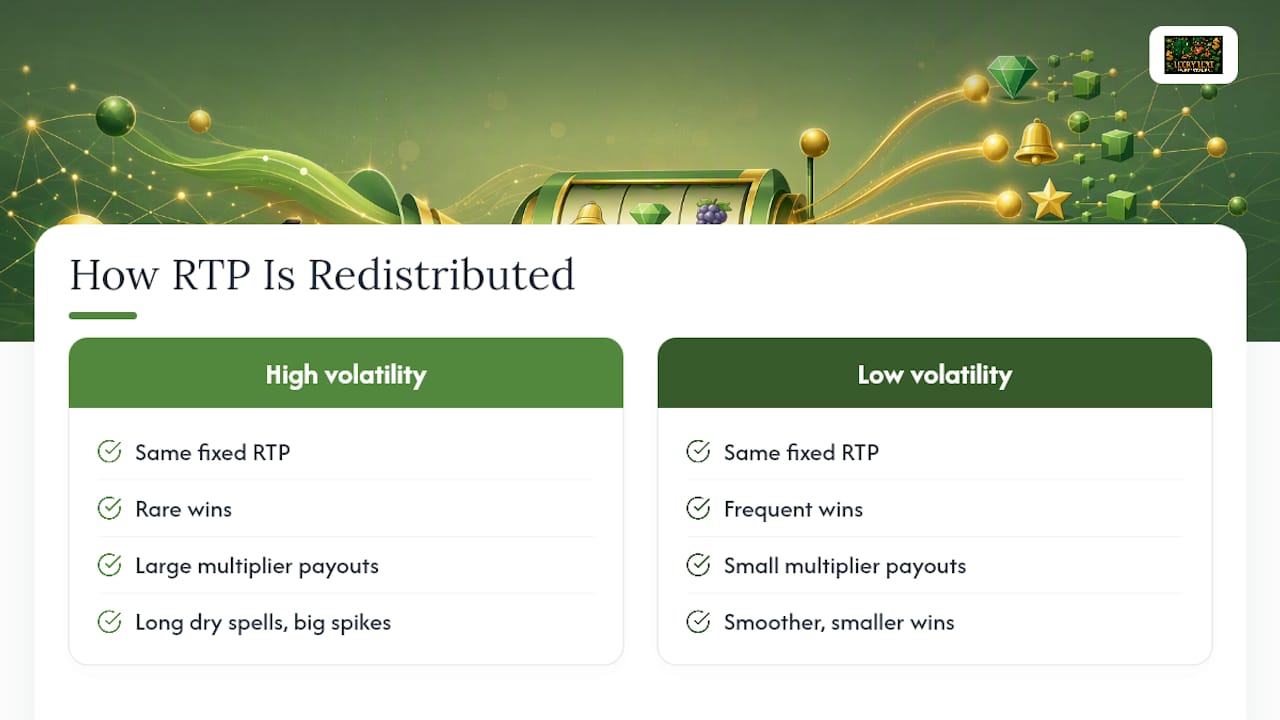
That redistribution is what pushes a slot toward higher volatility. A game leaning heavily on rare, large multipliers will produce long stretches with no meaningful win, followed by a spike that can dwarf everything that came before it. A game using small, frequent multipliers smooths that curve out, paying more often but in smaller amounts.
For your bankroll, this distinction decides how a session actually feels. High-volatility multiplier slots demand a longer runway of spins to have a fair shot at hitting the feature that matters. Checking a slot's payout profile before you commit real money tells you which type of session you're signing up for.
How Do You Verify Multiplier Rules Before You Play?
Every reputable slot publishes its multiplier behavior in the paytable or help screen, usually accessible through an "i" icon or a menu labeled rules and paytable. Run through this checklist before you commit real stakes:
- Where does the multiplier apply? Per line, total spin, or feature total.
- How do multipliers stack? Additive, multiplicative, or highest-applies only.
- Is the value fixed or variable? A flat x3 behaves very differently from a multiplier that climbs with each retrigger.
- Does it reset? Check whether a non-winning spin or feature end wipes the accumulated value.
- Is there a max-win cap? Some games cap total payout regardless of how large the multiplier math gets.
Confirming where a multiplier applies, its stacking behavior, and its cap takes less than a minute in most modern game interfaces, and it removes almost all the guesswork before you place a bet.
Pro Tip: Run a handful of minimum-stake spins after reading the rules, specifically during the feature the multiplier attaches to. Watching it trigger live confirms the paytable's wording matches what actually happens on screen.
What's the Best Strategy for Playing Multiplier Slots?
Multiplier features reward a plan more than they reward luck alone. Here's how to put the mechanics to work for you instead of against your bankroll.
- Match your stake to the volatility. High-multiplier, low-frequency games need a bigger spin budget to reach the feature that pays. Lower your bet size if you're playing a game known for rare, large multipliers.
- Pick features that fit your goal. If you want a longer, steadier session, favor base-game multiplier slots. If you want the shot at a big spike, go with free-spins or cascading multiplier games and accept the longer dry stretches that come with them.
- Set a bankroll percentage per session. A common approach is capping any single session at a small fraction of your total bankroll, so one cold streak doesn't wipe out your budget.
- Use stop-loss and take-profit thresholds. Decide before you start what loss ends the session and what win locks in profit, then stick to both.
- Lean on responsible-play tools. Deposit limits, session timers, and self-exclusion options exist on legitimate platforms for a reason, and BeGambleAware offers free support if play ever stops feeling fun.
Pro Tip: Before choosing a game for a session, check its bonus feature list against your goal. A checklist for picking slots with bonus features speeds this up considerably.
Short Worked Examples: Additive vs. Multiplicative Payouts
Numbers make stacking rules concrete faster than any description. Take a $10 win hit by two x3 multipliers.
- Additive: $10 × (3 + 3) = $60
- Multiplicative: $10 × 3 × 3 = $90
- Highest-applies: $10 × 3 = $30, since only one multiplier counts
Now stretch that across a cascading sequence. Say a game's multiplier starts at x1 and climbs by 1 with each consecutive win, capping at three cascades: a $5 win on cascade one pays $5, a $4 win on cascade two at x2 pays $8, and a $6 win on cascade three at x3 pays $18. Small individual wins compound into a session-defining hit.
A "max win = 5,000x stake" statement means your $1 spin could theoretically return $5,000, but that ceiling almost always requires the rarest possible combination of multiplier and symbol landings, not an average outcome.
How Do Multipliers Affect Jackpot Wins and Max Payouts?
Multipliers and jackpots operate on different systems in most slots, but they intersect in ways that shape how a game's headline "max win" figure gets built. A fixed jackpot pays a set amount regardless of multiplier activity elsewhere in the game. A progressive jackpot grows from a pool of player wagers and typically pays independent of any multiplier feature running in the base game or bonus round.
Where multipliers genuinely move the needle is in a slot's advertised maximum win, the figure you see written as "up to 10,000x stake" on a game's loading screen or paytable. That ceiling is usually the product of every multiplier, wild, and bonus mechanic in the game stacking in the most favorable possible sequence at once. It is a mathematical outer bound, not a realistic target for any single session.
This distinction matters because a game with a modest jackpot but an aggressive multiplier system in its bonus round can produce a bigger practical payout for an average player than a game with a flashy jackpot label and a weak multiplier structure. The multiplier mechanics running through cascades, free spins, and stacked wilds do more heavy lifting for most players' actual results than jackpot pools ever will, since jackpots by design pay out rarely and to a small fraction of players over the game's lifetime.
Reading the max-win figure alongside the multiplier rules in the paytable gives a far more accurate sense of what a game can realistically deliver than the jackpot number alone.
Common Myths and Misconceptions About Multipliers in Slots
The biggest myth is that a bigger advertised multiplier automatically means a better game. A slot boasting "up to x1,000" can be mathematically weaker for an average player than one capped at x20, if that x1,000 requires an astronomically rare combination while the x20 triggers regularly. Frequency and size trade against each other, and the headline number tells you nothing about that trade-off on its own.
Another common misconception treats multipliers as something that increases your odds of winning. They don't. A multiplier changes the size of a win that has already occurred; it has no bearing on whether your next spin produces a winning combination in the first place. Hit frequency and multiplier value are set independently in a game's math model.
Some players also believe multipliers signal a "hot" machine or a game "due" for a bigger payout after a dry streak. Each spin on a properly certified RNG slot is independent of the last. A string of small multiplier hits has no predictive value for what comes next, and no amount of pattern watching changes that.
Finally, there's a persistent idea that all multipliers stack the same way across games. As covered earlier, additive, multiplicative, and highest-applies rules produce wildly different outcomes from identical multiplier values, and assuming one game's stacking behaves like another's is one of the fastest ways to misjudge a bonus round's real potential.
How Do Different Software Providers Build Multiplier Features?
Multiplier design is not a single formula applied uniformly across the industry. Each software studio builds its own math model, and developers run large-scale simulations to balance player excitement against the operator's payout exposure, tuning both how often a multiplier triggers and how large it gets before a game ever reaches a live casino floor.
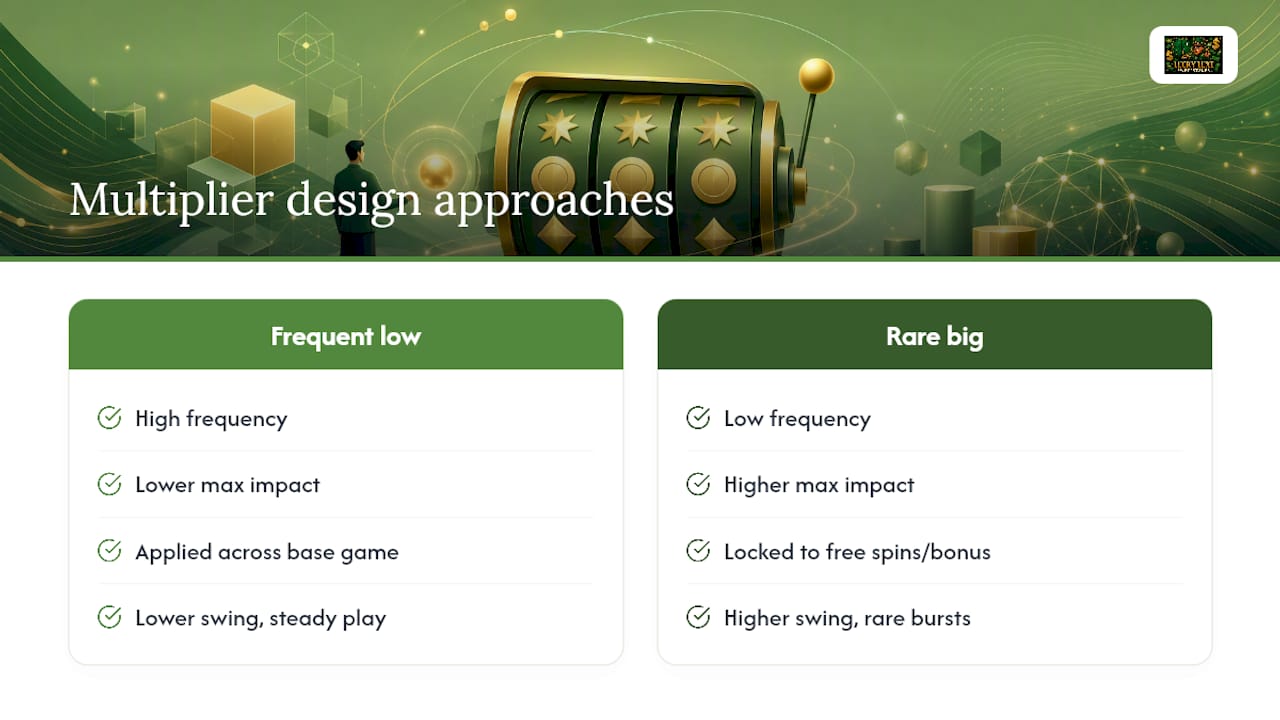
That tuning process produces real differences in how multiplier slots feel to play. Some studios favor low, frequent multipliers layered across the base game, producing a steadier, lower-swing experience. Others concentrate multiplier potential almost entirely inside free spins or a single bonus round, creating long stretches of ordinary play punctuated by rare, high-impact features. Neither approach is inherently better; they simply target different kinds of players.
Providers also differ in how transparently they document stacking rules. Some publish detailed breakdowns directly in the in-game paytable, spelling out exactly how multiple multipliers combine on a single win. Others keep the explanation vague, using phrasing like "multipliers may apply" without detailing the stacking method, which is exactly why reading the help screen before you commit stakes matters regardless of which studio built the game.
The practical takeaway: two games can share an identical "up to x500" headline number and deliver completely different play experiences, because the studio behind each one made different choices about frequency, trigger conditions, and stacking math. Recognizing a provider's general design philosophy after a few sessions helps you predict what a new release from that same studio is likely to feel like.
What Are the Risks of Chasing Big Multiplier Wins?
Chasing multiplier features carries a specific kind of risk that's easy to underestimate: the games built around rare, large multipliers are, by design, high-volatility, and high volatility means longer losing stretches between meaningful payouts. Insight from industry coverage of streaming culture notes that multipliers are a primary driver of viral big-win moments, and those viral clips create a skewed impression of how often such wins actually happen for the person watching them.
The gap between what you see clipped online and what an average session delivers is enormous. A streamer's five-minute highlight reel compresses hours or days of ordinary, unremarkable spins into a single dramatic moment. Chasing that same outcome without adjusting your bankroll or expectations is one of the fastest ways to burn through a session budget with nothing to show for it.
There's also a subtler risk in games with accumulating or sticky multipliers: they can create a sense of being "close" to a big win as the multiplier climbs, which pushes some players to keep spinning past their planned stop point to see the feature through. That instinct is worth naming directly, because it's exactly the moment a stop-loss threshold set before the session started is supposed to protect against.
Higher variance also means bigger bankroll swings even when the math is fair and the RTP is honest. A game can be perfectly legitimate and still hand you a losing streak that outlasts your patience. Treating multiplier features as entertainment with an occasional upside, rather than a reliable path to a specific payout, keeps the risk in proportion to what you're actually spending.
The Lucky Luxe Take on Multiplier Transparency
Multiplier hype sells, but clarity keeps players coming back. An ideal slot, fishing, and arcade lineup should feature straightforward paytables and clean interfaces so players know what a feature does before they chase it. High-quality graphics matter, but fair play and transparent rules matter more, and that's the standard every game on the platform gets held to.
— Skyline
Ready to Put These Multiplier Rules to the Test?
Now that you know the difference between additive and multiplicative stacking, you're equipped to actually read a paytable instead of guessing at what "up to x500" means. A game library can include slots built around free spins, cascading reels, and progressive multiplier rounds, with paytables available to check before placing a bet.
Games often document their multiplier scope and stacking rule in the help screen, allowing players to run small-stake test spins with confidence. If you're building a session around free-spins multipliers specifically, this breakdown of free-spin feature mechanics is worth a read first. Play stays entertainment first: set a limit before you start, and lean on BeGambleAware if you ever want extra support managing your play. Head to Luckyluxe and browse the multiplier-featured slots to see the paytables for yourself.
Sources
- Guide to Online Slots: How Multipliers Work | PokerNews
- Slots
- How online slot multipliers work | Push Gaming
- BeGambleAware
FAQ
What Is the $20 Rule on Slot Machines?
It's a bankroll guideline some players use, betting no more than a small, fixed amount like $20 on a single machine before deciding whether to move on, rather than an official casino rule. It functions as a personal stop-loss, not a rule enforced by any game or platform.
How Does a Multiplier Work in Slots?
A multiplier takes an existing win and scales it by a set number, so a $10 win with a 3x multiplier pays $30. It typically does nothing on a spin with no win, and the exact scope (per line, total spin, or feature) depends on the specific game's paytable.
What Is the $100 Slot Strategy?
Similar to the $20 rule, this is an informal bankroll approach where a player allocates a set $100 budget to a session or a specific game, tracking wins and losses against that number rather than playing without a limit. It's a personal budgeting habit, not a strategy that changes a game's math or odds.
Do Multipliers Increase My Odds of Winning?
No. A multiplier changes the size of a win that has already happened; it has no effect on whether a spin produces a winning combination. Hit frequency and multiplier size are separate parts of a game's math model.
Does a Higher Multiplier Mean a Better Slot?
Not necessarily. A rare, very high multiplier paired with low hit frequency can deliver worse long-run value for an average player than a smaller, more frequent multiplier, since the two typically trade off against each other in a game's design.