

RTP, or return to player, is the percentage of every dollar wagered on a slot that the game is designed to pay back over its full lifetime of spins. A slot with 96% RTP keeps a 4% house edge, meaning the math is built to favor the house on average, not you, in any one sitting. That figure is a long-run design spec, not a promise about your next hour of play, since variance can push a single session well above or below it.
TL;DR:
- Most online slots cluster around a 96% RTP, but small differences in percentages can lead to significantly higher expected losses over many spins.
- Accurate RTP measurement requires tens of thousands to hundreds of thousands of spins, while short-term observations often mislead due to statistical variance.
- Always verify the specific RTP version shown in the game's info panel and avoid trusting unverified or inconsistent figures provided by third-party sites.
- Hit rate and volatility influence your session's feel and risk, with higher hit rates favored for small bankrolls and higher volatility suited for chasing large payouts.
- Prioritize checking the game's RTP and volatility before play, set session loss limits, and treat gambling as entertainment rather than an investment.
Table of Contents
- What Is RTP in Slots, and How Is It Calculated?
- What RTP and House Edge Actually Mean for Your Money
- RTP vs Volatility vs Hit Rate: What's the Difference?
- Where Can You Actually Find a Slot's RTP?
- Why Short-Term RTP Trackers Can Mislead You
- How to Pick a Slot Using RTP, Volatility, and Hit Rate
- Why Trust This Breakdown
- What Most RTP Advice Gets Backwards
- Try a Platform Built Around Transparent Play
- Where to Verify RTP and Get Player Support
- Sources
What Is RTP in Slots, and How Is It Calculated?
RTP comes from a simple formula: total returned divided by total wagered, multiplied by 100. If a slot pays back $960,000 across $1,000,000 in total bets during testing, its RTP is 96%. That number gets baked into the game's math model before it ever reaches a casino floor or an app, and it stays fixed unless the developer publishes a different configuration.
Independent testing labs like eCOGRA, iTech Labs, and GLI verify these figures by running simulated spins in bulk, often millions of rounds, to confirm the game's random number generator behaves as designed and the payout math matches what the provider claims. Regulators in many jurisdictions require this disclosure before a title can go live.
Here's what separates theoretical RTP from what you experience:
- Theoretical RTP is calculated across the game's full statistical cycle, sometimes billions of spins in simulation.
- Observed RTP in any short session is just a sample, and small samples wander far from the theoretical number.
- Published RTP is a specification, similar to a car's EPA mileage rating: accurate in aggregate, not a guarantee for any single trip.
Statistic: Online slots typically cluster between roughly 94% and 98% RTP, with 96% widely treated as a reasonable baseline for a fair game.
What RTP and House Edge Actually Mean for Your Money
House edge is just RTP flipped around: subtract the RTP from 100% and you get the cut the game keeps over time. A 96% RTP slot has a 4% house edge. A 98% RTP slot has a 2% edge, half as much. That difference sounds small until you multiply it across thousands of spins, where it steadily reshapes how long your bankroll lasts.
Typical bands look like this:
- 97%+ RTP: genuinely generous, common among newer online slots and player-favorite titles.
- 95% to 97% RTP: the broad middle where most online slots sit.
- Below 94% RTP: on the stingier end, though still legal and common on certain land-based machines.
- Land-based slots: often run several points lower than their online counterparts, partly due to overhead and floor economics.
Statistic: Small differences in RTP percentages can accumulate to meaningful differences in expected losses over many spins. The math compounds the same way compounding interest does, just working against the player instead of for them.
RTP vs Volatility vs Hit Rate: What's the Difference?
RTP tells you the average payback over a huge number of spins. Volatility (also called variance) tells you how bumpy the ride is to get there. Hit rate tells you how often a spin returns any win at all, big or small. All three numbers matter, and none of them tell the whole story alone.
Same long-run number, wildly different session feel. Our breakdown of what hit frequency really means digs deeper into how that number is measured.
A few rules of thumb for matching these numbers to your goals:
- Short session, small bankroll: favor higher hit rate and lower volatility so your balance doesn't zero out fast.
- Chasing a big single payout: higher volatility slots with lower hit rates are built for exactly that, at the cost of more empty spins.
- Long, steady play: prioritize RTP first, since it's the number that governs your expected loss rate over time.
Pro Tip: If a slot feels "cold" for 50 spins straight, that's volatility talking, not a broken RTP. Check the hit rate listed in the game info before assuming something is off.
Where Can You Actually Find a Slot's RTP?
RTP isn't hidden, but it isn't always in the first place you'd look. Here's where to check, in order of reliability:
- The in-game info icon or paytable. Most licensed slots display RTP inside the "i" or menu button, often on the last screen of the paytable.
- The casino or platform's rules page. Operators frequently list RTP for their full game catalog in one reference document.
- The provider's own published rules. Studios like Pragmatic Play or NetEnt (as examples of how the industry operates) publish official RTP sheets for each title they release.
One wrinkle worth knowing: many slots ship with multiple RTP configurations, and the operator chooses which version goes live on their platform. Always verify RTP for the specific version in front of you, not the number you remember from a review.
Red flags to watch for: no RTP listed anywhere in the game, inconsistent numbers between the lobby and the paytable, or a platform that refuses to disclose it on request. Our fairness indicators checklist covers more signals worth checking before you commit real money to a title.

Why Short-Term RTP Trackers Can Mislead You
The single biggest misunderstanding about slot RTP is treating it like a stat that shows up accurately after a weekend of play. It doesn't work that way, and the reason comes down to basic statistics: the law of large numbers says a sample's average only converges on the true theoretical value once the sample gets large enough. For RTP, "large enough" is enormous.
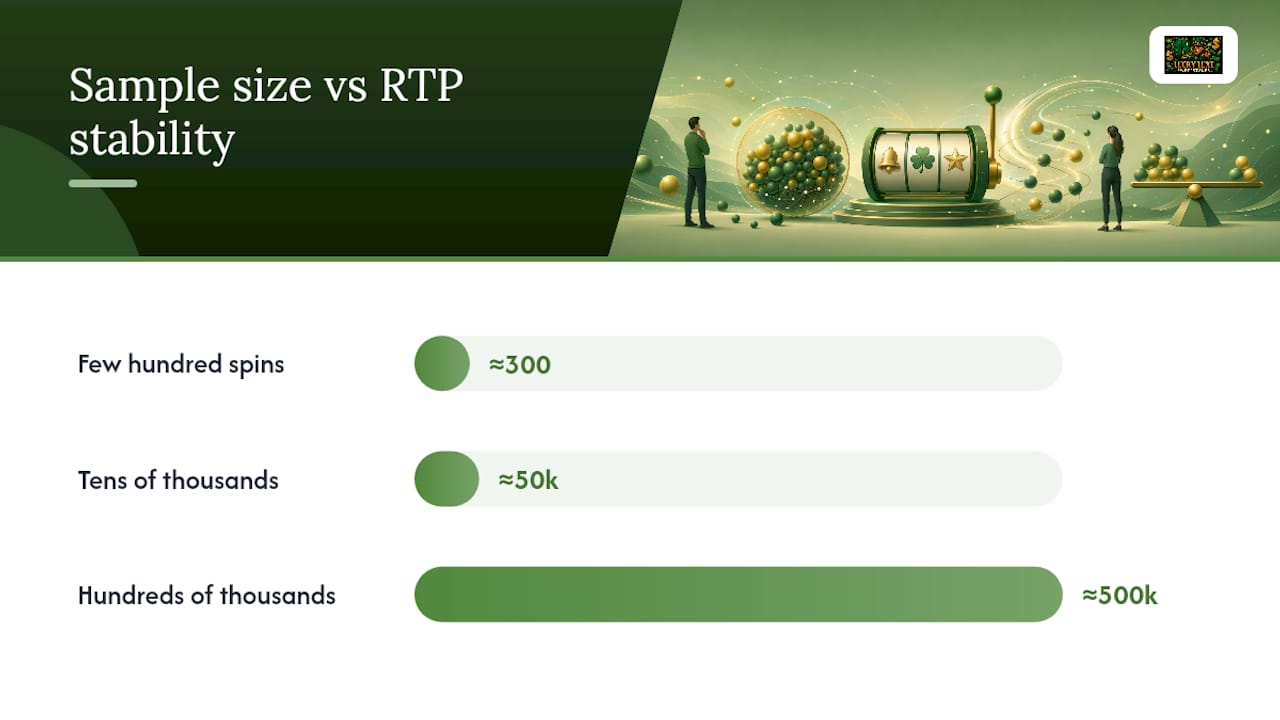
Statistic: SpinAudit's testing shows that reliable RTP measurement requires tens of thousands to hundreds of thousands of spins before observed results stabilize close to the published figure. A few hundred spins tell you almost nothing about true RTP, no matter how the session felt.
Hit rate is a different story. It stabilizes far faster than RTP because it's measuring a simpler binary event (did this spin pay something, yes or no) rather than a payout magnitude that can swing wildly on rare big hits. That's part of why reputable trackers lean on it so heavily.
- Trust trackers that report hit rate and spread with confidence intervals rather than a single "RTP today" number.
- Be skeptical of any site claiming a precise real-time RTP based on a small sample size.
- Look for sample-size disclosure. If a tracker doesn't say how many spins its number is built on, treat it as noise.
StakeSim's live tracker is a good example of doing this correctly: it reports measured hit rate and spread across thousands of tracked spins instead of pretending a short window reveals true RTP. A Herald Extra analysis makes a similar point: RTP gets misread as a short-term guarantee far more often than it should be, largely because players expect averages to show up quickly when they actually need volume to emerge. Research on gambling behavior suggests this misreading is partly a framing problem: people intuitively expect percentages to apply session by session, not across tens of thousands of spins.
How to Pick a Slot Using RTP, Volatility, and Hit Rate
Turn all of this into a five-step habit before you load your balance into any slot:
- Check the RTP in the game's info panel, not from memory or an old review.
- Confirm the version. If the platform lists multiple RTP configurations, verify which one is live.
- Check hit rate and spread if a tracker or the provider's rules page lists them.
- Match volatility to your bankroll. Smaller bankroll, lower volatility; bigger cushion, higher volatility is fair game.
- Set a stop-loss for the session and treat the whole thing as entertainment spending, not investment.
Our guide on slot variance and bankroll breaks this down further.
Two myths worth killing outright: there's no such thing as a slot being "due" for a win after a cold streak, and stopping or restarting a session doesn't change your odds on the next spin. Each spin is independent.
Pro Tip: Write your stop-loss number down before you start playing. Deciding it mid-session, after a few losses, is exactly when your judgment is worse.
Why Trust This Breakdown
Lucky Luxe runs a catalog of slots, fishing games, and arcade titles built around transparent game info and published fairness standards, not buried fine print. This guide draws on that same standard: verified certification practices, sample-size math, and tracker methodology rather than casino marketing copy. For related reading, see our guide on spotting fair play certified slots.
What Most RTP Advice Gets Backwards
Most slot content treats RTP like the only number that matters, then buries volatility and hit rate as footnotes. That's backwards for anyone making a real decision about which game to load up tonight. RTP tells you what happens over a horizon most players will never reach in one sitting, while hit rate and spread tell you what your actual next hour looks like.
The conventional advice, "just find the highest RTP slot," isn't wrong, but it's incomplete to the point of being unhelpful on its own. If there's one thing worth prioritizing first, it's matching volatility to your actual bankroll size before you even glance at the RTP figure on the second decimal place.
Sample size discipline matters just as much. Treat any short-session RTP claim, from a tracker, a forum post, or your own last hour of spins, as anecdote rather than evidence. The number that deserves your attention is the certified figure in the game's info panel, cross-checked against a tracker that shows its sample size.
— Skyline
Try a Platform Built Around Transparent Play
Lucky Luxe is the straightforward option for players who want to actually apply everything above, not just read about it. Every slot on the platform, alongside fishing and arcade titles, displays its game info clearly, so checking RTP before you play takes seconds instead of a search through fine print. Players use Gold Coins for entertainment play and can earn Sweeps Coins through promotions for a shot at redeemable prizes, all inside an interface built for quick verification rather than buried disclosures.
Lucky Luxe also backs this with real support resources and a referral program, so the responsible-play habits covered in this guide, checking your session limits and confirming game info, have a home on the platform itself. If you're ready to put the RTP and hit rate checks from this guide into practice, browse the game selection and start with a title that shows its numbers upfront.
Where to Verify RTP and Get Player Support
For checking real numbers: StakeSim and SpinAudit track hit rate and spread across large sample sizes. For player-safety resources and support, GambleAware offers tools and guidance for responsible play.