

Six rules cover most of what separates winners from also-rans in slot tournaments: maximize your spin volume, enter only tournaments with acceptable expected value, pick medium-variance slots with high hit frequency, run a consistent spin-stop rhythm, use re-buys early when the format allows, and cut every distraction before the round starts. That's the whole checklist. Everything below explains the mechanics behind each rule and how to apply them under pressure.
- Maximize spin volume. More spins equal more chances at a scoring hit. Efficient players can sometimes triple or quadruple their spin counts versus casual players in the same time window, according to The Wager Theorem.
- Choose positive-EV tournaments. Freerolls, overlay events, and small-field buy-ins often return more than their entry cost in expected prize share.
- Pick medium-variance, high-hit-frequency slots. Frequent smaller hits keep your credit total climbing; jackpot-chasing on high-variance machines usually stalls your score.
- Use a spin-stop rhythm. Manually interrupting reel animations and triggering the next spin immediately is the core speed mechanic pros practice.
- Re-buy early when allowed. Getting extra credits at the start of a round keeps you in the spin-volume race rather than catching up from behind.
- Eliminate distractions. Checking the leaderboard mid-round costs seconds you cannot recover.
Key Takeaways
Spin volume is the single most controllable lever in any slot tournament, and tournament selection determines your EV baseline before a single spin is taken.
| Point | Details |
|---|---|
| Maximize spin volume | Use the Spin-Stop technique and skip all win animations to triple your spins per minute. |
| Choose positive-EV events | Freerolls, overlay events, and small-field buy-ins offer the best entry fee-to-prize-pool math. |
| Match slot to scoring format | Medium-variance, high-hit-frequency slots win under total-credits rules; higher variance fits largest-single-win formats. |
| Re-buy early, not late | A re-buy at the midpoint of a round produces far more spins than one in the final two minutes. |
| Luckyluxe for practice | Luckyluxe's sweepstakes-format slots let you rehearse spin rhythm and bonus evaluation before committing to a buy-in event. |
Table of Contents
- How slot tournaments actually work: formats, timers, and rule variations
- How scoring methods change your strategy
- Priority tactics: spin speed, bet sizing, and spin-stop technique
- Choosing the right slot in a tournament: RTP, variance, and bonus structure
- Entry fees, prize pools, and EV: choosing tournaments worth your time
- Re-buys and add-ons: when to buy extra credits and when to hold back
- Game-day checklist: arrival, registration, and distraction control
- Common named tactics explained: the "$20 method" and the "$100 strategy"
- How to practice tournament skills: drills and mental warm-ups
- Research-backed perspective: why tournament selection and mental control beat exotic tactics
- How to adjust strategy based on opponent behavior and leaderboard status
- Understanding and exploiting tournament-specific bonus rounds
- Optimal timing for aggressive play and conservation phases
- How tournament structure variations change your approach
- Common mistakes to avoid in slot tournaments
- What the checklist actually looks like in practice
- Where to practice tournament-style play before your next event
- Sources
How slot tournaments actually work: formats, timers, and rule variations
Slot tournaments run on a simple premise: players compete on designated machines for a set period or a fixed number of spins, and whoever accumulates the highest score wins a share of the prize pool. The machine is set to tournament mode, which means it does not accept cash during the round. Your starting credits are provided by the casino, and any credits left unspent at the end have no cash value, so there is no reason to hold back.
Common formats you'll encounter:
- Freerolls. No entry fee; prize pools are typically smaller but offer pure positive EV for anyone who qualifies.
- Buy-in tournaments. You pay an entry fee for starting credits and a shot at the prize pool. Rake and field size determine whether the math works in your favor.
- Sit-and-go events. Start as soon as enough players register; common in online casinos and on cruise ships.
- Scheduled heats. Multiple rounds across hours or days, with top scorers from each heat advancing. MGM Resorts uses this structure for many of its property-based events.
- Slot races. Continuous leaderboard competitions where any spin on a qualifying machine earns points; no dedicated session required.
Typical rounds run for a set time within a range generally spanning several minutes with fixed starting credits. Some events use fixed spin counts instead of a timer, which shifts the dominant tactic from speed to bet sizing. Round progression and leaderboard display vary by operator.
Pro Tip: In the 60 seconds before the round starts, check three things: whether bonus rounds pause the clock, which scoring method is active (total credits, biggest single hit, or net profit), and whether re-buys are permitted and when.
How scoring methods change your strategy
Scoring rules are the single biggest tactical variable in any tournament. The same player should behave very differently depending on which system is in use.
| Scoring method | What it rewards | Your priority |
|---|---|---|
| Total credits accumulated | Consistent hit frequency over the full session | Spin volume, medium-variance slot, spin-stop rhythm |
| Largest single win | One massive hit | Higher-variance slot, max bet when credits allow |
| Net profit (credits out minus credits in) | Efficiency, not just volume | Bet sizing discipline, avoid chasing losses |
| Volume-based (spins completed) | Raw speed | Fastest possible spin rate, smallest qualifying bet |
Under total-credits scoring, your job is to keep the meter climbing steadily. Under largest-single-win rules, you need one big moment, so a higher-variance slot with a large top payout makes more sense even if it hits less often. Net-profit formats punish reckless re-buys and reward conservative bet sizing early in the round.
A quick scenario: imagine two players in a 10-minute round with 1,000 starting credits. Under total-credits rules, the player who completes 300 spins at a consistent hit rate will almost always outscore the player who completes 180 spins hunting a single jackpot. Flip the scoring to largest-single-win, and the jackpot hunter's approach becomes defensible. TonyBet's analysis of tournament formats confirms that fixed-credit rounds reward spin speed while fixed-spin-count events shift the advantage toward bet sizing.
Priority tactics: spin speed, bet sizing, and spin-stop technique
Speed is the dominant lever in most tournament formats. The Spin-Stop technique, where you manually interrupt the reel animation and trigger the next spin immediately rather than waiting for the reels to settle on their own, is the core mechanic that separates fast players from slow ones. Practice it until it's automatic.
Practical bet-sizing guidance:
- In fixed-credit formats, bet the maximum the rules allow. Larger bets produce larger absolute wins, which matter most under total-credits and largest-single-win scoring.
- In real-money qualification formats where you're wagering your own funds to earn a tournament seat, treat bet sizing conservatively. The goal is to qualify, not to score big during the qualifier.
- Never bet below the minimum required to activate all paylines or bonus features. A partial-bet spin is a wasted spin.
On autoplay: use it only when the tournament rules explicitly allow it and when the autoplay speed matches or exceeds your manual spin rate. Many players are faster manually, and autoplay can lock you out of the Spin-Stop technique. The Wager Theorem is direct on this: tournament credits are ammunition, not a bankroll to protect. Leaving credits unspent at the buzzer is the only unforced error in the game.
Pro Tip: Use the spacebar on a desktop, not the mouse click, for faster and more consistent spin triggering. On mobile, tap with your dominant thumb and keep the device flat on the table to reduce fatigue over a 15-minute round.
In-round checklist:
- Spin immediately when the round starts; do not adjust settings mid-round.
- Skip all win animations by hitting spin again the moment the result registers.
- Keep your eyes on the spin button, not the credit counter.
- Never pause to check the leaderboard.
Choosing the right slot in a tournament: RTP, variance, and bonus structure
Most tournaments assign a specific machine or a short list of approved titles. When you have a choice, the decision comes down to three factors: variance, hit frequency, and animation speed.
Medium-variance slots with high hit frequency are the default pick for total-credits and volume-based scoring. They produce enough winning spins to keep your credit total growing without the long dry spells that high-variance jackpot machines deliver. Cardgame Guide's slot tournament breakdown recommends this approach for most tournament formats.
Bonus features are a double-edged consideration. Free-spin rounds that pause the tournament clock are valuable because you get spins without burning time. Bonus rounds that play out in real time, with long animations and multiple pick screens, are time sinks. A 30-second bonus animation in a 10-minute round costs you roughly 15–20 spins at a fast manual rate.
Pro Tip: Before the round starts, watch the machine for 30 seconds. Count how long a standard win animation runs. If it exceeds two seconds, that machine will cost you more spins per minute than a faster-animating alternative.
Quick pre-round slot evaluation:
- Does the bonus round pause the clock? Check the rules sheet.
- How long do win animations run? Shorter is better.
- Does the slot have frequent small pays or rare large ones? Match to your scoring format.
- Are all paylines active at the minimum bet? Confirm before the round starts.
For a deeper look at which bonus features are worth your time in timed formats, the slot bonus feature checklist covers pause behaviors and feature types in detail.
Entry fees, prize pools, and EV: choosing tournaments worth your time
Expected value (EV) is the clearest filter for deciding which tournaments to enter. The basic math: multiply your estimated prize share by the probability of winning it, then subtract the entry fee and any expected loss from qualifying wagers.
A simplified example: a $20 buy-in tournament with a $500 prize pool and 50 entrants. Subtract the $20 entry fee and you get an EV of negative $10. That tournament is a losing proposition unless you have a meaningful skill edge over the field or the prize distribution is more top-heavy.
Signals of favorable EV:
- Overlay events. When the guaranteed prize pool exceeds what entry fees alone would generate, the casino is subsidizing the difference. That's free equity.
- Small fields with large prizes. A 20-person tournament with a $1,000 prize pool gives each player a much higher expected prize share than a 200-person event with the same pool.
- Freerolls with real prizes. Pure positive EV if you qualify without spending money.
- Generous re-buy structures. When re-buys are cheap relative to the prize pool, they can improve your EV if timed correctly.
TonyBet's tournament EV analysis notes that casino rake and prize distribution structures significantly affect expected returns, and that overlay events and small fields are the clearest cases where tournaments can beat regular play in EV. For practical bankroll guidance that complements this framework, the bankroll management guide is worth reviewing before you commit to a buy-in.
Statistic callout: Casino rake on slot tournaments varies by operator and format. Understanding how much of the entry fee pool is retained by the house versus paid out as prizes is the first number to check before registering.
Re-buys and add-ons: when to buy extra credits and when to hold back
Re-buys are one of the few genuine decision points in a slot tournament. Get the timing wrong and you waste money. Get it right and you stay competitive in the spin-volume race.
The core argument for re-buying early: if you're allowed to re-buy at any point in the round, doing it immediately after your starting credits run low keeps your spin count high throughout the session. A player who re-buys in the final two minutes of a 15-minute round gets far fewer spins from those extra credits than one who re-buys at the five-minute mark.
When to hold back on re-buys:
- The prize pool is small relative to the combined entry and re-buy cost.
- The field is large and the leaderboard gap to a paying position is mathematically unreachable.
- You've already re-bought once and the remaining time is under two minutes.
- The tournament uses net-profit scoring, where re-buys increase your cost basis and make it harder to finish positive.
Pro Tip: Before re-buying, glance at the leaderboard once to check whether the next paying position is within reach. If the gap requires a score you haven't approached in any prior spin sequence, skip the re-buy and save the money for a better-structured event.
In unlimited re-buy formats, set a personal cap before the round starts and stick to it regardless of leaderboard position.
Game-day checklist: arrival, registration, and distraction control
Physical and logistical preparation matters more than most players expect. Arriving late, fumbling with registration, or sitting at a slow machine costs points before the round even starts.
Pre-round checklist:
- Arrive at least 15 minutes early to confirm registration, review the rules sheet, and locate your assigned machine.
- Test the input method (spacebar, mouse, touchscreen) before the round begins. Know which one gives you the fastest consistent trigger.
- Check the machine's animation speed and bonus behavior during the warm-up period if one is provided.
- Silence your phone and remove it from your line of sight.
Seat and machine selection signals: shorter win animations, fewer audio interruptions, and an ergonomic button layout all reduce friction over a 15-minute round. If you have a choice of machines, spend 30 seconds watching each one before committing.
Royal Caribbean's casino host guidance is explicit: checking the live leaderboard during a round causes anxiety and costs seconds you cannot recover. Casino hosts advise players to focus entirely on speed and concentration. The leaderboard is useful only between rounds, never during one.
Pro Tip: For multi-round events, do a 30-second breathing reset between heats: four counts in, four counts hold, four counts out. It clears the adrenaline from the previous round and resets your focus before the next one starts.
Common named tactics explained: the "$20 method" and the "$100 strategy"
The "$20 method" and "$100 strategy" circulate widely in slot tournament discussions, but they're shorthand for budget discipline rather than mechanical tricks. The "$20 method" typically describes entering low-cost or freeroll events and treating $20 as a hard session cap, which is sound bankroll discipline dressed up as a system. The "$100 strategy" usually refers to a buy-in ceiling for tournaments where the prize pool justifies the risk.
Neither method changes the RNG outcomes on the machine. What they do is enforce tournament selection discipline and re-buy limits, which are genuinely useful guardrails. MGM Resorts confirms that tournament machines run in tournament mode and do not accept player cash during a round, so your credits are entirely separate from your cash balance. There's no mechanical edge to be gained by how much you bring to the table.
The useful core of any named method is usually one of three things: a bet-sizing rule, a re-buy discipline rule, or a tournament selection filter. Strip away the branding and apply the underlying principle directly.
Pro Tip: Before using any named method, run it against the actual event rules. Ask: does this method assume fixed-credit scoring or net-profit scoring? Does it assume re-buys are available? If the event structure doesn't match the method's assumptions, the method doesn't apply.
How to practice tournament skills: drills and mental warm-ups
Spin rate is a trainable skill. Most players who practice it for a week before an event see a measurable improvement in their spins-per-minute count.
Step-by-step spin-rate drills:
- Set a one-minute timer and spin as fast as possible on any demo slot, counting total spins completed.
- Record your baseline. Most casual players complete 30–50 spins per minute manually.
- Practice the Spin-Stop technique: hit the spin button, immediately hit it again to stop the reels, then hit it again to start the next spin. Repeat until the motion is automatic.
- Run a five-minute endurance set at your target spin rate. Note where your speed drops off; that's your stamina ceiling.
- Practice ignoring win animations. Train yourself to trigger the next spin the moment the result registers, without watching the reels settle.
Rehearsal checklist before an event:
- Practice rapid paytable scans: can you identify the top pay symbol and the bonus trigger in under 10 seconds?
- Run a quick feature recognition drill: watch a slot for 60 seconds and identify whether its bonus round pauses the clock.
- Set a micro-goal for the round: "I will complete X spins in Y minutes." Concrete targets keep you focused when the pressure builds.
Mental warm-up: spend two minutes before the round doing nothing except slow breathing. It sounds trivial, but adrenaline narrows focus in ways that hurt spin consistency. A calm entry into the round produces steadier mechanics than a rushed one.
Research-backed perspective: why tournament selection and mental control beat exotic tactics
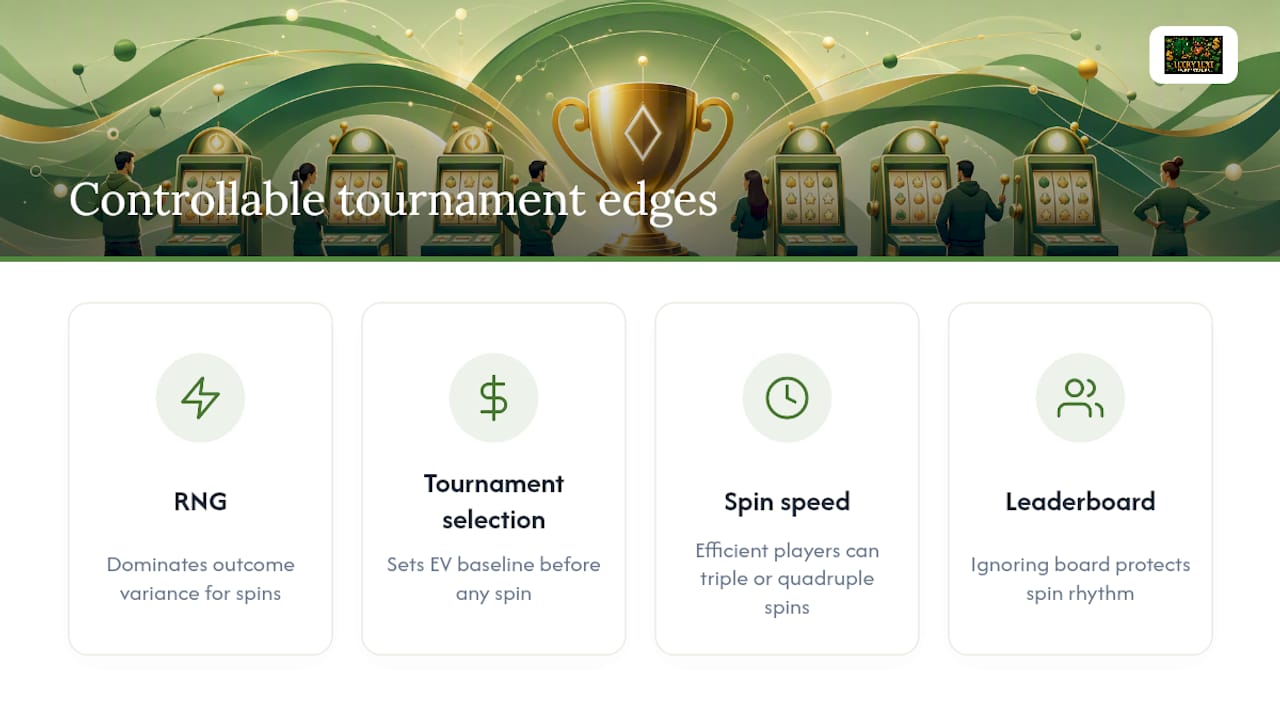
The clearest finding across tournament strategy analysis is that RNG dominates outcome variance. No spin-stop technique, no bet-sizing formula, and no named method changes the probability distribution of any individual spin. What players can control is the number of spins they take and which tournaments they enter.
PokerNews' tournament analysis makes this point directly: practical choices like tournament selection and spin speed create marginal edges, but tournament selection is the larger lever because it determines the EV baseline before a single spin is taken. An overlay freeroll with a $500 prize pool and 30 entrants has a fundamentally different EV profile than a $50 buy-in with 200 entrants and a $2,000 pool, even if your in-round mechanics are identical.
The leaderboard-avoidance advice from casino hosts isn't just a comfort tip. It's a process recommendation. Royal Caribbean's host guidance frames it as a performance issue: anxiety from leaderboard checking disrupts the spin rhythm that drives score accumulation. Ignoring the board isn't passive; it's an active choice to protect your process.
Statistic callout: Efficient players can sometimes triple or quadruple their spin counts versus casual players in the same time window, per The Wager Theorem. That gap is the clearest evidence that speed is a real, trainable edge.
Pro Tip: Set a micro-target before each round: identify the score you need to reach the next paying position and focus on hitting that number, not on beating the leader. When the gap to first place is unreachable, Gaming-Fans notes that experienced players shift focus to the next achievable prize tier to optimize their return on re-buys and effort.
For players who want to keep their tournament play within healthy limits, Begambleaware provides self-assessment tools and resources worth bookmarking.
How to adjust strategy based on opponent behavior and leaderboard status
Leaderboard position changes what the optimal play actually is, and checking it between rounds (never during) is how you make that adjustment.
When you're leading: the rational move is to maintain your spin volume and resist the urge to shift to a higher-variance slot to "protect" your score. Your lead came from process; abandoning process to play defensively usually costs more than it saves.
When you're trailing: the math changes. If the gap to a paying position requires a score significantly above your current trajectory, a higher-variance slot or a re-buy becomes more defensible. A trailing player who plays conservatively finishes out of the money with certainty; a trailing player who takes a calculated risk at least has a chance.
Reading the field: in small-field events, watch whether other players are re-buying frequently. Heavy re-buy activity signals that the field is competitive and that your own re-buy decision carries more weight. In large-field events, the leaderboard is mostly noise until the final round.
Understanding and exploiting tournament-specific bonus rounds
Not all bonus features behave the same way in tournament mode. The most valuable are free-spin rounds that pause the tournament clock, because they give you spins without consuming your time budget. A 10-spin free-spin round triggered at the eight-minute mark of a 15-minute session is effectively free scoring time.
Pick-screen bonuses are the opposite. A 20-second pick screen in a 10-minute round costs roughly 10 spins at a fast manual rate. If the pick screen's expected payout doesn't exceed what those 10 spins would have produced, it's a net negative.
Multiplier features that apply to all wins during a bonus round are worth triggering even if they don't pause the clock, provided they activate quickly. The key question is always: does this feature produce more expected score per second than a standard spin sequence?
The slot bonus feature checklist is a practical reference for identifying which feature types pause the clock and which run in real time.
Optimal timing for aggressive play and conservation phases
A tournament round has three phases, and the right approach differs across all three.
This is when you establish your score baseline. Don't adjust settings, don't check the leaderboard, and don't slow down for any reason.
If you're tracking well above your target score, stay the course. If you're well below it, this is the window to consider a re-buy, not the final minutes.
Focus entirely on spending every remaining credit before time expires. Unspent credits at the buzzer are the only guaranteed loss in a slot tournament.
The timing of aggressive play versus conservation is mostly a re-buy decision. In-round bet sizing should stay consistent throughout; changing it mid-round based on score anxiety is a reactive move that rarely improves outcomes.
How tournament structure variations change your approach
Head-to-head formats, multi-round heats, and continuous leaderboard races each demand a different strategic emphasis.
Head-to-head: You only need to beat one opponent. If your opponent is clearly ahead with two minutes left, a higher-variance play is justified because conservative play guarantees a loss. If you're ahead, protect your lead by maintaining spin volume rather than switching machines or adjusting bets.
Multi-round heats: Advancement is the goal, not the highest score in the field. Identify the cutoff score for advancement and target it. Burning re-buys to chase first place in a heat when fifth place also advances is a waste of money.
Continuous leaderboard races (slot races): These reward sustained participation over time. The optimal approach is consistent play on qualifying machines during high-traffic periods when the leaderboard is most active, rather than sporadic high-intensity sessions.
PokerNews' overview of tournament formats catalogs these structures and notes that scoring and round progression vary significantly by operator, which is why reading the rules sheet before each event is non-negotiable.
Common mistakes to avoid in slot tournaments
Most tournament losses trace back to a short list of repeatable errors.
- Leaving credits unspent. The single most costly mistake. Credits have no cash value after the round ends.
- Checking the leaderboard mid-round. Costs seconds and raises anxiety, both of which hurt spin rate.
- Playing the wrong slot for the scoring format. High-variance jackpot machines under total-credits scoring is a mismatch that almost always underperforms.
- Re-buying too late. A re-buy in the final two minutes produces a fraction of the spins of an early re-buy.
- Ignoring animation speed. Slow-animating machines cost 5–10 spins per minute compared to fast ones. Over a 15-minute round, that's a meaningful gap.
- Entering tournaments with negative EV. No amount of in-round skill overcomes a structurally bad entry fee-to-prize-pool ratio.
- Changing bet size mid-round based on score anxiety. Reactive bet changes disrupt rhythm without improving expected outcomes.
What the checklist actually looks like in practice
The six-rule checklist isn't abstract. Applied to a real 15-minute buy-in tournament, it produces a specific sequence of decisions: arrive early and confirm the scoring method, pick the fastest-animating medium-variance slot available, set your bet at the maximum allowed, start spinning the moment the round opens, re-buy at the eight-minute mark if the prize pool justifies it, and never look at the leaderboard until the buzzer sounds.
What makes this approach credible isn't complexity. It's that each rule addresses a specific, measurable loss point: slow spin rate, bad tournament selection, wrong slot type, wasted re-buy timing, and distraction cost. Luckyluxe's platform is built around the same principle: clear rules, fair-play certified games, and formats that let players focus on process rather than chasing myths. The slot game fairness indicators checklist is a useful reference for understanding how certified RNG systems work in tournament-mode machines.
Where to practice tournament-style play before your next event
Luckyluxe gives you a low-stakes environment to build the skills this checklist demands. The platform's sweepstakes-format slots let you practice spin-stop rhythm, evaluate bonus feature behavior, and develop the focus habits that carry over to real buy-in events, all without committing tournament entry fees before you're ready.
The game library covers a range of variance profiles, so you can deliberately practice on medium-variance titles and compare them against higher-variance options to see how scoring trajectories differ across formats. The referral program and daily bonus structure mean you can log meaningful practice volume using Sweeps Coins earned through promotions rather than purchases.
Ready to put the checklist to work? Start practicing at Luckyluxe and use the platform's game selection to run through the pre-round slot evaluation drill before your next tournament entry.
Sources
- Slot Tournament Guide: How Slot Races Work & How to Win (2026)
- Winning Slot Tournament Strategy: Maximize Your Spins - The Wager Theorem
- How Do Slot Tournaments Work? | Royal Caribbean
- How Do Slot Tournaments Work? | PokerNews
- What is a Slot Tournament - MGM Resorts
- Slot Tournaments: Are They Worth It? — TonyBet Blog
Tournament machines run on certified RNG systems and are set to tournament mode during competition, meaning outcomes on any individual spin are not influenced by speed or bet size. The competitive edge comes from spin volume, tournament selection, and process discipline, not from altering the machine's behavior. This article is general information about tournament strategy and is not a guarantee of winnings. Always confirm current rules and formats with the host casino before entering any event.