

Bankroll management for online slots is the practice of allocating a dedicated gambling budget and controlling how you spend it across every session. Done right, it extends your playtime, reduces emotional decisions, and keeps losses predictable. Most players skip this step entirely, then wonder why their funds disappear in minutes. The core principles are simple: separate your gaming money from personal finances, size your bets to match your bankroll, set hard stop limits, and track every session. These four habits form the foundation of every effective bankroll strategy.
How to manage bankroll playing online slots: setting a dedicated budget
The first rule of slots bankroll allocation is to treat gaming money as completely separate from your household budget. Mixing the two is the fastest way to turn a bad session into a financial problem. Standard guidance recommends allocating 2%–5% of your monthly disposable income as your dedicated gaming bankroll. That means if you have $1,000 in disposable income each month, your slots budget sits between $20 and $50.
Keeping that money physically or digitally separate reinforces the boundary. Practical ways to do this include:
- E-wallets (such as PayPal or Skrill) used exclusively for gaming deposits
- Prepaid cards loaded with your monthly budget and nothing more
- Platform deposit limits set directly inside your gaming account before you play
- Sub-accounts or separate bank accounts dedicated solely to entertainment spending
The deposit limit option deserves special attention. Most licensed platforms let you set daily, weekly, or monthly deposit caps before a session starts. Setting that cap at your 2%–5% budget figure removes the temptation to reload mid-session. Luckyluxe offers built-in deposit limit tools that enforce this discipline automatically.
Pro Tip: Set your deposit limit on the platform before you fund your account for the first time. Changing it later often requires a cooling-off period, which works in your favor.
What bet size should you use for different slot volatilities?
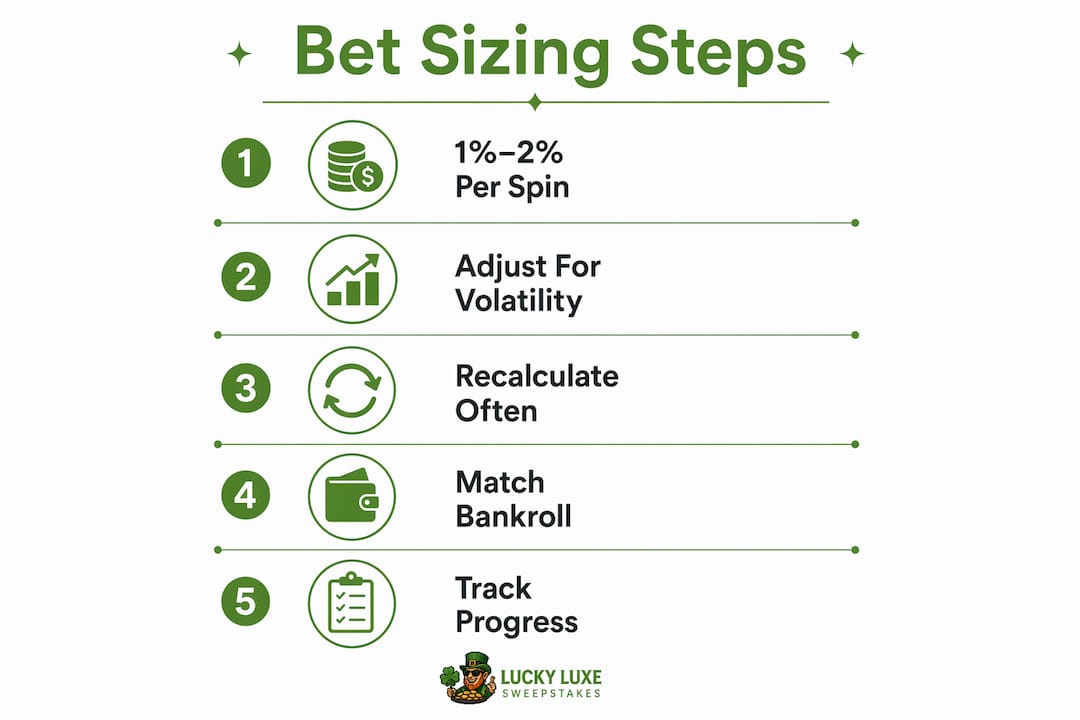
Bet sizing is where bankroll management becomes a math problem, and the math is straightforward. Per-spin stakes of 1%–2% of your total session bankroll give you enough spins to ride out normal variance. For high-volatility slots, stay at the 1% end of that range. High-volatility games pay less frequently but in larger amounts, so you need more spins to hit a meaningful win.

The table below shows how this plays out across different bankroll sizes and volatility levels.
| Session bankroll | Low volatility (2% per spin) | Medium volatility (1.5% per spin) | High volatility (1% per spin) |
|---|---|---|---|
| $50 | $1.00 per spin | $0.75 per spin | $0.50 per spin |
| $100 | $2.00 per spin | $1.50 per spin | $1.00 per spin |
| $200 | $4.00 per spin | $3.00 per spin | $2.00 per spin |
| $500 | $10.00 per spin | $7.50 per spin | $5.00 per spin |
RTP (return to player) also affects this calculation. A slot with a 96% RTP returns more over time than one at 92%, which means your bankroll lasts longer at the same bet size. Always check the RTP before you sit down. Luckyluxe highlights fair play certified slots so you can confirm RTP figures before committing your budget.
Recalculate your bet unit whenever your bankroll changes significantly. If you started with $100 and you are now at $60, your 1% bet drops from $1.00 to $0.60. Chasing losses by increasing bet size does the opposite of what you want.
Pro Tip: Before each session, write down your starting bankroll and your target bet size. Recalculate after every 50 spins. This keeps your sizing honest as your balance moves.
How do stop-loss and stop-win limits protect your bankroll?
Stop limits are the most underused tool in slots bankroll management, and skipping them is what turns a winning session into a losing one. A stop-loss limit defines the maximum you will lose before you walk away. Set your stop-loss at 50%–70% of your session bankroll. If you sit down with $100, you quit when you hit $30–$50 remaining.
A stop-win target works the opposite way. Set a stop-win at 150%–300% of your starting bankroll to lock in profits before variance pulls them back. Starting with $100 and hitting $200 means you cash out and stop. Most players ignore this rule because winning feels like momentum. It is not. Slots use random number generators, and the next spin has no memory of the last one.
Practical ways to stick to these limits:
- Write them down before the session starts, not during it
- Set in-app alerts or use a phone timer to check your balance at set intervals
- Use platform loss limit tools that automatically pause your session at a set threshold
- Take a 15-minute break after hitting either limit before making any decision to continue
The psychological challenge is real. Hitting a stop-win and walking away feels wrong when you are on a streak. Hitting a stop-loss and quitting feels like giving up. Neither feeling is accurate. Both limits exist to protect your budget from your own emotions.
Pro Tip: Write your stop-loss and stop-win numbers on a sticky note and put it next to your screen. Physical reminders beat mental ones every time.
Tools and techniques for tracking your slot sessions
You cannot manage what you do not measure. Maintaining a log of every session, including stake size, game volatility, time played, and results, is the only way to see your real spending patterns. Most players overestimate their wins and underestimate their losses. A written record corrects that bias fast.
Your session log does not need to be complicated. A simple spreadsheet with these columns covers everything:
- Date and game name
- Starting and ending bankroll
- Bet size used
- Session duration
- Net result (win or loss)
After four to six weeks of logging, patterns emerge. You will see which games drain your bankroll fastest, which sessions tend to run long and end badly, and whether your bet sizing is actually consistent with your rules.
"Tracking every session bet and result is what separates long-term players from those who reload and quit." This is the single habit that turns bankroll management from theory into practice.
Autoplay features accelerate bankroll depletion by removing the natural pause between spins. That pause is where you check your balance, reconsider your bet size, and decide whether to continue. Without it, you can burn through a session bankroll in minutes without realizing it. Manual spins take longer but give you control. Online slots run at 400–800 spins per hour on autoplay. At that speed, a $100 bankroll at $1 per spin can be gone in under 15 minutes. Structured sessions of 60–90 minutes followed by a 15-minute break interrupt that autopilot state and reduce impulsive decisions. Luckyluxe's responsible gaming tools include session time reminders that help you stay within these boundaries.
Key Takeaways
Effective bankroll management for online slots requires a dedicated budget, disciplined bet sizing, hard stop limits, and consistent session tracking.
| Point | Details |
|---|---|
| Separate your bankroll | Allocate 2%–5% of disposable income and keep it in a separate account or e-wallet. |
| Size bets by volatility | Use 1%–2% of session bankroll per spin; drop to 1% for high-volatility games. |
| Set stop limits before you play | Stop-loss at 50%–70% loss; stop-win at 150%–300% of starting bankroll. |
| Avoid autoplay | Manual spins preserve mental checks and slow down bankroll depletion. |
| Track every session | Log date, game, bet size, and result to identify spending patterns over time. |
The mindset shift that actually makes bankroll discipline stick
Most bankroll advice focuses on numbers, and the numbers matter. But the reason players ignore their own rules is almost never mathematical. It is psychological. The moment a session goes badly, the temptation to reload and "get it back" overrides every rule you set in advance.
Framing your bankroll as an entertainment cost, not an investment, is the single most effective mindset shift I have seen work consistently. You do not expect to profit from a movie ticket. You should not expect to profit from a slots session. When you accept that the money you deposit is the price of an entertaining hour, losing it does not trigger the same emotional response. You stop chasing. You stop reloading after a bust.
Reloading after busting your session bankroll is the most costly mistake players make. The math of the slot does not change on a re-deposit. The RTP is the same. The volatility is the same. You are simply spending more money on the same odds. I have watched players triple their losses in the hour after a bust because they convinced themselves the next session would be different.
The players who last longest treat slow, manual spins as a feature, not an inconvenience. They log their sessions. They set limits before they play, not during. They take breaks. None of this is complicated. All of it requires patience and self-awareness, which are harder to build than any spreadsheet. Start with one habit: write down your stop-loss before every session. That single action changes how you play.
— Skyline
Luckyluxe supports your bankroll goals
Luckyluxe is built for players who take their gaming budget seriously. The platform includes deposit limits, loss limit tools, and session reminders that enforce the bankroll rules covered in this article before you ever spin a reel.
Luckyluxe's game library highlights RTP figures and volatility ratings so you can match your bet size to the right game from the start. The responsible gaming resources on the platform walk you through setting up limits step by step. Whether you are working with a $50 session budget or $500, the tools are the same. Visit Luckyluxe to set up your account with the limits already in place.
FAQ
What percentage of income should a slots bankroll be?
Standard guidance sets a dedicated slots bankroll at 2%–5% of monthly disposable income. This keeps gaming losses predictable and prevents them from affecting household expenses.
How much should I bet per spin on online slots?
Bet 1%–2% of your session bankroll per spin. Use the lower end of that range for high-volatility slots to give yourself more spins and a better chance of hitting a significant payout.
What is a good stop-loss limit for a slot session?
Set your stop-loss at 50%–70% of your session bankroll. If you start with $100, quit when your balance drops to $30–$50, regardless of how the session feels in the moment.
Does autoplay hurt your bankroll faster?
Yes. Autoplay removes the natural pause between spins, which is when most players check their balance and reconsider their bet. Without that pause, bankroll depletion accelerates significantly.
How do I track my slot sessions effectively?
Log the date, game name, starting and ending balance, bet size, and session length after every session. A simple spreadsheet works well. After a month of data, spending patterns become clear and you can adjust your strategy accordingly.