

Bonus buys are mainly a time-versus-variance trade, not a hidden edge. You're paying to skip the base game and land straight in a slot's highest-volatility feature, but that convenience usually accelerates bankroll depletion unless the published buy RTP matches or beats the base RTP. Treat every buy as entertainment spending with a known cost, not an investment, and size it accordingly.
TL;DR:
- The published buy RTP generally ranges from 94% to 96%, often lower than the base game RTP of 96% to 97%, representing the house’s fee for skipping normal play.
- Choosing a buy should depend on whether the buy RTP matches or exceeds the base RTP, with volatility playing a key role in actual session outcomes.
- Limited bankroll, ideally 20 to 30 buys, is essential to handle the high variance and avoid risking more than 10-20% of total session funds on a single purchase.
- Checking game tiers, jackpot restrictions, and demo testing before buying can help avoid unfavorable configurations and unexpected payout disadvantages.
Table of Contents
- What Are Bonus Buy Slots and How Do They Work?
- How Much Do Bonus Buys Cost, and What Do You Actually Get Back?
- When Does Buying the Bonus Actually Make Sense?
- What Do Popular Bonus Buy Features Actually Look Like?
- Lucky Luxe Checklist: Choosing Bonus Buy Slots and a Safer Play Routine
- How I Actually Use Bonus Buys
- Try Bonus-Style Play at Lucky Luxe First
- Sources
What Are Bonus Buy Slots and How Do They Work?
A bonus buy slot lets you skip the spins-and-wait routine and pay a lump sum to enter the feature round directly. Instead of grinding through base spins hoping a scatter symbol lines up, you tap "Buy Feature," the game deducts a multiple of your stake, and you're dropped straight into free spins, a pick-me bonus, or whatever mechanic the title built its identity around.
Pricing is always expressed as a multiple of your base bet, not a flat dollar figure. That structure matters because it scales with however you're betting. Drop your stake to $0.20 and the same 100x buy costs $20, not $100.
Most bonus buy titles offer more than one flavor of the feature, and the differences aren't cosmetic:
- Free spins packages — a fixed number of spins, often with a multiplier trail attached
- Pick-me bonuses — you choose from hidden prizes until a "collect" symbol ends the round
- Sticky wilds — wilds lock in place for a set number of spins, common in tumble-style games
- Multiplier ladders — each win climbs a multiplier track before the round ends
- Premium or "super" tiers — the same feature but with better starting conditions, at a steeper price
That last category deserves its own explanation. Tiered buys aren't the same bonus at a markup. Each tier changes the starting distribution of the round itself. A base buy might start you with 10 free spins and a 1x multiplier; the premium tier for the same game might start you with 10 spins and a 2x multiplier already active, or swap in a richer symbol set for the duration. Statistically, those are two different games wearing the same skin, and each one carries its own published return figure.
That figure lives in the game's information panel, usually accessed through an "i" icon on the game screen. Reputable studios list a separate RTP for the bought feature alongside the base game RTP, and that gap is the single most important number on the page. If a game hides its buy RTP entirely or lists only one blended figure, treat that as a yellow flag and consider it before spending.
Pro Tip: Screenshot or note the buy RTP the first time you check a new title. Studios occasionally update math models, and having a baseline lets you spot if a "buy" option quietly got worse over time.
How Much Do Bonus Buys Cost, and What Do You Actually Get Back?
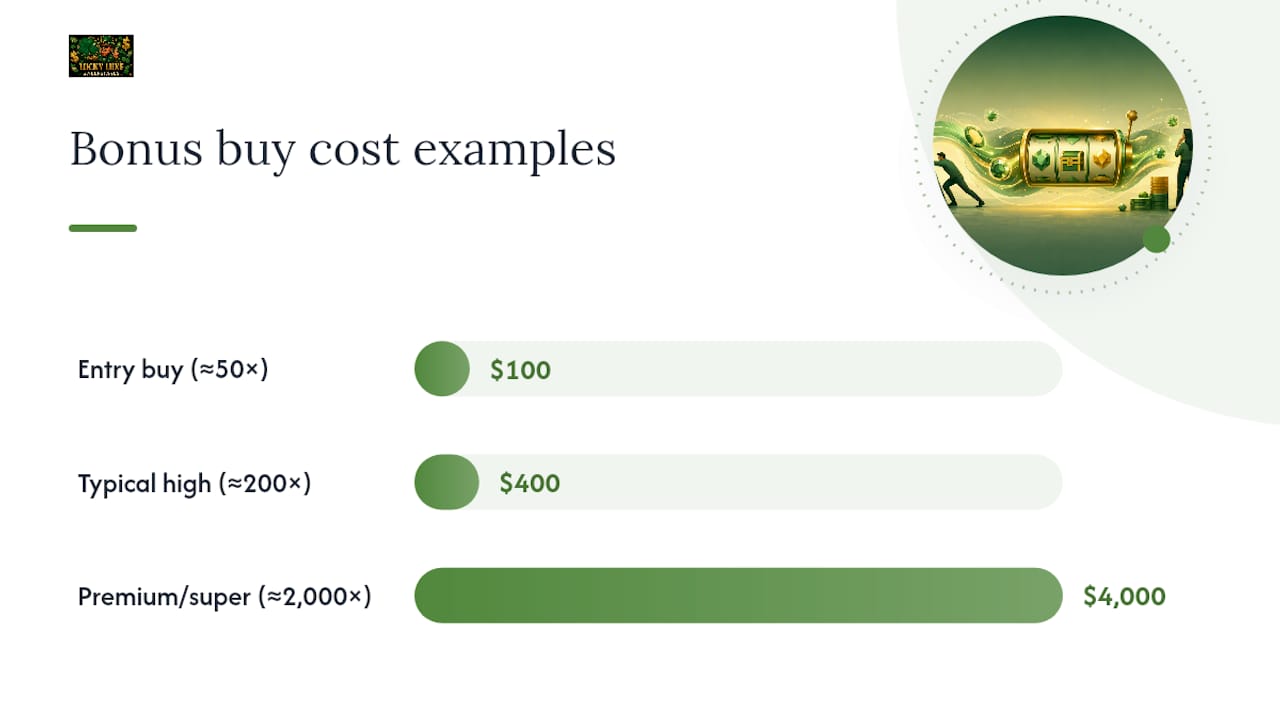
Cost is where most players underestimate what they're signing up for. Typical bonus buy prices run from roughly 50x to 200x your base stake, with premium or "super" tiers in some titles climbing as high as 2,000x. On a $2 stake, that range translates to anywhere from $100 for an entry-level buy to $4,000 for a top-tier premium version of the same feature.
The RTP gap that matters: Published buy RTP figures commonly land between 94% and 96%, while the base game RTP on the same title often sits around 96% to 97%. That two-to-three-point gap is the house's cut for letting you skip the wait, and it's baked into the math before you press the button.
The expected value math is straightforward once you have both numbers. Multiply the buy RTP by the buy cost, and that's your statistically expected return over a large number of buys, not any single purchase.
- A 100x buy at a stake of $1 costs $100
- If the published buy RTP is 95%, the expected return is $95
- The $5 gap is the structural cost of skipping the base game, repeated every time you buy
When a game's published buy RTP equals or exceeds its base RTP, the math actually favors buying over grinding for a natural trigger. Those titles exist, but they're the exception, not the rule, so check before you assume one favors you.
Here's the part RTP alone won't tell you: volatility decides what actually happens in your session, and RTP only describes the long-run average. Bonus buy outcomes swing hard — a single feature round can return less than you paid for it, or it can exceed 1,000x your stake in a standout hit. Because that variance gets concentrated into one purchase instead of spread across dozens of natural spins, a bonus buy needs a larger bankroll behind it than the same amount of ordinary base-game play. You're not smoothing out risk over time; you're compressing it into a handful of high-stakes moments.
When Does Buying the Bonus Actually Make Sense?
Bonus buys make sense when three conditions line up: the buy RTP is competitive with the base RTP, the cost fits comfortably inside your session bankroll, and your goal is entertainment intensity rather than stretching playtime. Miss any one of those and you're better off skipping the button.
Start with bankroll sizing, because this is where most players get burned. A single buy should never exceed roughly 10% to 20% of your total session bankroll. If you've set aside $200 for a session, a single $150 buy at 150x your $1 stake isn't a bold move, it's most of your bankroll gone on one outcome. Practitioners who build entire sessions around buying rather than natural triggers generally recommend carrying enough bankroll for 20 to 30 buys before starting, which gives the variance room to even out rather than wiping you out on a cold run of three or four bad rounds in a row.
Run through this checklist before you commit to a purchase:
- Check the buy RTP against the base RTP. If the buy figure is lower, you're paying a premium for speed, not value.
- Look at the cost multiple relative to your stake. A 200x buy at a $0.50 bet behaves very differently than the same multiple at $5.
- Define your session objective first. Are you trying to maximize entertainment per dollar, or are you chasing a specific big-win moment? Those call for different bankroll rules.
- Check whether an ante bet option exists. Some titles let you pay a smaller premium on every spin to boost your natural trigger odds instead of buying outright.
- Play the demo version first. Free-play modes show you the feature's pacing and volatility without touching real money.
Ante bets deserve a closer look because they're the most underused middle ground in this whole conversation. Instead of one large lump-sum purchase, an ante bet spreads a smaller surcharge across every spin, which can improve your natural trigger frequency or the feature's overall return without concentrating all your risk into a single transaction. It's a slower path to the same feature, but it trades a chunk of that concentrated volatility for a steadier ride.
If a buy doesn't clear your checklist, you've got real alternatives that aren't "just play the base game and hope":
- Try a lower-tier buy instead of the premium version if the price gap between tiers is steep relative to the RTP improvement
- Use demo or free-play modes to learn a new title's pacing before risking real money on its feature
- Let the game trigger naturally on titles where the base RTP outpaces the buy RTP, since that's the mathematically favorable side of the equation
None of this works without honest bankroll management sitting underneath it. Our guide to managing bankroll while playing online slots breaks down session limits in more detail, and pairing that with an understanding of how variance shapes your results will do more for your long-term enjoyment than any single buy decision. If you notice yourself chasing losses by buying repeatedly to recover a prior purchase, that's the moment to step away, and resources like GambleAware are built specifically for that situation.
What Do Popular Bonus Buy Features Actually Look Like?
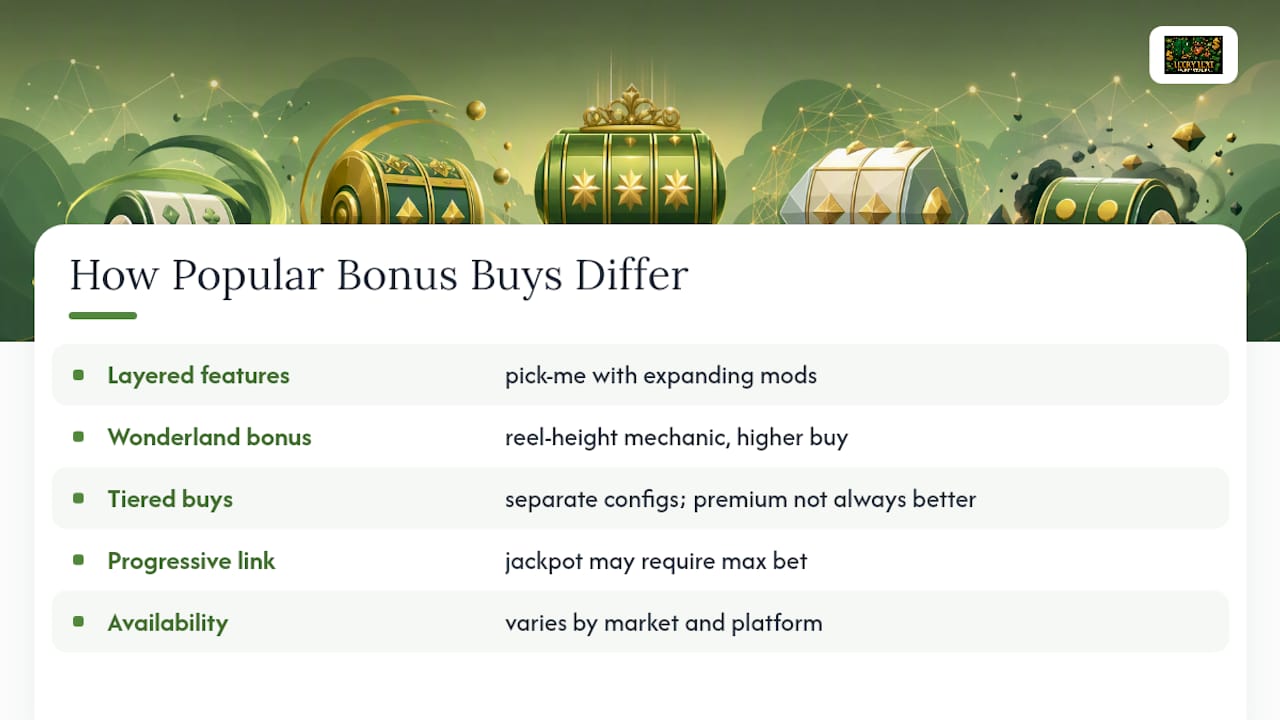
Feature types vary more than a quick glance at a lobby screen suggests, and the differences show up the moment you buy in. Money Train 4 layers on a pick-me style bonus mechanic on top of its free spins, where the buy gets you into a round with expanding modifiers that can compound quickly. White Rabbit Megaways uses a "Wonderland" bonus tied to increasing reel heights, and its buy price historically runs higher than simpler free-spin formats because the feature itself carries more upside variance.
The tiered-buy structure shows up constantly across these families of games. A standard buy might drop you into 10 free spins with a low starting multiplier, while the premium version of the identical feature guarantees a higher multiplier floor or extra scatter symbols already on the reels. Treat each tier as its own configuration with its own published stats rather than assuming "premium just means better odds at a higher price." Sometimes it does. Sometimes it just compresses the same odds into a bigger price tag with a flashier starting screen.
Progressive jackpot connections add another layer worth checking before you buy. Some titles tie their bonus round to a progressive jackpot pool, and those jackpots often carry eligibility rules like max-bet requirements or specific qualifying wagers. If you're buying a feature specifically hoping to land a progressive, confirm the eligibility terms first. Buying the bonus on a reduced stake sometimes disqualifies you from the jackpot pool entirely, which defeats the purpose of the purchase.
Availability also depends heavily on where and how you're playing. Some regulatory environments restrict or disable bonus buy features outright, meaning the buy button you see advertised in a game's marketing might not even appear once you load it on a licensed operator in a restricted market. Sweepstakes-style platforms and social gaming sites often structure the experience differently than traditional real-money operators, since play there typically runs on virtual currency systems rather than direct cash wagers, so the regulatory picture and the buy mechanics can look different depending on which type of platform you're using.
Lucky Luxe Checklist: Choosing Bonus Buy Slots and a Safer Play Routine
Before you spend on any bonus buy, run the title through a short checklist rather than relying on gut feel. Compare the buy RTP against the base RTP, note the buy multiple relative to your stake size, check the game's stated volatility rating, confirm whether multiple tiers exist and what changes between them, and verify jackpot eligibility if a progressive is involved.
- Buy RTP versus base RTP, side by side, before you commit
- Buy cost expressed as a multiple, converted into an actual dollar figure at your stake
- Volatility rating and how it interacts with your session bankroll
- Number of tiers available and what specifically changes between them
- Progressive jackpot eligibility rules, if the feature connects to one
- How the buy interacts with any active wagering requirements on bonus funds
Practically, that means demoing a new title before spending on it, setting a fixed buy budget for the session and sticking to it, and keeping a quick log of buy outcomes so you can see your actual results instead of relying on memory of the one big win.
| Step | Why it matters |
|---|---|
| Demo the game first | Shows feature pacing without risking money |
| Compare buy RTP to base RTP | Reveals the real cost of skipping the base game |
| Set a fixed buy budget | Prevents one purchase from swallowing the session |
| Log buy outcomes | Replaces gut feeling with an actual record |
Our full Slot Bonus Feature Checklist expands on each of these steps, and if you're still building a sense for which titles suit your style, the guide on choosing slots with strong bonus features is worth reading first.
How I Actually Use Bonus Buys
On a $100 session, that caps a single buy around $15, which forces me to pick lower-multiple entries rather than premium tiers I can't really afford to lose. I treat every buy as the price of a concentrated, faster round of entertainment, never as a bet I expect to beat. That mindset alone has saved me more money than any specific strategy ever has.
— Skyline
Try Bonus-Style Play at Lucky Luxe First
Reading about buy RTP and bankroll math only gets you so far. At some point you want to see how a feature actually plays before deciding whether it's worth your budget, and that's exactly the gap Lucky Luxe fills for players who want to explore bonus-style mechanics without committing real cash upfront.
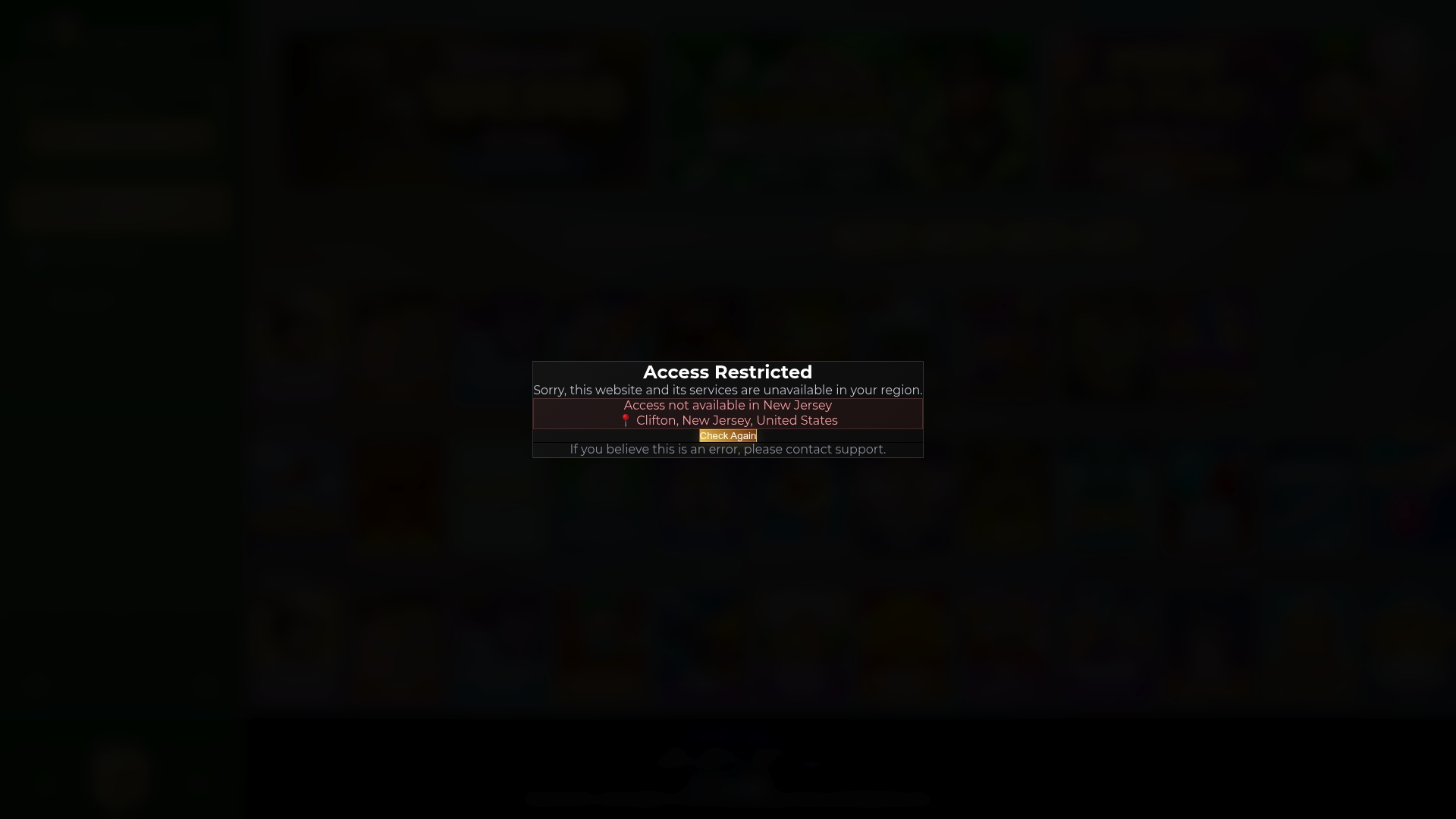
Lucky Luxe runs on Gold Coins for entertainment play and Sweeps Coins for sweepstakes-style entries, which gives you room to test how a feature round feels before you decide it's worth chasing with a bigger spend. Pair that with the Slot Bonus Feature Checklist and the bankroll management guide covered earlier, and you've got a practical framework instead of a guess. Head to Lucky Luxe to try a session, check the checklist against a game you're curious about, and set your budget before you touch the buy button.
Sources
- Bonus Buy Slots: What They Cost, What They Pay, Whether They're Worth It
- Understanding bonus buy slots: how do they work