

Slot variance is a measure of how spread out a game's payouts are around its long-run average. It tells you whether wins arrive often in small amounts or rarely in large ones, and that single distinction should drive which games you pick and how you size your bets. If you want your bankroll to last through a long session, lean toward low variance. If you're chasing a life-changing hit and can absorb dry spells, high variance is the tool for that job. Neither one tells you anything about your next spin. Variance is a statement about thousands of spins, not the one you're about to make, and treating it as a prediction machine is where most players go wrong.
Key Takeaways
Slot variance determines how a game's payouts are spread over time, and matching that spread to your bankroll matters more than chasing a single RTP number.
Table of Contents
- What Does Slot Variance Mean in Practical Terms?
- Low, Medium, High, and Extreme Variance: What to Expect
- How Is Slot Variance Different From RTP?
- How Do You Find a Game's Variance Before You Play?
- Sizing Your Bankroll and Bets to Match Variance
- Common Myths About Slot Variance
- Quick Checklist: Choosing a Slot by Variance
- A Player's Note on Reading Variance
- Practice Variance-Aware Play on Luckyluxe
- Sources
What Does Slot Variance Mean in Practical Terms?
The math behind slot volatility comes from a formula you probably haven't seen since a statistics class: variance equals the average of the squared payouts minus the square of the average payout. Providers take the square root of that number to get standard deviation, which converts an abstract statistical unit into something you can actually picture in dollars and cents. A game with a standard deviation of $2 on a $1 bet behaves very differently from one with a standard deviation of $40, even if both return 96% over the long haul.
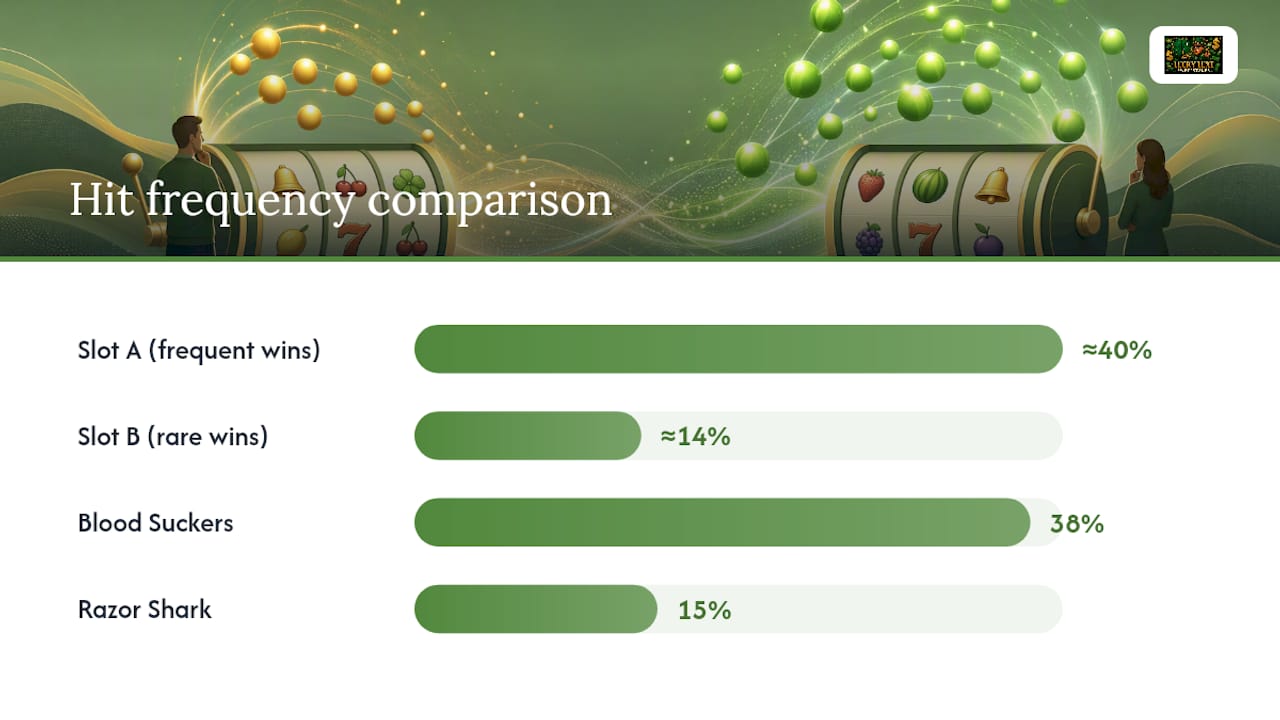
Here's a rough way to see it play out. Imagine two slots, each returning $0.96 on average per $1 spin. Slot A pays out small amounts constantly: mostly $0.20 to $1.50 wins that show up on nearly 4 in 10 spins. Slot B stays quiet for long stretches, then occasionally drops a $50 or $200 win on maybe 1 in 7 spins. Same average. Wildly different experience sitting in the chair.
That gap comes down to hit frequency (how often you win anything at all) combined with payout size (how big those wins tend to be) when they land. Real games illustrate the spread: Blood Suckers hits around 38% of spins, while Razor Shark hits closer to 15%. Certain design features reliably push variance higher:
- Progressive or fixed jackpots that pay rarely but massively
- Cascading or tumbling reel mechanics stacked with multipliers
- Free-spin rounds with paytables that dwarf the base game
- Wild reels or expanding symbols that create occasional huge combinations
Low, Medium, High, and Extreme Variance: What to Expect
Providers and reviewers commonly sort slots into low, medium, and high volatility tiers, and a fourth "extreme" category has become common for jackpot-heavy titles. Each band changes what a session actually feels like.
Low variance games pay small wins often. Expect frequent hits, few dramatic swings, and a bankroll that erodes slowly. This is the territory for players who want an hour of entertainment on a modest deposit without watching their balance vanish in ten spins.

Medium variance blends the two. You'll see dry patches, but also mid-size wins that feel meaningful. Most mainstream video slots with a bonus round sit here.
High variance slots stay quiet for long stretches, then deliver big multipliers or bonus payouts. Sessions can look flat for 100 spins and then spike hard.
| Variance band | Hit frequency | Typical win size | Bankroll multiplier fit |
|---|---|---|---|
| Low | Frequent | Small wins relative to bet | Modest bankroll multiplier fit |
| Medium | Moderate | Medium-sized wins | Medium bankroll multiplier fit |
| High | Less frequent | Larger wins | Larger bankroll multiplier fit |
| Extreme | Rare | Very large wins | Very large bankroll multiplier fit |
A player with $50 on a low-variance game might see their balance drift between $35 and $65 over an hour. That same $50 on an extreme-variance title could hit $10 fast, or turn into $800 on one spin. Both are working exactly as designed.
How Is Slot Variance Different From RTP?
RTP, or return to player, is the percentage of all wagered money a slot is mathematically built to pay back over its full lifetime, calculated across millions of simulated spins. It tells you nothing about the shape of your individual sessions. RTP and variance operate independently of each other, which is the part most players miss.
Two games can both carry 96% RTP and play like completely different products. One pays that 96% back through frequent small wins, so a session feels steady. The other pays it back through rare, oversized jackpots, so most sessions look like a slow bleed punctuated by the occasional spike.
- RTP answers: "How much will this game return over the long run?"
- Variance answers: "How bumpy will the ride be while I find out?"
The practical rule: check RTP first to rule out weak-paying games, generally anything below 94%, then check variance to match the game to your bankroll and mood. Choosing on RTP alone is like picking a flight by ticket price and ignoring whether it has three layovers.
How Do You Find a Game's Variance Before You Play?
Slot developers rarely print a raw variance number on the game screen, but the signals are there if you know where to look.
- Check the developer's own volatility rating, usually shown as a star scale or a low/medium/high tag on the game info screen.
- Look up third-party variance scores from review sites that run large-scale simulations rather than relying on a handful of personal spins.
- Study the paytable shape: a huge gap between the top symbol payout and everything else usually signals higher variance.
- Note the hit frequency if it's listed. Anything above 30% tends toward low variance; below 15% tends toward high or extreme.
- Play the free demo for 50 to 100 spins and track how often you see any win at all versus dead spins.
A word of caution: 50 spins is nowhere near enough to prove anything statistically. You can run a cold streak on a low-variance game or a hot one on a high-variance game purely by chance. Use demo observation as a directional signal, not proof, and don't fall into the trap of thinking three losing spins in a row means the machine is "due."
Sizing Your Bankroll and Bets to Match Variance
Bankroll math should shift with the variance band you're playing, because the swings you'll absorb are completely different at each level.
A workable starting point is to increase your bankroll size in proportion to the slot's variance category, with larger bankrolls recommended for higher variance games. These guidelines are general recommendations, not guarantees. A brutal cold streak can still burn through any bankroll, and providers don't publish exact variance figures publicly, so treat the tiers as guidance rather than a formula.
Bet-sizing follows the same logic. On high or extreme variance games, smaller bets stretched over more spins give the math room to work in your favor. Betting big on an extreme-variance title with a thin bankroll is the fastest way to end a session in ten minutes. For structured bankroll management, decide your loss limit before you start, not while you're down.
If you're working through a bonus with wagering requirements, lower-variance games are usually the smarter path. Steady, frequent wins keep your balance closer to your starting point while you grind through the requirement, rather than risking it all on one swing.
- Set a stop-loss before you start, and actually walk away when you hit it
- Match bet size to the variance band, not to how the last few spins went
- Save extreme-variance jackpot chasing for money you've mentally written off as entertainment cost
Pro Tip: Run any new game in demo mode first and count how many spins pass between meaningful wins. That single observation tells you more about real variance than any star rating on the lobby screen.
Common Myths About Slot Variance
The biggest misconception is that variance predicts what happens next. It doesn't. Variance describes the shape of the entire payout distribution across thousands of spins, not the outcome of the spin you're about to make. A high-variance machine that hasn't paid in 200 spins is not "due." The odds on spin 201 are identical to the odds on spin one.
Another common trap: switching machines after a loss to "reset" your luck. Machines have no memory, and switching games changes nothing about the math you're playing against.
Variance measures the spread of the full payout distribution and does not predict the outcome of any single spin. It explains how results deviate from the average over many spins, not over ten or twenty.
If tracking your losses, chasing bets, or feeling unable to stop starts to feel familiar, BeGambleAware and Gambling Therapy both offer free, confidential support.
Quick Checklist: Choosing a Slot by Variance
Before you load up a game, run through this fast:
- Does the bankroll multiplier match this game's variance band?
- Have you checked RTP and volatility rating together, not RTP alone?
- Did you demo-test it for at least a few dozen spins?
- Is your max bet capped to fit your bankroll math?
- Do you have a stop-loss number set before you start?
Low variance stretches your playtime. High variance chases the bigger number. Pick based on what you actually want from the session, not what the last player at the machine seemed to be doing.
A Player's Note on Reading Variance
Understanding variance changed how I picked games long before I could explain the math behind it. The dry stretches on high-volatility titles used to feel like something was wrong; now they just look like the distribution doing exactly what it's built to do. Variance preference is personal. There's no wrong answer, only a mismatch between the game and what you actually wanted from the session.
Practice Variance-Aware Play on Luckyluxe
Reading about variance bands is one thing. Actually feeling the difference between a low-volatility grind and a high-volatility swing is what makes the concept stick, and that's exactly what demo play is for. Luckyluxe gives you free-play access across its slots, fishing, and arcade library, so you can run the spin-count test from this article on a real title before you ever commit Gold Coins to it.
Browse the lobby with variance in mind: try a steady, frequent-win title back to back with a spiky, jackpot-style one, and notice how differently the same $20 balance behaves. Luckyluxe also runs a referral program and regular promotional offers on Gold Coin packages, so once you've found a volatility band that fits how you like to play, there's a clear path to jump in further. Availability depends on your state of residence, so confirm local eligibility before purchasing, and pace your play using the bankroll multipliers covered above. Head to Luckyluxe to start testing games in demo mode today.
Sources
- Slot Volatility Explained: Low vs High Variance Slots | PokerNews
- Slot Variance & Volatility Explained 2026 — RTP vs Risk | Payout Verdict
- Slot Volatility Math: Standard Deviation in Plain English | Effortless Math
- BeGambleAware
These sources were chosen for mathematical clarity, industry-standard terminology, and player-safety credibility.