

A combo meter counts how many successful actions you chain together without a break, and in most arcade games it turns that streak into extra points. Hit, shoot or press on time and the number climbs. Wait too long or make the wrong move and it drops back to zero. Once you know the three rules behind it, you can read the meter in almost any arcade game and play to keep it alive. That is also the habit that makes a short session on Lucky Luxe's arcade, slot and fish table games more enjoyable, because you know what each screen is asking of you before you spend a coin.
TL;DR
- A combo meter counts consecutive successful actions; a timer or a failure condition resets it.
- Most meters run on three rules: each success adds one, the next success must land inside a short window, and a miss or an expired window resets the chain.
- The payoff varies by game: a score multiplier in one, bonus damage in another, a rank or a reward in a third.
- Read the meter and the timer bar together, because the chain size alone does not tell you how long you have.
- Before you play for sweepstakes prizes, check which coin type a game uses and what its rules say about streaks.
Table of Contents
- What a combo meter actually tracks
- The three rules behind nearly every combo meter
- How players build a combo and keep it going
- What breaks a combo
- How a combo changes your score, damage and rewards
- How combo rules differ from game to game
- Reading the display like a designer
- Streaks in slots and sweepstakes-style games
- Playing arcade games with a plan on Lucky Luxe
- Where to try it
- Our perspective
- FAQ
- Sources
What a combo meter actually tracks
The meter tracks one thing: how long your current streak is. A game-design reference from Worcester Polytechnic Institute defines a combo as a score mechanic that rewards chaining several in-game actions in a row. The game can show it explicitly, with a number that goes up, or implicitly, through a change in the game world. Some games add a duration bar that drains and resets the combo when it empties.
That last detail matters for how you play. A number alone tells you how well you are doing. A number plus a draining bar tells you how much time you have left to act. A design explainer by Miguel De Guzman argues that this timer is what makes combos tense: you stop waiting for enemies to come to you and go to them, because every pause costs the chain.
The three rules behind nearly every combo meter
De Guzman's breakdown boils the mechanic down to three rules. They are useful because once you spot them, a new game stops being a mystery.
- Each success adds one. A hit, a kill or a well-timed press counts toward the chain.
- A short window opens after each success. The next success has to land inside it, and each new success usually restarts the window.
- A reset drops the chain to zero. That happens when the window runs out or the game defines a failure, such as taking a hit or missing a note.
In practice, every arcade combo meter you meet is a variation on these. The differences are in the window length, what counts as failure, and what the chain is worth.
How players build a combo and keep it going
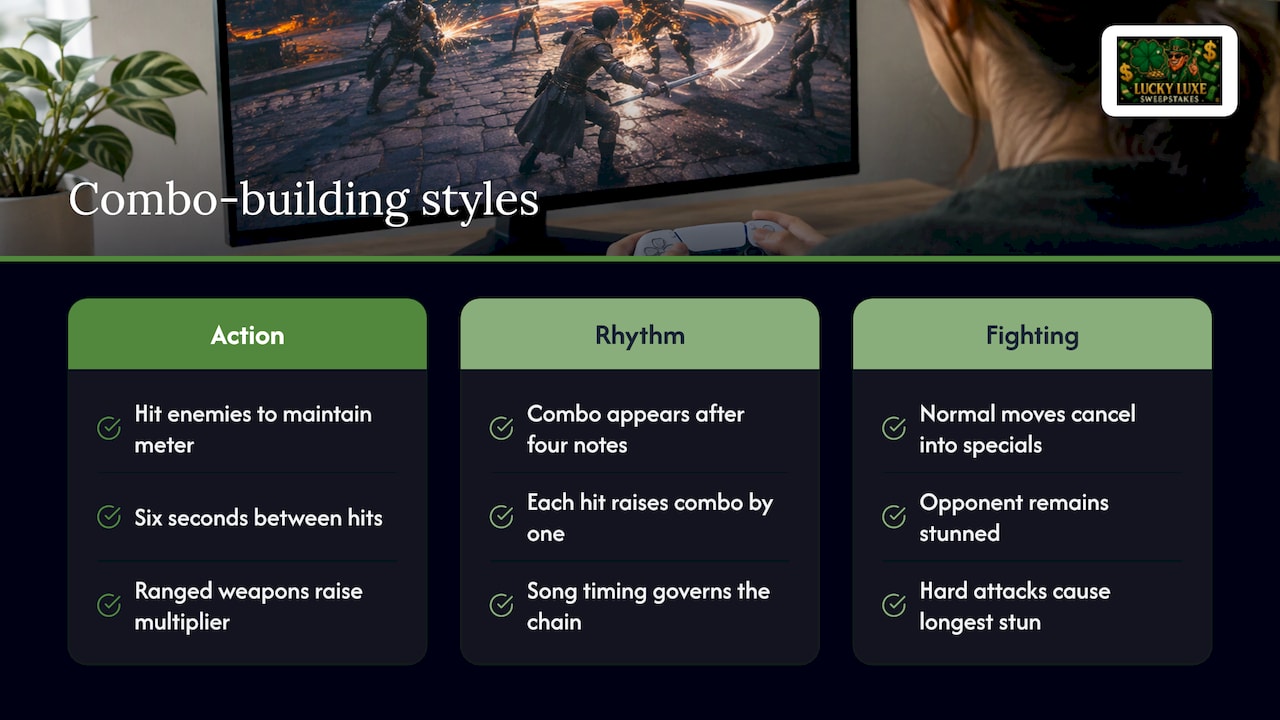
Building a chain is mostly about tempo. Take a look at three styles.
Action games with a countdown. In Bayonetta 2, you keep the meter going by hitting enemies and avoiding damage. According to Nintendo Life's scoring guide, after you land a hit you have six seconds to land another or the meter breaks. Ranged weapons can keep the multiplier rising when enemies are far away. The lesson: always have the next target in mind before the current one falls.
Rhythm games. In Dance Dance Revolution, the combo number appears after you hit at least four notes in a row and rises by one per successful hit. Here there is no countdown bar. The song itself is the timer, and the chain lives or dies on your timing against the beat.
Fighting games. Here the chain is a sequence of attacks the opponent cannot escape. In Street Fighter Alpha 3, one community guide explains buffering: a normal move can cancel into a special move while the opponent is still stunned, and weak attacks cause the shortest stun while hard attacks cause the longest. Which special move connects depends on how long the stun lasts compared with how long the special takes to start.
A habit that carries across all three: look one step ahead. Players who watch only the current action lose chains at the transition, the moment between one target, note or move and the next.
What breaks a combo
The usual culprits fall into four groups.
- Timing misses. In older DDR releases, a Good, Miss or N.G. judgment broke the combo. From DDR (2013) on, a Good no longer breaks it. Always check which rule set your cabinet or game uses.
- Failing to continue the sequence. In Tetris The Grand Master, failing to clear a line with the next piece resets the combo counter.
- Running out of the meter or leaving the move set. In Bomb Rush Cyberfunk, a combo ends when you drop out of your trick style on the ground, when the manual or slide meter runs out, or when you return to normal riding.
- Repetition. The same game rewards variety: tricks on the same rail go stale and award fewer points until you refresh them.
The common thread is that a reset is rarely random. It follows from a rule the game states somewhere, in a tutorial, a rules screen or a help page. Reading that rule once saves many broken chains.
How a combo changes your score, damage and rewards
The chain is only worth something because of what it feeds. Games use it in four main ways.
Score multipliers
The most common payoff is a multiplier. De Guzman's worked example, a tank shooter called Tank City Zero Day, shows how simple it can be: each destroyed enemy adds one to the chain and restarts a 2.5-second window. The multiplier is one plus one for every three kills, capped at eight, and each kill scores its base points times the multiplier. Run the numbers on a 12-kill chain: 12 divided by 3 is 4, so the multiplier is 5, and a 100-point kill is worth 500. The cap of eight means that after 21 kills the multiplier stops growing, so the smart play past that point is to keep the chain alive rather than chase a bigger number.
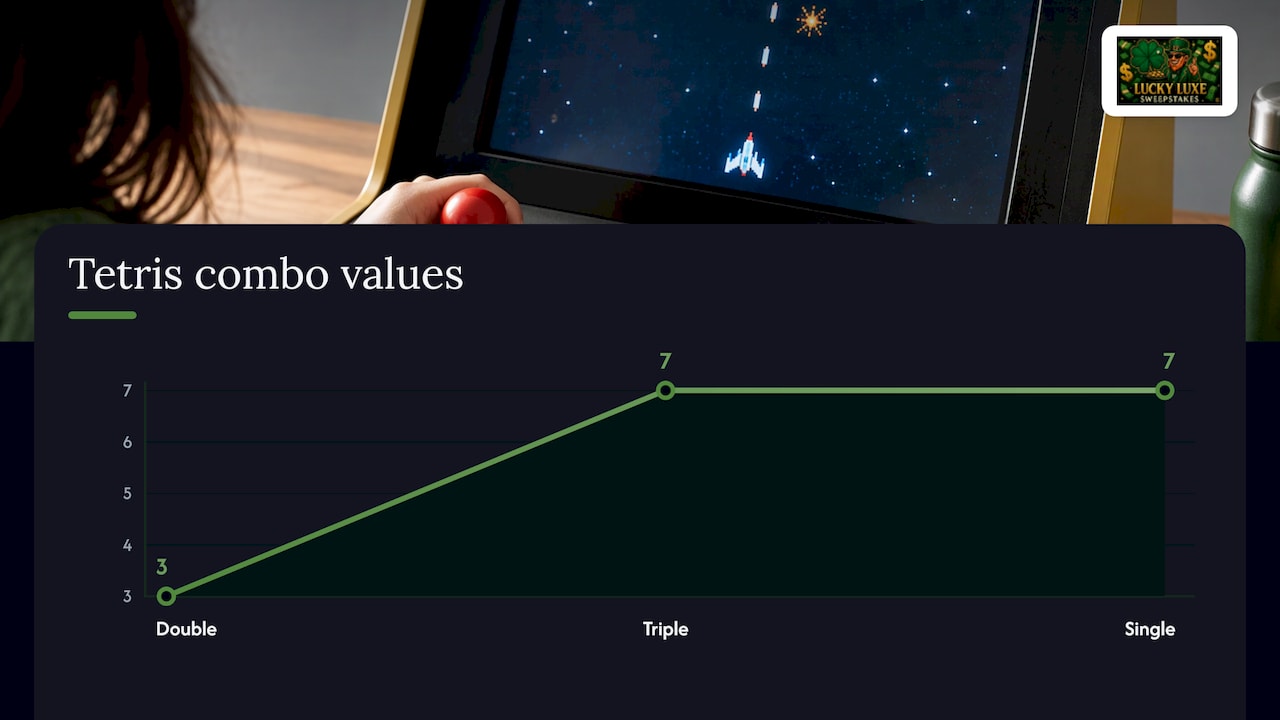
In Tetris The Grand Master, TetrisWiki's scoring page gives the combo bonus as the previous combo value plus twice the lines cleared, minus two. A double, then a triple, then a single produces combo values of 3, 7 and 7. Small, steady clears build a chain, but bigger clears lift the value faster.
Damage
In Killer Instinct, Prima Games' combo guide explains that a Knockdown Value meter appears when a combo starts and governs how far it can extend before the opponent is knocked down. Light attacks fill it fastest and heavy attacks slowest, which gives heavy attacks the most damage potential but also gives the opponent more time to break the combo. The flashing part of the opponent's life bar is potential damage, and you only cash it in by finishing the combo with an Ender. If the combo is broken, only the instant damage stays.
Meter refills and resources
Some games treat the combo as a resource. In Rollerdrome, Gamepur's guide explains that damage slightly boosts the combo meter, kills fully refill it, each quick kill adds a combo level that raises the multiplier, and five combo coins per arena can each instantly refill a nearly empty meter. Knowing where the refills are lets you take bigger risks.
In fighting games, super meter fills for both players as attacks connect, and FightingGameGuide notes that after a point the defender builds more meter than the attacker. Ending the combo into a knockdown can be better than extending it.
Rank and progression
In some games the final grade depends on your best chain. The WPI reference describes Pizza Tower (2023) as an example where the combo meter can run out, pickups can extend it, and the final point reward and rank depend on combo size. In a game like that, a chain is not just a number. It is how the game decides what you earned.
How combo rules differ from game to game
The same word means different things across genres, and that is where players get caught. The WPI reference notes that in style-based platformers and stunt games, combos usually show up as a multiplier on trick points, while in rhythm games the combo is a common indicator of consecutive notes hit. Designers decide whether the number affects score at all or simply signals skill.
Here is a quick comparison of the examples above.
| Game type | What counts | What resets it | What it pays |
|---|---|---|---|
| Action shooter | Hits and kills inside a timer window | Window expires or you take a hit | Score multiplier |
| Rhythm | Consecutive notes hit | Miss, and in older versions a Good | Higher scoring and a longer streak display |
| Fighting | Linked attacks while the opponent is stunned | Opponent breaks it or you drop it | Damage and super meter |
| Block puzzle | Consecutive line clears | A piece placed with no clear | Bonus score |
| Trick or stunt | Tricks in a row | Landing, running out of meter, stale tricks | Points and multipliers |
Super meters add another wrinkle. In Street Fighter Alpha 3, a Dhalsim guide describes a bar at the bottom of the screen that fills by attacking, being hit and hitting the opponent. It behaves differently depending on the play style you pick: a red bar that a Super Combo fully depletes, a green three-level bar, or a blue percentage bar. Same word, three different meters. Always find out which one you are looking at.
Reading the display like a designer
A good combo display shows two things: the size of the chain and how much time remains. If a game only shows the number, you are guessing at the window. If it shows both, you can plan your next move by watching the bar. Examples of streak-based game mechanics show how different designs communicate the chain and the time left to continue it, which helps explain why some meters feel fair and others feel punishing.
When a new game starts, spend the first round just watching the meter. Note how long the window feels, what makes the number flash or change color, and what happens at certain thresholds. Most games put those thresholds at round numbers, so you can anticipate them.
Streaks in slots and sweepstakes-style games
A combo in an action game is skill. A streak in a slot is different, and it pays to keep the two apart. Reel outcomes in a slot are not a chain you build with timing, so a winning run does not mean the next spin is more or less likely to win. Our guide to what hot and cold slot streaks really mean walks through that distinction.
What slots do have are features that feel like combo mechanics. Cascades and tumbles chain several wins from one spin, and our explainer on how cascading reels work shows how a multiplier can rise with each step in the chain. For the multiplier math itself, the paytable checklist for multipliers lets you check what a game really pays in under a minute.
Playing arcade games with a plan on Lucky Luxe
Lucky Luxe is an online social gaming platform with slots, fishing, arcade and sweepstakes games. You play with virtual Gold Coins for entertainment, and Sweeps Coins let you take part in sweepstakes games for a chance at redeemable prizes. Because there are two coin types, the first step in any arcade game is to look at which one you are playing with.
A short routine that fits any game with a streak or multiplier:
- Find the rules or help screen. Learn what counts toward a chain, how long the window is and what resets it.
- Check the coin type. Make sure you know whether the session uses Gold Coins or Sweeps Coins. Our guide to checking both coins before you play covers what to look for in U.S. arcade sweepstakes games.
- Set a session size. Decide in advance how many coins you will use. Our 15-minute arcade strategy shows how to stretch Sweeps Coins across a short session.
- Play the first rounds to learn the tempo. Watch the meter before you push for a longer chain.
- Look at rewards. If you play for missions, see how arcade mission rewards are unlocked so your chain-building lines up with what the game actually grants.
Players who like fishing tables can apply the same habit: learn what the game counts, how long a rhythm of shots lasts and what it pays, then play with that plan rather than reacting shot by shot.
Where to try it
If you want arcade, fishing and slot games in one place, Lucky Luxe offers premium slots, fish tables and arcade games, including live dealer options, with promotions and a referral program for players who bring friends. Gold Coins are for entertainment play, and bonus Sweeps Coins come through promotions or Gold Coin purchases. Lucky Luxe is for adults in the United States, excluding certain states.
Browse the full lineup at Lucky Luxe and open the rules screen on any game you pick, so you know how its streaks work before the first round.
Our perspective
A combo meter is a promise the game makes to you: do the next thing well and I will reward you for it. The best ones keep that promise clearly. You can see the chain, you can see the time, and you know what a failure costs.
That is how we think about play at Lucky Luxe. We built our platform around a user-friendly interface, a wide selection of slots, fishing and arcade games, including rare fishing table games, and a stated commitment to high-quality graphics and fair play. Players should be able to pick a game, understand what it asks of them and enjoy it.
We also like that our promotional offers and hot game highlights are shown regularly, because they help players choose where to spend a session. If you enjoy chasing a streak, the referral program is a friendly way to share that with someone else.
Skyline
FAQ
What is a combo meter in an arcade game?
It is an on-screen counter or bar that tracks how many successful actions you have chained together without a break. Many games convert that chain into bonus points, damage or a better rank. It resets when the timer runs out or you fail.
How long do I have between actions to keep a combo?
It depends on the game. Bayonetta 2 gives six seconds after a hit, while the Tank City Zero Day example uses a 2.5-second window. Rhythm games have no countdown, and the song sets the pace. Watch the timer bar if the game shows one.
Does a longer combo always mean a higher score?
Not always. The WPI reference notes that designers choose whether a combo affects score or only signals skill. In Dance Dance Revolution the combo factor can multiply base points heavily, but in other games the number may be only a display. Check the rules screen.
Do winning streaks in slots work like combo meters?
No. A combo meter rewards your timing and skill. Slot outcomes are not something you chain through timing, so a run of wins does not change what the next spin will do. Cascade and multiplier features can build a chain within a single spin, and the game's paytable explains how.
Sources
- DGMI wiki: Combo mechanic
- Combo Meter in Games: How Chains and Multipliers Work
- Bayonetta 2 combat scoring system, Nintendo Life
- What Is DDR? RemyWiki
- Street Fighter Alpha 3 combo and systems guide
- Street Fighter Alpha 3 Dhalsim guide
- TGM legend, Hard Drop Tetris Wiki
- Combos, Bomb Rush Cyberfunk Wiki
- Tetris The Grand Master, TetrisWiki
- The Combo System, Killer Instinct Guide, Prima Games
- How combos work in Rollerdrome, Gamepur
- How Combos Work in Fighting Games
- Streak-based game mechanic examples