

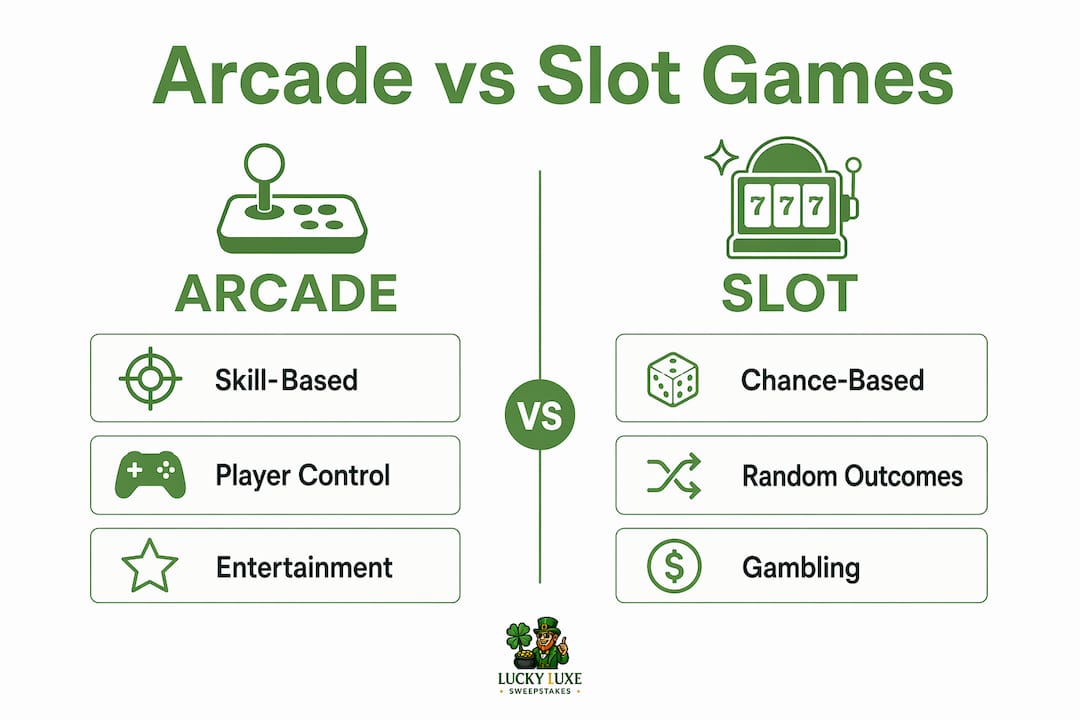
Arcade games are defined as skill-based entertainment where players pay for time and experience, while slot machines are gambling devices determined by random chance at spin. That single distinction shapes everything: how you play, what you win, and what the law says about each. The difference arcade vs slot games comes down to whether your ability changes the outcome. In arcade games, it does. In slots, it never does. Understanding this split helps you pick the right game for your goals, whether you want a skill challenge or a chance at a payout.
What is the core difference between arcade and slot games?
Arcade games reward skill, timing, and pattern recognition. Slot machines reward nothing except luck, because their outcomes are set the moment you press spin. That gap defines the entire arcade vs slots comparison and explains why regulators treat them so differently.
Think of it this way: arcade players rent entertainment time. They get better with practice, and their score reflects their ability. Slot players wager on independent, unpredictable events with no skill component. A beginner and a veteran pulling the same slot lever face identical odds.
Legal and industry standards reinforce this divide. Skill-based reward systems classify a game as entertainment. Random cash payouts classify it as gambling. That classification determines licensing, regulation, and where the game can legally operate.
How do gameplay mechanics differ between arcade and slot machines?
Arcade game mechanics center on player control. You dodge, aim, time jumps, and read patterns. Your input directly changes what happens on screen. Slot machine gameplay works the opposite way: a Random Number Generator (RNG) decides the outcome the instant you initiate a spin, and nothing you do afterward changes it.
Here is how the two formats break down mechanically:
- Arcade games use reaction time, hand-eye coordination, and pattern recognition as core mechanics.
- Slot machines use formally audited RNGs that determine outcomes at the moment of activation.
- Arcade randomness is controlled and often used to add variety, not to decide winners.
- Slot randomness is absolute. Every spin is statistically independent of the last.
- Arcade-slot hybrids blend both formats but remain regulated as gambling devices.
Slot machines have evolved dramatically from simple three-reel mechanical devices into video-based electronic games with thousands of outcome combinations. That evolution added visual complexity without adding player control.
Pro Tip: If you want your skill to matter, look for games that track high scores or require timing. If a game only asks you to press a button and wait, it is almost certainly chance-based.
Arcade-slot hybrids are worth noting here. These games add interactive bonus rounds and story elements to a slot framework. They look like arcade games, but the underlying payout system is still RNG-driven.
Does skill actually matter in slot games?
Skill does not affect slot payouts. This is the most misunderstood point in the entire arcade vs slots comparison. Slot machines use fixed Return to Player (RTP) percentages and volatility settings that no player action can change.
Player interaction in slot bonus rounds is mostly aesthetic. Payout volatility and RTP are algorithmically fixed independent of player input. Choosing one door over another in a bonus round feels like a decision, but the result was already determined.
Arcade games work the opposite way. A player who masters a game like a classic shooter or a rhythm title will consistently outperform a beginner. That performance gap is the defining feature of skill-based entertainment.
The legal stakes here are real:
- Skill-based rewards place a game in the entertainment category.
- Random cash payouts place it under gambling law.
- Hybrid machines sometimes complicate legal classification because they blend both systems.
- Jurisdictions differ on where the line falls, so local regulation always applies.
Perceived skill in slots is a design choice, not a functional one. Game developers add interactive elements to increase engagement, not to give players real influence over outcomes.
How do visual and audio design create player appeal in each format?
Arcade games hook players through immediate feedback. Every action produces a visible, audible response. Points pop up, characters react, and levels progress. That feedback loop keeps players engaged and motivated to improve. The design philosophy is "easy to learn, difficult to master," which drives repeat sessions.
Slot developers recognized that feedback loop and borrowed it directly. Slot games adopt arcade mechanics like pacing, visual intensity, and reward animations to trigger familiar engagement patterns. The "just one more go" psychology works in both formats, even though the underlying mechanics are completely different.
Modern slot design goes further with these four borrowed elements:
- Story-driven narratives that give players a reason to keep spinning beyond the payout.
- Progressive jackpot counters that mirror arcade redemption machines, using networked shared pools and animated displays to build communal excitement.
- Interactive bonus rounds that simulate player choice and create the feeling of control.
- High-energy soundtracks and animations that match the sensory intensity of classic arcade cabinets.
Pro Tip: When a slot game feels like an arcade game, that is intentional design. The visual excitement is real. The skill element is not. Separate the two before you play.
Casual players often respond more strongly to arcade-style design because it feels active rather than passive. That is exactly why slot developers invest heavily in arcade-borrowed aesthetics. The engagement is genuine even when the control is not.
What are arcade-slot hybrid games, and how do they affect players?
Arcade-slot hybrids are defined as games that integrate arcade-like interactive elements into a slot machine framework while remaining regulated as gambling devices. They include multi-reel setups, bonus rounds, and story-driven features that go beyond classic slots. They also go beyond traditional arcade games by introducing wagering and chance-based payouts.
Here is a clear breakdown of how the three formats compare:
| Feature | Traditional arcade | Traditional slot | Arcade-slot hybrid |
|---|---|---|---|
| Outcome determined by | Player skill | RNG | RNG |
| Player input matters | Yes | No | Partially (aesthetics only) |
| Monetary wagering | No | Yes | Yes |
| Regulated as gambling | No | Yes | Yes |
| Skill development possible | Yes | No | No |
The biggest misconception about hybrids is that the interactive layer gives players real influence. It does not. The RNG still controls payouts. The interactive elements disguise fixed chance mechanisms beneath an arcade-style surface, which can genuinely confuse players about what they are actually playing.
Regulatory bodies in most jurisdictions classify hybrids as gambling because the payout system is chance-based. Players who approach hybrids expecting arcade-style skill rewards will be disappointed. Players who understand they are playing a slot with extra visual features can enjoy them for what they are.
You can learn more about online arcade game types to see how the categories break down in practice.
How do you choose between arcade and slot games for your playstyle?
The right choice depends on what you want from a gaming session. Arcade games deliver skill development, competition, and entertainment. Slot games deliver suspense, chance, and the possibility of a monetary payout. Neither is better. They serve different purposes.
Use these questions to guide your choice:
- Do you want your skill to matter? Choose arcade games. Your improvement will show in your results.
- Are you comfortable with pure chance? Slot games offer no skill advantage, so accept that before you play.
- What is your budget? Arcade games charge for time. Slot games charge per wager. Know the cost structure before you start.
- Are you playing for fun or for potential winnings? Arcade games are entertainment. Slot games are gambling. That distinction affects how you should manage your expectations.
- Do you recognize the difference in a hybrid? If a game looks like an arcade but asks for a wager, treat it as a slot.
Responsible play starts with knowing which category you are in. Check slot game fairness indicators before wagering, and set a clear budget for any chance-based game. For arcade games, set a time limit and track your improvement. Managing your bankroll in online slots is a separate skill entirely from the games themselves.
Key Takeaways
Arcade games reward player skill for entertainment, while slot machines use fixed RNG systems to deliver chance-based monetary outcomes, and no amount of player input changes that fundamental divide.
| Point | Details |
|---|---|
| Skill vs. chance | Arcade outcomes depend on player ability; slot outcomes are fixed by RNG at the moment of spin. |
| Legal classification | Skill-based rewards define entertainment; random cash payouts define gambling under most jurisdictions. |
| Hybrid games | Arcade-slot hybrids look interactive but remain RNG-driven gambling devices regulated as slots. |
| Design borrowing | Slot developers use arcade pacing and feedback loops to boost engagement without adding real player control. |
| Responsible play | Know your game category before you play, set a budget for slots, and track improvement in arcade games. |
Why the blurred line matters more than most players realize
I have spent years watching players walk into arcade-style slot games expecting their skill to count. It never does. The design is so convincing that even experienced gamers get caught off guard. That is not an accident. It is the result of decades of deliberate design borrowing, where slot developers studied what made arcade games addictive and replicated the feeling without the function.
The part that concerns me most is the hybrid category. These games sit in a gray zone that confuses players about what they are actually doing. When a game asks you to "aim" or "choose," your brain registers that as a skill moment. Your wallet does not get that memo. The payout was already decided.
My honest advice: treat any game that involves wagering as a slot, regardless of how it looks. Enjoy the arcade aesthetics if you like them. But never let the visual design convince you that your choices are changing the odds. They are not. The players who enjoy both formats most are the ones who understand exactly what each one offers and play accordingly.
— Skyline
What Luckyluxe offers for arcade and slot players
Luckyluxe brings together a wide selection of arcade games, slot titles, and fishing games in one place, so you can play across categories without switching platforms.

Whether you want the skill challenge of a true arcade format or the suspense of a chance-based slot, Luckyluxe gives you clear game categories, high-quality graphics, and fair play standards across every title. The platform regularly highlights hot games and promotions so you can make informed choices before you play. Explore the full game selection at Luckyluxe and find the format that fits your playstyle.
FAQ
What is the main difference between arcade and slot games?
Arcade games are skill-based entertainment where player ability determines the outcome. Slot games are gambling devices where a Random Number Generator decides results at the moment of each spin.
Can skill improve your results in slot machines?
No. Slot machine payouts are controlled by fixed RTP percentages and RNG algorithms. Player input in bonus rounds does not change payout odds or volatility.
Are arcade-slot hybrid games considered gambling?
Yes. Arcade-slot hybrids are regulated as gambling devices in most jurisdictions because their payout systems are RNG-based, regardless of the interactive elements layered on top.
How do slot games borrow from arcade design?
Slot developers use arcade mechanics like pacing, feedback loops, and visual intensity to drive player engagement. Progressive jackpot counters also replicate the communal excitement of arcade redemption machines.
How do I know if a game is truly skill-based or chance-based?
A true skill-based game tracks performance, rewards improvement, and produces different results based on player ability. If a game requires a wager and produces random payouts, it is chance-based regardless of how interactive it appears.