

The autoplay feature in slot games is defined as an automated spin function that triggers a preset number of reels rotations based on player-configured parameters, without requiring manual input for each spin. Understanding how autoplay feature works in slots means recognizing that it operates as a session management layer sitting on top of the game's core Random Number Generator (RNG). Every automated spin runs through the same RNG pathways as a manual spin, so game outcomes stay fair and unaltered. Recent regulatory changes in 2026 have reshaped how autoplay behaves across licensed platforms, adding mandatory stop conditions, spin pace limits, and real-time session displays. Knowing these mechanics puts you in full control of your sessions.
How does the autoplay feature work in slots?
Autoplay functions as a session management layer that calls the RNG on your behalf at regular intervals. Each spin it triggers is statistically identical to one you would start by pressing the spin button yourself. The RTP, variance, and paytable rules stay exactly the same. Autoplay simply removes the need for repeated manual clicks.

The RNG connection
The RNG generates a new outcome the instant each spin begins, whether you clicked manually or autoplay triggered it. Autoplay does not alter probability or RTP in any way. This is the most common misconception players carry into autoplay sessions. The math behind the game does not change because a machine is pressing the button instead of you.
The Intervention Layer
Modern autoplay implementations include a dedicated Intervention Layer that monitors every spin against your preset limits in real time. If a jackpot lands or a loss limit is reached, this layer pauses autoplay within 44ms to prevent you from skipping past a significant event. That speed matters because autoplay can cycle through spins faster than you can process each result. The Intervention Layer acts as your safety net during hands-free play.
Pro Tip: Enable the stop-on-jackpot or stop-on-bonus setting before every autoplay session. Missing a bonus round trigger because autoplay kept spinning is one of the most frustrating experiences in slot gaming.
What autoplay settings can you configure?
Players configure autoplay parameters including spin count, loss limits, win limits, and stop-on-bonus conditions before the session begins. These settings give you a defined boundary for your session before a single reel moves. Getting them right is the difference between a controlled session and one that drains your bankroll faster than expected.
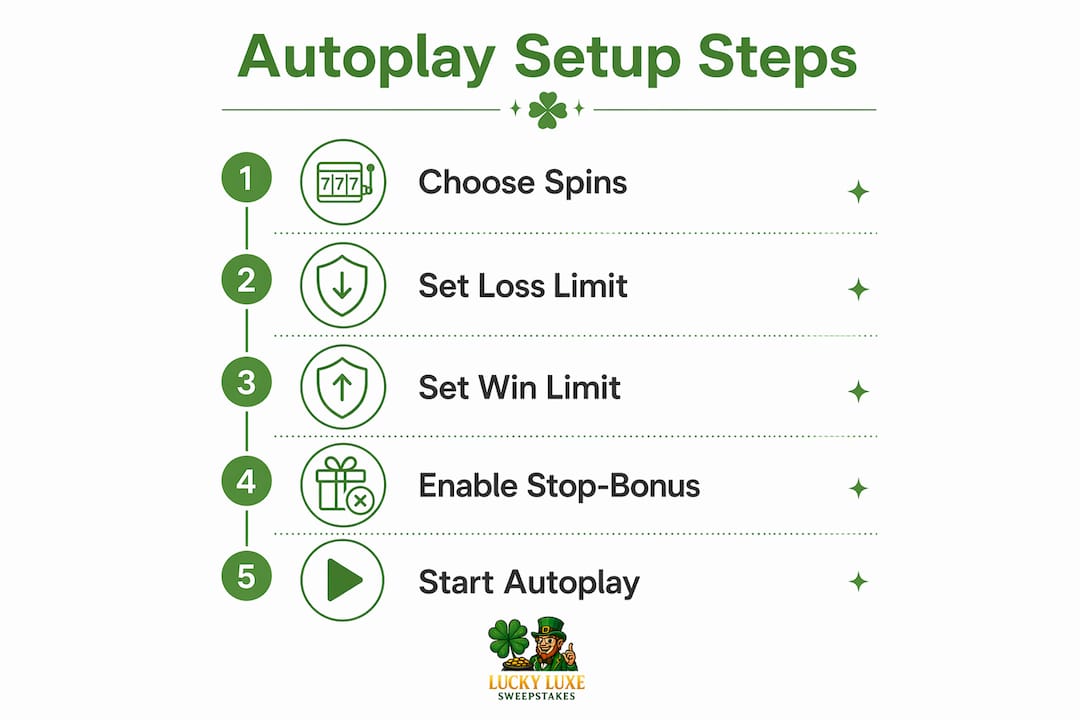
Spin count options
Most platforms offer preset spin counts ranging from 10 to 100 spins. Shorter counts work well when you are testing a new slot or playing a high-volatility title where swings are large. Longer counts suit low-volatility games where you expect steady, smaller wins over time.
Stop conditions you should always set
- Loss limit: Stops autoplay when your balance drops by a fixed amount. Set this before every session based on your total bankroll, not just what you feel comfortable losing in the moment.
- Win limit: Pauses autoplay when you hit a profit target. This locks in gains before a losing streak can erase them.
- Stop-on-bonus: Halts autoplay when a bonus round or free spins feature triggers. This lets you play interactive features manually, which is often where the biggest wins occur.
- Single-win limit: Stops the session if any single spin pays above a set threshold. Useful on high-volatility slots where one big hit can exceed your session goal.
- Balance drop limit: Ends autoplay if your balance falls below a specific floor, not just by a relative amount. This is a more precise version of the loss limit.
Pro Tip: Match your loss limit to the slot's volatility. On a high-volatility title, set a wider loss limit to avoid stopping autoplay during a normal dry spell. On a low-volatility game, a tighter limit is fine because swings are smaller.
What regulatory changes shaped autoplay in 2026?
Regulatory bodies across multiple jurisdictions banned Turbo Auto-Play and Slam Stops in late 2025 and into 2026. These features previously allowed spins to complete almost instantly, giving players no time to process each result. The bans exist to reduce dissociation, the state where players lose track of time, money, and outcomes during fast automated play.
The table below summarizes the key 2026 autoplay safeguards now mandatory in many regulated markets.
| Safeguard | What it does | Why it matters |
|---|---|---|
| Turbo Auto-Play ban | Removes excessively fast spin modes | Gives players time to process each result |
| Slam Stop ban | Prevents instant spin completion | Maintains minimum spin duration |
| Mandatory loss-limit stop | Halts autoplay at preset loss threshold | Prevents runaway spending |
| Loss-Limit Lock | Disables reactivation for 30–60 minutes after limit hit | Creates friction against impulsive restart |
| Real-time session display | Shows total time and net balance change | Keeps players aware of session progress |
| Minimum spin pace | Approximately 5 seconds per spin in most markets | Prevents dissociation from rapid cycling |
The Loss-Limit Lock is the most significant of these changes. Once you hit your preset loss threshold, autoplay cannot be reactivated on the same game for 30 to 60 minutes. This friction point stops impulsive decisions made in the heat of a losing streak. Regulations also now require platforms to display your session time and net balance change in real time during autoplay, so you always know where you stand.
What are the benefits and risks of autoplay in slots?
Autoplay paired with configured stop conditions makes longer sessions manageable without constant manual input. That convenience is real and worth using. The risks are equally real and worth understanding before you start.
Benefits
- Reduced fatigue: Autoplay removes repetitive clicking across hundreds of spins, letting you stay comfortable during longer sessions.
- Consistent pace: Automated spins run at a steady rhythm, which helps you track session length more accurately than erratic manual play.
- Efficient bonus hunting: On slots where bonus rounds trigger after a certain number of spins, autoplay gets you there without the grind of manual clicking.
- Preset boundaries: Stop conditions force you to define your limits before emotions enter the picture, which is a structural advantage over manual play.
Risks
- Faster losses: Autoplay cycles through your bankroll at a fixed pace. Without a loss limit, a bad run depletes funds faster than manual play where you might naturally slow down.
- Dissociation risk: Watching reels spin automatically can reduce your engagement with each outcome. Regulatory stop conditions exist specifically to counter this effect.
- Missed interactive features: Some bonus rounds require player input. Autoplay can trigger and then skip past these if stop-on-bonus is not enabled.
- False sense of control: Setting a spin count of 100 feels structured, but without loss and win limits attached, the spin count alone provides no real financial protection.
Best practices for using autoplay effectively
Autoplay settings are control tools, not gameplay strategies. The distinction matters. Autoplay does not improve your odds or change the game's math. It manages how you interact with the game over time.
Start every autoplay session with a spin count of 10 to 25 spins rather than jumping straight to 100. This keeps you engaged with the session and lets you reassess your limits after each short run. Once you are comfortable with a game's rhythm and volatility, you can extend the count gradually.
Use volatility awareness when setting your limits. Industry experts recommend using volatility meters and tight single-win limits on high-volatility slots to maintain session control. A high-volatility slot can go 50 spins without a meaningful win before paying out significantly. Setting a loss limit that is too tight on such a game will stop your session during a normal dry spell. Understanding bankroll management for slots before configuring autoplay makes every limit you set more meaningful.
Always enable stop-on-bonus. Interactive bonus rounds are where slot games deliver their most engaging moments and often their largest payouts. Letting autoplay run through a bonus round without pausing means you miss both the experience and the strategic choices some features offer.
Avoid unlimited autoplay sessions entirely. Even with loss limits in place, very long automated sessions reduce your awareness of how the session is progressing. Check your balance and session time at regular intervals, a habit that 2026 regulations now support by requiring platforms to display these metrics in real time.
Key takeaways
Autoplay in slot games automates spin triggering through the same RNG pathways as manual play, leaving RTP, volatility, and fairness completely unchanged, while 2026 regulations add mandatory safeguards that make the feature safer and more transparent than ever before.
| Point | Details |
|---|---|
| RNG integrity stays intact | Autoplay triggers spins identically to manual play; outcomes and RTP never change. |
| Intervention Layer protects you | Autoplay pauses within 44ms on jackpots or limit hits so you never miss a key event. |
| Configure all four stop conditions | Set loss limit, win limit, stop-on-bonus, and spin count before every session. |
| 2026 regulations add real protection | Loss-Limit Locks and real-time session displays are now mandatory in most regulated markets. |
| Start small, scale up | Begin with 10–25 spin counts to stay engaged, then extend once you know the game's rhythm. |
Why autoplay is more useful than most players realize
Most slot players treat autoplay as a lazy option, something you turn on when you want to step away from the screen. That framing undersells what the feature actually does when configured properly.
The real value of autoplay is that it forces you to make decisions about your session before emotions are involved. When you set a loss limit of $50 before the first spin, you are making that decision with a clear head. If you were playing manually and hit a bad run, the temptation to keep going is much harder to resist. Autoplay with a hard stop removes that temptation structurally.
The 2026 regulatory changes reinforce this point. The Loss-Limit Lock, the real-time balance display, the minimum spin pace. These are not restrictions on fun. They are tools that keep you in the driver's seat. Platforms that implement them well give you a more honest picture of your session than most manual play setups ever did.
My honest take is that autoplay is best used by players who have already spent time with a game manually. You need to understand a slot's volatility and bonus frequency before you can set meaningful limits. Jumping straight into 100-spin autoplay on an unfamiliar title is the one scenario where the feature genuinely works against you. Pair it with solid responsible gaming practices and it becomes one of the most useful tools in your session toolkit.
— Skyline
Autoplay-enabled slots at Luckyluxe
Luckyluxe offers a curated selection of autoplay-enabled slots built with configurable stop conditions, real-time session metrics, and responsible gaming tools integrated directly into the platform.
Every slot on Luckyluxe supports the full range of autoplay settings covered in this guide, including loss limits, win limits, and stop-on-bonus triggers. The platform displays your session time and net balance change in real time, giving you the transparency that 2026 regulations require. Whether you prefer short automated runs on high-volatility titles or longer sessions on steady low-volatility games, Luckyluxe gives you the controls to play on your terms. Browse the slots catalog and set up your first autoplay session with every limit in place.
FAQ
Does autoplay change a slot's RTP or odds?
Autoplay does not change RTP, variance, or paytable rules. Every automated spin runs through the same RNG as a manual spin, producing statistically identical outcomes.
What stop conditions should I always enable?
Set a loss limit, a win limit, and stop-on-bonus before every autoplay session. These three conditions define your session boundaries before emotions can influence your decisions.
What is the Loss-Limit Lock in 2026 autoplay regulations?
The Loss-Limit Lock disables autoplay reactivation on the same game for 30 to 60 minutes after you exceed your preset loss threshold. It acts as a mandatory cooling-off period in most regulated markets.
Is autoplay faster than manual play?
Autoplay in regulated 2026 markets runs at approximately 5 seconds per spin, which is similar to a steady manual pace. Turbo modes that allowed near-instant spins are banned in most jurisdictions.
When should I avoid using autoplay?
Avoid autoplay on a slot you have never played manually before. Without knowing a game's volatility and bonus frequency, you cannot set meaningful limits, which removes the main benefit of using the feature.