
Fair play certified slots are games independently tested and audited by third-party laboratories to verify that their random number generators, payout percentages, and game mechanics meet legally defined fairness standards. The industry term for this process is RNG certification, and knowing how to spot fair play certified slots separates informed players from those gambling blind. Labs like GLI (Gaming Laboratories International), eCOGRA, and iTech Labs are the three most recognized names in this space. Their seals on a game or casino site are the clearest signal that the slots you are playing have been held to a measurable standard, not just a marketing claim.
How to spot fair play certified slots: what certification actually means
Certification is not a quality badge. It is a legal and regulatory requirement in most licensed jurisdictions, and the process behind it is far more rigorous than most players realize.
When a developer submits a slot for certification, the lab receives the full game build, the mathematical model (called a PAR sheet), and complete documentation covering every rule, symbol behavior, and edge case. GLI certifies games across more than 480 jurisdictions worldwide, making it the most widely accepted testing authority in the industry. That reach matters because it means a GLI-certified slot has passed a consistent, internationally recognized standard.

The core of the process is RNG testing. Labs run the game's random number generator through statistical test suites, including NIST SP 800-22, which checks for patterns, biases, or predictability in the output. A slot that fails these tests does not get certified. Beyond the RNG, labs verify that the certified math matches the actual game math running in production. A mismatch between the approved mathematical model and the live game is grounds for certification failure, which protects players from games that perform differently than their stated RTP.
Audit logs are another layer of protection. Labs inspect these logs to reconstruct individual spins and detect anomalies that would not appear in aggregate statistics. This spin-level reconstruction is what separates genuine certification from a surface-level review.
Pro Tip: Ask the casino directly whether their slot library links to published audit reports. Legitimate platforms make these documents accessible, not buried in fine print.
Here is a breakdown of what the certification process covers:
| Certification element | What it checks |
|---|---|
| RNG testing (NIST SP 800-22) | Statistical randomness and absence of predictable patterns |
| PAR sheet review | Accuracy of stated RTP, symbol frequencies, and bonus math |
| Audit log inspection | Spin-level reconstruction to detect anomalies |
| Documentation completeness | Wild rules, Free Spins edge cases, and all game variants |
| Jurisdictional compliance | Legal requirements for each market the game enters |
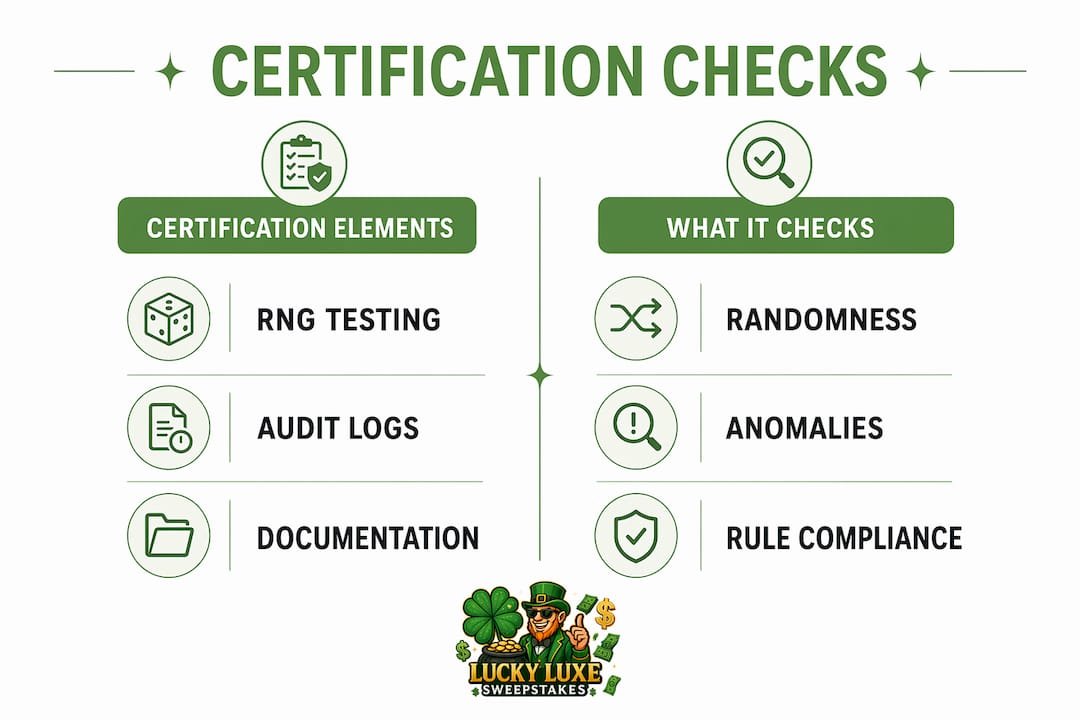
Documentation completeness is a detail most players never think about, but labs reject games where rules for Wild symbol behavior or Free Spins edge cases are inconsistently described. That rigor directly protects you from games with hidden mechanical quirks.
What are the practical steps to identify certified slots?
Spotting certified slot games on a casino platform takes about two minutes once you know what to look for. Here is the process in order:
- Check the casino's licensing page. Licensed casinos operating under the Malta Gaming Authority, the UK Gambling Commission, or the New Jersey Division of Gaming Enforcement are required to use certified games. Legitimate casinos publish RTP information and submit games for third-party testing as a condition of their license.
- Look for certification seals in the game lobby or footer. eCOGRA and GLI both issue visible seals that casinos display. Click the seal. A real seal links to a live verification page on the lab's official website. A static image with no link is a red flag.
- Check the individual game's info panel. Most certified slots display their RTP percentage and a certification reference in the game's paytable or information screen. An RTP above 96% with a named certifier attached is a strong indicator of a properly audited game.
- Search the lab's public database. GLI and eCOGRA maintain searchable registries of certified products. Enter the game name or developer to confirm the certification is current and not expired.
- For provably fair slots, use the built-in verification tool. Platforms like Stake and BC.Game offer user-friendly verification interfaces where you enter the seed values from your session to independently confirm the outcome was not manipulated.
Pro Tip: Cross-reference the RTP listed in the game with the RTP published in the casino's audit report. A discrepancy of more than 0.5% is worth investigating before you continue playing.
The secure gaming platforms guide from Luckyluxe covers additional methods for validating slot fairness, particularly for players on crypto and entertainment-focused platforms.
RNG-certified slots vs. provably fair slots: which is more transparent?
These two certification types serve the same goal through fundamentally different mechanisms. Understanding the difference helps you choose the right type of game for your priorities.
Traditional RNG-certified slots rely on post-release audits conducted by labs like GLI, eCOGRA, and iTech Labs. The player never sees the audit process. You trust the seal and the published RTP. The statistical test suites used are rigorous, but the verification happens invisibly, behind closed doors, before and after the game goes live.
Provably fair slots use cryptographic verification. Before each spin, the casino generates a server seed and the player generates a client seed. Both are hashed and combined to produce the outcome. After the spin, you can verify the result yourself using the seed values and a hash function. Cryptographic verification means you do not need to trust the casino's word. You can confirm the math independently.
The trade-offs are real:
- Traditional RNG slots offer thousands of titles from developers like NetEnt, Pragmatic Play, and Play'n GO, with rich graphics and complex bonus features.
- Provably fair slots tend to have smaller game libraries due to the technical complexity of integrating cryptographic verification into feature-heavy games.
- Many no-KYC crypto casinos combine both options, offering provably fair originals alongside licensed RNG-certified titles to cover both player preferences.
- Traditional certification requires trusting the lab's independence. Provably fair systems require trusting the cryptographic math, which is publicly verifiable.
For most players on regulated platforms, RNG-certified slots from GLI or eCOGRA-audited developers are the practical standard. Provably fair slots are the better choice when you want to verify outcomes yourself without relying on any third party.
Common pitfalls when verifying fair play certification
The biggest mistake players make is treating a certification seal as self-evident proof. Fake or misleading certification claims exist, and players should verify audits and seals directly with official lab websites rather than accepting casino marketing at face value.
Here are the most common traps to avoid:
- Static seals with no verification link. A real eCOGRA or GLI seal links to a live page. If clicking the seal does nothing, treat it as unverified.
- Expired certifications. Certifications have expiration dates. A casino displaying a seal from a 2019 audit without a renewal date has not confirmed its games meet current standards.
- Misusing the "provably fair" label. Some casinos apply this term loosely to games that use a basic RNG without any cryptographic verification interface. A genuinely provably fair game gives you the tools to verify outcomes yourself.
- Missing audit documentation. Transparent casinos link directly to audit reports in their responsible gaming or licensing sections. If you cannot find a published report, the certification may exist only in name.
- Unlicensed platforms with certification claims. A certification seal means nothing on a platform that holds no valid gaming license. The license is the legal framework that makes the certification enforceable.
"Players gain the most trust in slots when certifications come with publicly stated audit references and verification tools, avoiding reliance on unchecked casino claims." — Best Real Money Online Casinos for December 2026
The why fair play matters resource from Luckyluxe explains how published audit reports reduce the risk of deceptive marketing and what to look for in a transparent gaming platform.
Key takeaways
Spotting fair play certified slots requires checking for active certification seals from GLI, eCOGRA, or iTech Labs, verifying published RTP data, and confirming the casino holds a valid gaming license.
| Point | Details |
|---|---|
| Certification is legally required | Licensed casinos under MGA or UKGC must use independently tested, certified slot games. |
| GLI covers 480+ jurisdictions | GLI certification is the most globally accepted standard for slot game fairness. |
| Seals must link to live verification | A static seal image with no clickable verification link is not confirmed certification. |
| Provably fair offers direct verification | Cryptographic seed-based systems let players verify outcomes without trusting any third party. |
| Fake certification claims exist | Always cross-check seals on the official lab website before trusting a casino's claim. |
Why certification rigor matters more than players think
I have spent years watching players focus entirely on RTP percentages while ignoring the certification infrastructure that makes those numbers meaningful. A stated RTP of 97% is worthless if the game math running in production does not match the certified model the lab approved. That gap is exactly what GLI's certified math verification process is designed to catch, and it is the reason I always check whether a game's certification is current, not just present.
The shift toward provably fair slots is genuinely exciting, but I think the industry overstates how accessible the verification process is for average players. Most people are not going to hash seed values after every session. What provably fair systems actually deliver is accountability. Knowing the tools exist changes how casinos behave, even if most players never use them.
My honest advice: prioritize casinos that publish their audit reports in a format you can actually read, not just display a seal. The difference between a casino that links to a live eCOGRA report and one that posts a static logo tells you everything about how seriously they take transparency. The independent testing agencies behind these certifications have real teeth, but only when players know to look for their work.
— Skyline
Play certified slots with confidence at Luckyluxe
Luckyluxe is built around the principle that every player deserves to know their games are fair before they place a single bet. The platform features a curated selection of certified slot games audited by recognized third-party labs, with RTP data and certification references available directly in the game interface.
Whether you prefer high-RTP slots from established developers or want to explore the platform's arcade and fishing game options, Luckyluxe publishes the information you need to play with confidence. The referral program and regular promotional highlights give you more ways to maximize your sessions. Register at Luckyluxe today and start playing games you can actually verify.
FAQ
What does a fair play certification seal actually confirm?
A fair play certification seal from labs like GLI or eCOGRA confirms that the game's RNG has passed statistical testing, the stated RTP matches the certified mathematical model, and the game meets the regulatory requirements of its licensed jurisdiction.
How do I verify a certification seal is real?
Click the seal on the casino's website. A legitimate seal links to a live verification page on the lab's official website, such as eCOGRA.org or gaminglabs.com, where you can confirm the certification is current and valid.
What is the difference between RNG-certified and provably fair slots?
RNG-certified slots are audited by independent labs before and after release, with results invisible to players. Provably fair slots use cryptographic hashing and seed values that players can verify themselves after each spin, offering direct outcome transparency.
Can a casino display a certification seal without being certified?
Yes. Fake or misleading certification claims exist, which is why players should always click the seal to confirm it links to a live lab verification page and check that the casino holds a valid gaming license from a recognized authority.
What RTP should I expect from a certified slot?
Certified slots from reputable labs frequently carry RTP values above 96%, though the exact figure varies by game. Always check the RTP in the game's information panel and cross-reference it with the casino's published audit documentation.