

A responsible gaming tool is a player-protection feature built into gambling platforms that lets you set limits, monitor your play, and block access when needed. The UK Gambling Commission requires these features as part of operator licensing conditions, making them a regulatory standard rather than a bonus feature. The most common tools include deposit limits, session time limits, reality checks, cooling-off periods, and self-exclusion. This guide covers every major type, explains how they fit into responsible gambling practices, and shows you exactly how to use them to stay in control.
What is a responsible gaming tool and how does it work?
Responsible gaming tools are software features embedded directly into gambling platforms to give players control over their betting behavior. They operate across three stages of play: before you start (setting deposit or session limits), during play (reality checks and time alerts), and after a session (account history reviews). This workflow design means the tools support mindful gambling at every point in your session, not just when things go wrong.

Spend and deposit limits
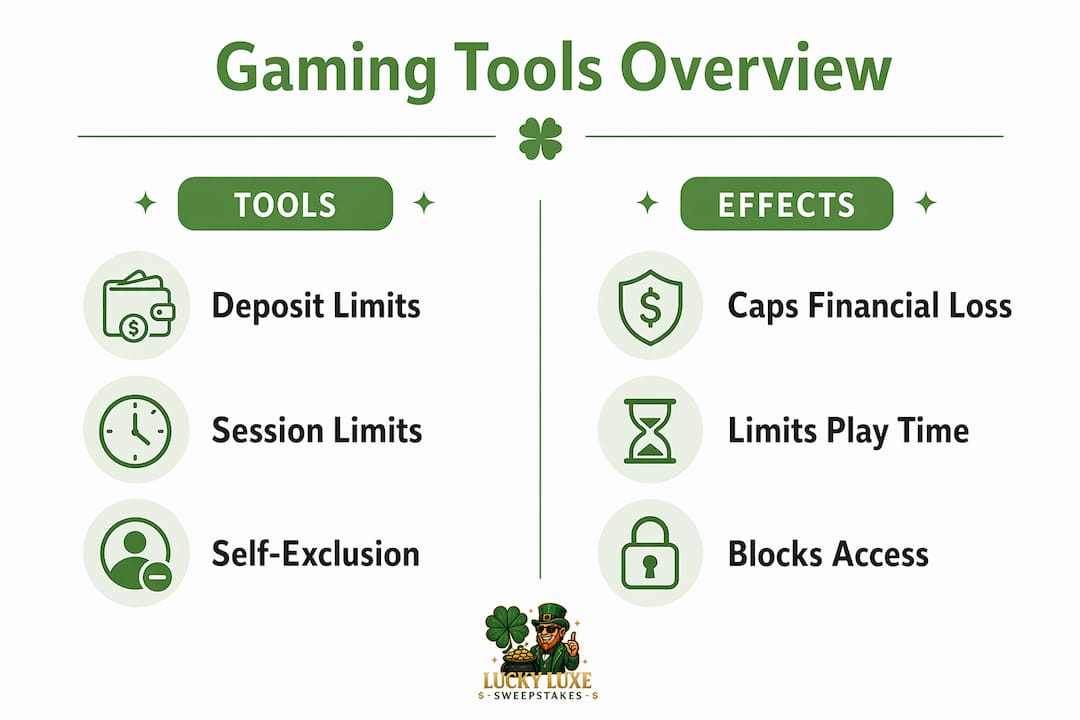
Deposit limits cap how much money you can add to your account within a set period, typically daily, weekly, or monthly. Once you hit that ceiling, the platform blocks further deposits until the period resets. This is the most widely used tool because it directly controls the financial exposure of your gambling activity.
Cooling-off periods work alongside deposit limits. If you want to lower your limit, the change takes effect immediately. If you want to raise it, most platforms impose a waiting period of 24 to 72 hours. That delay is deliberate behavioral design: it creates friction that interrupts impulsive decisions to spend more.
Session and time limits
Session limits cut off your play after a set amount of time, regardless of whether you are winning or losing. Reality checks are a softer version of the same idea. A reality check notification pops up at intervals you choose, showing how long you have been playing and sometimes how much you have spent. The Jerusalem Post describes these as tools designed to pause gameplay and return the decision of whether to continue back to the player.
Self-exclusion and time-outs
Self-exclusion is the strongest tool available. It is a formal, voluntary agreement that removes your access to gambling for a fixed period, ranging from months to years. The NSW Government describes self-exclusion enforcement as involving signed agreements and venue-level bans that operators are legally required to respect. This is not a simple account setting you can reverse with a few clicks. It is a documented intervention.
Time-outs are a lighter alternative. They block access for a short period, typically 24 hours to a few weeks, without the formal documentation of full self-exclusion. Use a time-out when you want a short break. Use self-exclusion when you recognize a pattern that needs a harder stop.
| Tool | Duration | Effect | Reversible? |
|---|---|---|---|
| Deposit limit | Daily / weekly / monthly | Caps financial input | Yes, with delay to increase |
| Session limit | Per session | Ends play at set time | Yes |
| Reality check | Customizable intervals | Prompts reflection mid-session | Yes |
| Time-out | 24 hours to a few weeks | Blocks account access | Yes, after period ends |
| Self-exclusion | Months to years | Formal access removal | No, until period expires |
Pro Tip: Never request a limit increase in the same session where you feel the urge to keep playing. The cooling-off delay exists precisely for that moment. Step away, and revisit the decision the next day.
How responsible gaming tools fit into harm reduction
Responsible gaming tools do not operate in isolation. They sit inside a broader harm-reduction framework that places shared responsibility on players, operators, regulators, and support organizations. The UK Gambling Commission's social responsibility conditions require operators to actively monitor player behavior and intervene when risk indicators appear, not just provide tools and wait.
"Operators must interact with customers in a way that minimizes the risk of customers experiencing harms associated with gambling." — UK Gambling Commission licensing conditions
That quote matters because it shifts the obligation beyond simply offering a settings menu. Operators are expected to detect patterns like extended play sessions, rapid deposit sequences, or repeated failed self-exclusion attempts, and then act on them. This means the tools you set are backed by a layer of operator monitoring you may never see directly.
Responsible gambling practices at the regulatory level also include age verification, transparent marketing, and accountability standards that protect players before they even log in. The tools you interact with are the visible layer of a much larger compliance structure.
The key limitation to understand is that tools require your cooperation to work. A deposit limit only protects you if you set one. A reality check only helps if you respond to it honestly. The harm-reduction framework is collaborative by design. Operators and regulators provide the infrastructure, but you activate it.
How to use gaming tools to manage your gambling
Using gaming self-control tools effectively starts before you deposit a single dollar. The most common mistake players make is setting limits reactively, after a losing session, rather than proactively based on their actual budget. Set your deposit limit to match what you would genuinely be comfortable losing in a month, not what you hope to win back.
Here is a practical sequence for setting up your tools on any platform:
- Set a monthly deposit limit first. This is your financial ceiling. Everything else builds on it.
- Add a session time limit. Decide in advance how long a single session should last. Thirty to sixty minutes is a reasonable starting point for most players.
- Turn on reality checks. Set them to trigger every 20 to 30 minutes. The interruption feels minor but consistently returns your attention to how long you have been playing.
- Review your account history weekly. Most platforms provide a transaction and session log. Use it. Patterns in your data are more honest than your memory.
- Use a time-out proactively. If you notice you are chasing losses or playing past your session limit, activate a time-out before the next session, not during it.
Pro Tip: Combine at least two tools simultaneously. A deposit limit alone does not stop you from playing for six hours on a small balance. Pair it with a session limit to address both the financial and time dimensions of your play.
The benefits of gaming tools multiply when you treat them as a system rather than individual switches. A deposit limit controls money. A session limit controls time. A reality check controls awareness. Together, they cover the three main vectors through which gambling can escalate beyond your intentions.
Common pitfalls to avoid:
- Requesting a limit increase immediately after a loss
- Disabling reality checks because they feel disruptive
- Using a time-out but switching to a different platform during the break
- Setting limits so high they provide no real constraint
- Treating self-exclusion as a temporary inconvenience rather than a serious commitment
What are the benefits and limitations of responsible gaming tools?
The core benefit of responsible gaming tools is that they return decision-making power to you at moments when emotion might otherwise take over. Deposit limits remove the option to overspend impulsively. Session limits prevent the kind of extended play that research consistently links to higher harm risk. Reality checks interrupt the flow state that makes time disappear at a slot machine.
Operators also benefit from behavioral monitoring systems that flag at-risk players and trigger interventions. This means the platform is actively working alongside your personal tool settings to reduce harm, not just recording it.
The limitations are real and worth understanding clearly. No tool eliminates addiction risk on its own. A player determined to circumvent a deposit limit can open accounts on multiple platforms. Self-exclusion enforcement varies by jurisdiction, and compliance gaps exist in some regions. Tools are most effective for players who are already motivated to manage their gambling. For players with a clinical gambling disorder, professional support from organizations like the National Council on Problem Gambling or Gamblers Anonymous is necessary alongside any platform-level tool.
| Benefit | Limitation |
|---|---|
| Caps financial loss through deposit limits | Only works if limits are set realistically |
| Interrupts extended play with session limits | Players can ignore or disable some alerts |
| Builds self-awareness through account history | Does not prevent play on other platforms |
| Self-exclusion provides formal, enforceable protection | Enforcement varies by jurisdiction |
| Operator monitoring adds a safety layer | Monitoring cannot catch every risk indicator |
One misconception worth correcting directly: self-exclusion is not a preference setting. It is a formal intervention backed by signed documentation and legal obligations on the operator. Treating it as something you can casually undo undermines the protection it is designed to provide.
Key takeaways
Responsible gaming tools work best as a coordinated system of deposit limits, session controls, and behavioral monitoring rather than as isolated features.
| Point | Details |
|---|---|
| Definition of the tool | A built-in platform feature that lets players set financial, time, and access limits. |
| Regulatory requirement | The UK Gambling Commission mandates these tools as part of operator licensing conditions. |
| Most powerful tool | Self-exclusion is a formal, enforceable intervention, not a simple account toggle. |
| Best usage practice | Combine at least two tools and set limits proactively, before your next session. |
| Core limitation | Tools require player cooperation and do not replace professional support for addiction. |
Why I think most players underestimate these tools
Most players scroll past the responsible gaming settings menu without a second thought. That is a mistake I have seen play out repeatedly. The behavioral design behind these tools is genuinely sophisticated. The deliberate friction built into limit increases, where you can lower a limit instantly but must wait days to raise it, is not bureaucratic inconvenience. It is one of the most effective impulse-control mechanisms in consumer software.
What strikes me most is how few players use reality checks despite them being the least intrusive tool available. A 20-minute pop-up that shows your session time costs you nothing and consistently breaks the concentration that makes time disappear. Players who use fair play certified platforms tend to engage with these features more because the platform culture treats them as normal, not as warnings for problem gamblers.
The ethical responsibility here is shared. Operators who bury the settings menu in a sub-menu of a sub-menu are not meeting the spirit of their licensing obligations, even if they technically comply. And players who set limits so high they mean nothing are not using the tools honestly. The framework works when both sides take it seriously. My honest view is that players who engage with these tools proactively, before they ever feel the need to, get the most out of their gambling experience. Control and enjoyment are not opposites.
— Skyline
Play smarter with Luckyluxe
Luckyluxe builds responsible gaming features directly into the platform so you can enjoy slots, fishing games, and arcade titles without losing track of your limits. The platform's support resources and account controls are accessible from your dashboard, not buried in a settings maze.
Whether you are setting your first deposit limit or exploring secure gaming platforms that take player protection seriously, Luckyluxe gives you the tools to play on your own terms. Visit Luckyluxe to set up your account controls and start your next session with a clear plan in place.
FAQ
What is a responsible gaming tool?
A responsible gaming tool is a built-in platform feature that lets players set deposit limits, session time limits, reality checks, and self-exclusion to manage their gambling behavior. The UK Gambling Commission requires operators to provide these tools as part of their licensing conditions.
How does self-exclusion differ from a time-out?
Self-exclusion is a formal, documented intervention that blocks access for months or years and requires operator compliance. A time-out is a shorter, reversible break typically lasting 24 hours to a few weeks.
Can I change my limits after I set them?
You can lower limits immediately on most platforms, but raising them requires a cooling-off delay of 24 to 72 hours. This delay is a deliberate design choice to reduce impulsive limit increases.
Do responsible gaming tools prevent gambling addiction?
No. These tools reduce harm and support self-control, but they do not eliminate addiction risk on their own. Players with a gambling disorder should seek professional support from organizations like the National Council on Problem Gambling alongside using platform tools.
What is responsible gambling as a broader concept?
Responsible gambling refers to a shared framework involving players, operators, and regulators working together to minimize gambling-related harm through tools, monitoring, transparent marketing, and age verification standards.