

Smooth payment processing is the system that moves money from a customer to a merchant securely, quickly, and with minimal friction at every step. The industry term for this end-to-end flow is payment processing, and "smooth" describes how well each stage performs without errors, delays, or failed transactions. 92% of US businesses now use faster payment methods like instant payments, same-day ACH, or digital wallets. That adoption rate shows how central efficient payment systems have become to staying competitive. Standards like ISO 20022 and networks like FedNow have raised the bar for what merchants and customers expect from every transaction.
What is smooth payment processing, and how does it work?
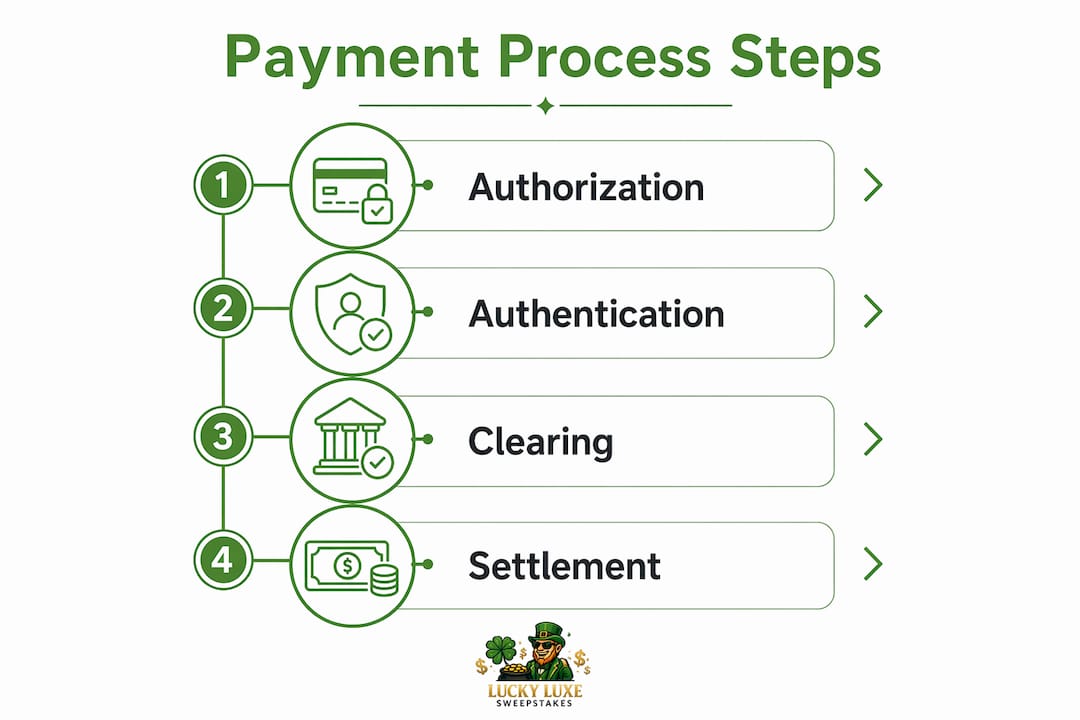
Smooth payment processing covers four core steps: authorization, authentication, clearing, and settlement. Each step must complete correctly for a transaction to succeed. A failure at any stage creates friction for the customer and a potential revenue loss for the merchant.
Authorization happens in under a second. The payment network checks whether the customer's card or account has sufficient funds and flags any fraud signals. Authentication confirms the customer's identity, often through 3D Secure protocols or biometric checks on mobile wallets. Clearing is the exchange of transaction data between the acquiring bank (your bank) and the issuing bank (the customer's bank). Settlement is when funds actually move into your account.

Standard settlement takes 24–48 hours, while instant payment networks like FedNow and TIPS settle in under 100 milliseconds. That gap matters for cash flow. A business running on tight margins cannot afford to wait two days for funds from a high-volume sale day.
Payment processors sit between you and the card networks. They route transaction data, handle encryption, and manage PCI DSS compliance requirements. PCI DSS (Payment Card Industry Data Security Standard) is the global security baseline every merchant must meet to accept card payments. Tokenization replaces sensitive card numbers with a unique token during transmission, so even if data is intercepted, it carries no usable value.
Pro Tip: If your processor supports FedNow or RTP (Real-Time Payments) rails, enable them for B2B invoices. Instant finality removes the "check is in the mail" problem entirely.
What makes payment processing smooth? Key factors beyond speed
Speed alone does not define a smooth payment experience. Predictability, meaning immediate finality with no economic uncertainty, matters just as much for businesses managing working capital and supplier relationships. A payment that settles in two days but always settles on time is more valuable than an instant payment that occasionally fails or reverses.
The ISO 20022 messaging standard is the clearest example of how data quality drives smoothness. ISO 20022 allows payment messages to carry rich, structured data, including invoice references, remittance details, and counterparty identifiers. That structured data reduces manual repair work and cuts inquiry costs, especially in cross-border or high-value transactions.
Four factors consistently separate smooth payment systems from unreliable ones:
- Data hygiene. Mismatched billing addresses and invalid card details are the leading cause of soft declines. Automated address verification (AVS) and card validation checks catch these errors before they reach the network.
- Intelligent routing. Dynamic payment rail selection picks the best network path for each transaction based on cost, speed, and success rate. Static single-channel routing misses this optimization entirely.
- Interoperability. Your payment system must communicate cleanly with the customer's bank, your accounting software, and any third-party platforms you use.
- Staff training. A truly smooth payment experience requires well-trained staff who can resolve exceptions quickly, not just technology running in the background.
Pro Tip: Run a monthly audit of your soft decline codes. Patterns in decline reasons reveal specific data hygiene or routing problems you can fix without changing your processor.
How does interoperability improve payment acceptance rates?
Interoperability is the ability of different payment systems to exchange and process transactions with each other. Without it, merchants face closed-loop systems where a customer using one digital wallet cannot pay a merchant set up for a different one. That fragmentation directly reduces your acceptance rate.
Closed-loop systems keep transactions inside one network, like a store-branded gift card. Open-loop systems, like Visa or Mastercard, work across any participating merchant and bank. Most modern payment strategies favor open-loop infrastructure because it maximizes the number of customers you can accept payments from.
Integrating fragmented payment services increases digital payment usage by over 50% in one year. That figure reflects what happens when previously siloed networks connect. Customers who could not pay before can now complete transactions, and merchants capture revenue they were previously losing.
The practical challenge is technical integration. Each payment rail, whether ACH, RTP, card networks, or digital wallets, uses different data formats and settlement timelines. ISO 20022 adoption helps here because it creates a common data language across networks. Merchants who build their payment stack around ISO 20022-compatible processors are better positioned as more networks migrate to the standard.
| System type | Settlement speed | Interoperability | Best use case |
|---|---|---|---|
| Card networks (Visa, Mastercard) | 24–48 hours | High (open-loop) | Retail, e-commerce |
| ACH (same-day) | Same day | Medium | Payroll, B2B invoices |
| RTP / FedNow | Under 100ms | Growing | Urgent B2B, gig economy |
| Digital wallets | 1–2 days | Varies by provider | Mobile, in-app purchases |
Practical strategies to reduce payment failures and speed up settlements
Reducing payment failures starts with your data, not your processor. Inconsistent customer data like mismatched billing addresses causes the majority of soft declines. Soft declines are recoverable errors where the transaction is declined not because of fraud or insufficient funds, but because of a data mismatch. Fixing them is largely a configuration problem.
Here are the most effective steps merchants can take:
- Enable automated address verification and card validation at checkout. These checks run in milliseconds and catch the most common soft decline triggers before the transaction reaches the network.
- Use intelligent routing for high-value or international transactions. Dynamic routing selects the payment rail with the highest success rate for each transaction type, reducing declines and lowering processing costs.
- Integrate your payment processor directly with your accounting or ERP system via API. Reconciliation automation reduces the time spent on manual error correction significantly, freeing your finance team for higher-value work.
- Offer multiple payment methods. Customers who cannot pay with their preferred method abandon the transaction. Supporting card networks, digital wallets, and instant payment options covers the widest range of customer preferences.
- Train your support staff on common payment exceptions. A customer whose card is declined needs a fast, clear resolution path. Staff who understand decline codes can guide customers to retry with corrected information rather than losing the sale.
For merchants managing referral programs or withdrawal flows, understanding referral withdrawal conditions is equally important. Payment friction at the withdrawal stage damages trust just as much as a failed purchase transaction.
The secure gaming platforms sector offers a useful model here. Platforms in that space have built multi-rail payment stacks that handle deposits, withdrawals, and bonus credits across different payment methods without manual intervention. That architecture is directly applicable to any merchant handling recurring or high-frequency transactions.
Key takeaways
Smooth payment processing depends on data quality, intelligent routing, and interoperability working together, not on speed alone.
| Point | Details |
|---|---|
| Speed vs. predictability | Immediate finality matters as much as transaction speed for cash flow management. |
| ISO 20022 adoption | Structured data messaging reduces manual errors and supports cross-border payment clarity. |
| Data hygiene first | Fixing mismatched billing data eliminates the majority of soft declines before they reach the network. |
| Interoperability drives volume | Connecting fragmented payment services can increase digital payment usage by over 50% in one year. |
| Automation saves time | API-based reconciliation with accounting software cuts manual correction work significantly. |
The metric most merchants ignore
Speed gets all the attention in payment processing discussions. Merchants ask about settlement times, instant payment rails, and checkout load speeds. Those metrics matter. But after watching payment operations across multiple business types, the single biggest driver of failed transactions is not slow technology. It is bad data.
A customer enters a billing address that does not match their card record. The transaction fails. The customer blames the merchant. The merchant blames the processor. The actual fix takes five minutes of configuration in an address verification system. That gap between the real problem and where merchants look for it costs real revenue every day.
Predictability is the second underrated metric. Businesses that switch to instant payment rails often focus on the speed gain. The more valuable benefit is knowing a payment is final the moment it settles. No chargebacks on already-shipped goods. No float risk on large invoices. That certainty changes how you manage inventory, supplier payments, and working capital.
The future of smooth payment processing is not faster rails. It is cleaner data flowing across more interoperable networks, with less human intervention required at every step. Merchants who invest in data hygiene and ISO 20022-compatible infrastructure now will find the transition to next-generation payment networks far less disruptive.
— Skyline
Luckyluxe and the payment experience your customers expect
Luckyluxe has built its platform around the principle that payment friction kills engagement. Every deposit and withdrawal on the Luckyluxe platform is designed to complete with minimal steps, clear confirmation, and fast settlement, so players spend time on games, not on troubleshooting transactions.
Whether you are managing high-frequency microtransactions or larger withdrawals through a referral program, Luckyluxe's payment infrastructure handles the complexity behind the scenes. The platform supports multiple payment methods, automated verification, and real-time transaction status updates. Merchants and platform operators looking for a proven model of low-friction payment design will find Luckyluxe worth studying closely.
FAQ
What is smooth payment processing in simple terms?
Smooth payment processing is a system that moves money from a customer to a merchant quickly, securely, and without errors. It covers authorization, clearing, and settlement with minimal manual intervention.
How long does smooth payment processing take?
Standard card processing settles in 24–48 hours. Instant payment networks like FedNow and TIPS settle in under 100 milliseconds, making them the fastest option for time-sensitive transactions.
What causes payment processing to fail?
The most common cause is data mismatch, such as a billing address that does not match the card record. Automated address verification and card validation checks prevent most of these soft declines before they reach the network.
What is ISO 20022 and why does it matter?
ISO 20022 is a global messaging standard that lets payment systems exchange rich, structured data. It reduces manual repair work and supports cleaner interoperability across banks, processors, and payment networks.
How can merchants reduce declined transactions?
Merchants reduce declines by enabling address verification, using intelligent routing to select the best payment rail per transaction, and training staff to resolve common payment exceptions quickly.