

Single sign-on (SSO) gaming is defined as a unified authentication system that lets players log in once with a single credential set and gain access to multiple games, platforms, and services without re-entering passwords. The industry term is SSO, and it already powers platforms you use daily. Steam, Xbox, and Google all function as SSO providers when you use them to log into third-party games. The core appeal is straightforward: one account, one login, full access. For gamers managing accounts across PC, mobile, and console, SSO removes one of the most persistent friction points in modern gaming.
What is single sign-on gaming and how does it work?
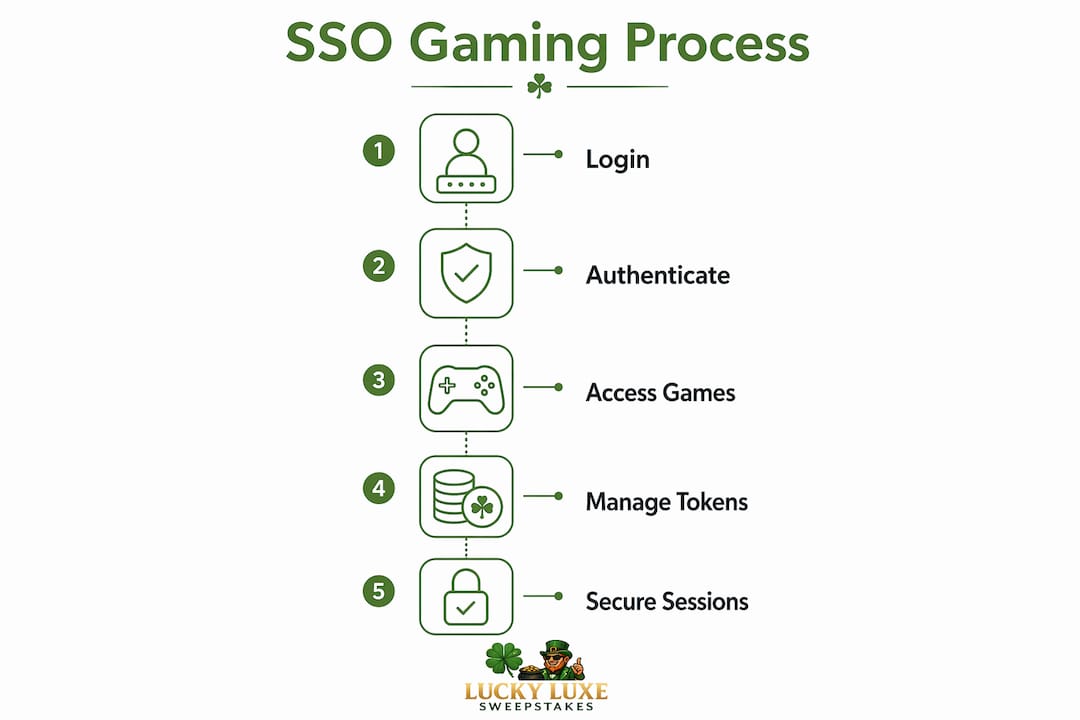
SSO in gaming operates through a token-based authentication flow. When you log into a platform like Steam or Xbox, the system generates a secure authentication token that proves your identity. That token is then passed to any connected game or service, which accepts it without asking you to log in again. According to FusionAuth's SSO documentation, SSO supports traditional email and password credentials, social logins through Google, Apple, and Facebook, and emerging passwordless options like biometrics.
Here is how the process works in a typical gaming session:
- You open a game client or platform and enter your credentials once.
- The identity provider (Steam, Xbox, Google) verifies your login and issues a session token.
- The token is shared with connected services, such as a cloud gaming platform or a game's companion app.
- Each connected service validates the token rather than requesting a new login.
- When the session expires, you log in once more and the cycle resets.
A real-world example: Gaijin Entertainment's integration with GeForce NOW allows players to launch games instantly without re-authenticating between the desktop client and the cloud streaming session. That single handshake replaces what used to be two separate logins. GAIMIN's Web3 platform takes this further, using SSO to unify access across gaming, esports, and cloud services through one account, blending blockchain infrastructure with a familiar login experience.
Pro Tip: If you use Google or Apple to sign into games, you are already using SSO. Check which account you used to register so you never lose access when switching devices.

What are the benefits of single sign-on for gamers and developers?
SSO delivers measurable advantages on both sides of the screen. For players, the most immediate benefit is speed. You skip the login screen and get into the game faster. For developers and platform operators, the gains are operational and financial.
Here is what SSO concretely delivers:
- Reduced login friction. Players access games without hunting for forgotten passwords. This matters most in cloud gaming, where session startup time directly affects satisfaction.
- Simplified account management. One account holds your profile, preferences, inventory, and rank across PC, mobile, and console. Gaming companies adopt SSO specifically to enable cross-platform data sync and reduce customer support costs.
- Centralized multi-factor authentication (MFA). Instead of setting up MFA on every individual game account, you configure it once on your master account. Every connected service inherits that protection automatically.
- Lower support costs. Modern authentication reduces password support tickets by 63%, which means fewer help desk interactions for both players and operators. That is a direct cost reduction with no trade-off in user experience.
- Preserved game progression. Your competitive rank, in-game inventory, and settings follow you across devices because they are tied to one identity, not a device-specific account.
The security benefit deserves special attention. Gaming accounts hold real monetary value through virtual items, currencies, and subscriptions. Centralized MFA enforcement through SSO makes account takeovers significantly harder than the fragmented model where each game manages its own password policy. For developers, Microsoft Entra ID represents the enterprise-grade approach to this problem, providing centralized identity management at the scale gaming studios require.
What security considerations come with SSO gaming?
SSO creates one critical vulnerability: a single point of failure. If your master account is compromised, every connected game and service becomes accessible to the attacker. This is not a reason to avoid SSO. It is a reason to secure your primary account with the same seriousness you would apply to a bank account.
The key security practices every SSO gamer should follow:
- Enable MFA on your master account immediately. SSO handles convenience while MFA verifies identity. The two work together, not as alternatives.
- Use an authenticator app rather than SMS. Apps like Google Authenticator or Authy generate time-based codes that cannot be intercepted through SIM-swapping attacks.
- Bind guest accounts to a permanent credential. Guest accounts in SSO systems are often temporary. Failure to link an official account may result in permanent loss of progress after a reinstall or data clearance.
- Monitor connected apps regularly. Review which services have access to your SSO account and revoke permissions for games you no longer play.
- Consider biometric options where available. Fingerprint and face recognition add a second layer without adding friction.
Token management is another area worth understanding. The authentication token issued during SSO login has a lifecycle. Expired or improperly handled tokens can cause unexpected account lockouts or, in worst cases, unauthorized access if tokens are intercepted. Reputable platforms handle token expiration automatically, but you should log out of shared devices to force token invalidation.
Pro Tip: Treat your Steam, Xbox, or Google account password like a master key. Use a unique, 16-plus character password stored in a password manager, and never reuse it anywhere else.
How does SSO shape the future of cloud and VR gaming?
The next phase of SSO in gaming is being driven by three forces: cloud gaming infrastructure, Web3 ecosystems, and spatial computing.
| Authentication method | Current state | Future direction |
|---|---|---|
| Password-based SSO | Standard across Steam, Xbox, Google | Being phased out in favor of passkeys |
| Social login SSO | Widely adopted on mobile and PC | Expanding to console and cloud platforms |
| Biometric SSO | Available on mobile, limited on console | Becoming default in VR and spatial computing |
| Blockchain SSO | Early adoption in Web3 gaming (GAIMIN) | Scaling across decentralized game ecosystems |
| Passkey authentication | Emerging standard | Replacing passwords entirely within 3 to 5 years |
Cloud gaming platforms benefit from SSO in a specific way: they eliminate the authentication delay between launching a streaming session and entering gameplay. When Gaijin Entertainment connected to GeForce NOW, the single authentication handshake replaced two separate login steps, reducing the time between clicking play and actually playing.
In VR and spatial computing environments, typing a password on a virtual keyboard is genuinely disruptive. Biometric SSO methods like iris scans solve this by authenticating through physical presence rather than typed credentials. This is not a distant concept. Headset manufacturers are already integrating biometric authentication as a standard feature.
The Web3 angle is equally significant. GAIMIN's platform demonstrates that SSO can span blockchain-based services and traditional gaming infrastructure simultaneously. One account authenticates you across esports tournaments, cloud compute services, and game libraries. As more studios explore on-chain assets and decentralized economies, SSO becomes the connective layer that makes those ecosystems usable rather than technically intimidating. Gaming identity is evolving from a per-game credential into a portable, persistent digital identity.
Key takeaways
SSO in gaming is the most practical way to balance fast access with strong security, provided you protect your master account with MFA and a strong, unique password.
| Point | Details |
|---|---|
| Core SSO definition | One credential set grants access to multiple games and platforms without repeated logins. |
| Token-based authentication | SSO issues a session token after one login; connected services validate that token automatically. |
| Security requires MFA | SSO alone creates a single point of failure; pairing it with MFA closes that vulnerability. |
| Cross-platform sync | SSO preserves rank, inventory, and settings across PC, mobile, and console through one identity. |
| Biometrics are next | VR and spatial computing are accelerating the shift from passwords to biometric SSO authentication. |
Why SSO is the login system gamers should stop ignoring
I have managed gaming accounts across more platforms than I care to count. Before SSO became standard, the routine was predictable: forget a password, trigger a reset, wait for an email, lose ten minutes before even loading a game. Multiply that across six platforms and it becomes a genuine barrier to actually playing.
What changed my perspective was not convenience alone. It was watching a friend lose a decade of progress on a mobile game because he had used a guest account and never linked it to an email. The account binding requirement exists precisely to prevent that outcome, and most players ignore it until it is too late.
SSO done right means you log in once, your identity travels with you, and your security is concentrated where you can actually manage it. The mistake I see most often is treating SSO as a reason to relax security rather than a reason to concentrate it. Your Steam or Xbox account is now the front door to everything. Lock it accordingly.
The platforms moving toward secure gaming authentication with biometrics and passkeys are not overcomplicating things. They are responding to the reality that gaming accounts hold real value and deserve real protection. Embrace SSO, enable MFA, and stop treating your master password as an afterthought.
— Skyline
Experience SSO-powered gaming at Luckyluxe
Luckyluxe is built for players who want to spend time gaming, not managing accounts. The platform gives you access to slots, fishing games, and arcade titles through a single account, so you move between games without interruption. Luckyluxe's easy platform navigation means your progress, preferences, and promotional offers are always where you left them. New players can explore the full game library, claim featured promotions, and use the referral program from day one. Visit Luckyluxe to create your account and see how unified access changes the way you play.
FAQ
What is single sign-on gaming in simple terms?
Single sign-on gaming lets you log in once with one account, such as a Google or Steam account, and access multiple games and services without entering credentials again. The system uses a secure token to verify your identity across connected platforms.
Is SSO gaming safe to use?
SSO is safe when paired with multi-factor authentication on your master account. Without MFA, a compromised primary account exposes every connected game and service simultaneously.
What platforms support SSO for gaming?
Steam, Xbox, Google, and Apple all function as SSO providers for gaming. Platforms like GeForce NOW and GAIMIN have implemented SSO to unify access across cloud gaming and Web3 services.
What happens if I use a guest account instead of SSO?
Guest accounts are typically temporary. If you do not link your guest account to a permanent email or social login, you risk losing all game progress permanently after a reinstall or data reset.
Will passwords disappear from gaming entirely?
Passkeys and biometric authentication are replacing passwords in gaming at an accelerating pace. VR and spatial computing environments are driving this shift because typing passwords on virtual keyboards disrupts immersion.