

Cluster pay slots are defined as slot games where wins form from groups of adjacent matching symbols on a grid, replacing traditional fixed paylines entirely. Instead of lining up symbols across set rows, you need a minimum cluster of symbols touching horizontally or vertically, with most games requiring between 4 and 9 connected symbols to trigger a payout. Common grid sizes run 5x5, 6x6, and 7x7, giving far more positions than a standard 5-reel, 3-row slot. The cascading (avalanche) mechanic is the signature feature: winning symbols disappear and new ones fall in, creating chain reactions from a single spin. Cluster pay slot machines have surged in popularity across online and crypto casino platforms, driven by demand for faster, more dynamic gameplay.
How do cluster pay slots work?
The cluster pay mechanic is built on one rule: matching symbols must touch each other to count. Two symbols sharing an edge, either left-right or top-bottom, form the start of a cluster. Add more touching matches and the cluster grows. Once it hits the game's minimum threshold, usually 4 to 9 symbols depending on the title, the win triggers.

Cascading reels and chain reactions
The cascading reels mechanic is what separates cluster pay games from almost every other slot format. When a winning cluster pays out, those symbols vanish from the grid. New symbols drop from above to fill the empty spaces. If those new symbols form another cluster, that cluster pays too, and the process repeats. This chain reaction continues until no new clusters form, ending the turn.
Cascading has been a core component of cluster pay design since approximately 2016. The mechanic creates multiple win opportunities from a single paid spin, which is the main reason players find these games so engaging. That said, cascades are chances, not guarantees. A cascade can fail immediately if the replacement symbols do not connect into a new cluster.
Multipliers and how they build
Many cluster pay games layer multipliers onto the cascade sequence. Each successful cascade in a chain increases a running multiplier, so a third or fourth cascade in a row can pay out at 3x or 4x the base win. This mechanic rewards streaks and creates the momentum-driven feel that defines the format. Grid layouts directly affect how often clusters form: a 7x7 grid with 49 positions generates more symbol overlap than a 5x5 grid with 25.
Pro Tip: Check the paytable before your first spin to find the exact multiplier reset rule. Some games reset the multiplier after each spin; others carry it into bonus rounds. That single rule changes the game's risk profile significantly.
How do cluster pays compare to traditional paylines?
Traditional payline slots pay when matching symbols land on a fixed line from left to right, usually across 10, 20, or 25 set paths. Cluster pay slots replace that structure entirely with adjacency-based wins. There is no left-to-right requirement. A cluster of 6 matching symbols sitting in the center of a 6x6 grid pays just as well as one in the corner.
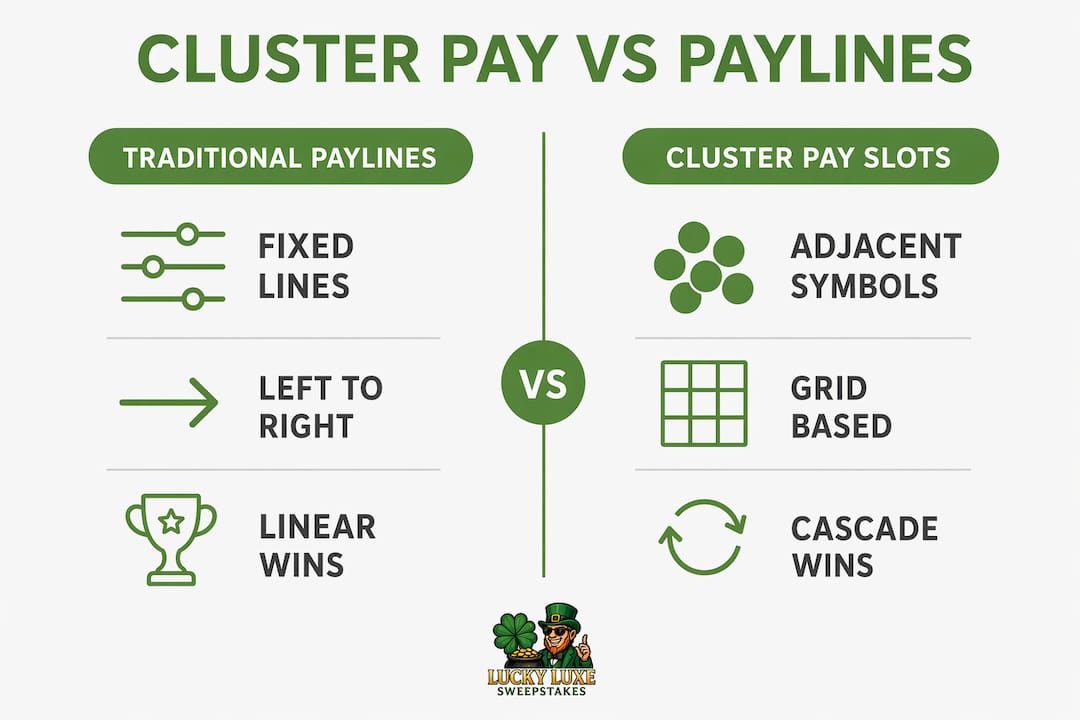
| Feature | Traditional paylines | Cluster pay slots |
|---|---|---|
| Win trigger | Symbols on fixed lines | Adjacent symbol groups |
| Grid size | Typically 5 reels x 3 rows | 5x5, 6x6, or 7x7 grids |
| Win frequency | Predictable, line-based | Frequent smaller wins with streaks |
| Cascading wins | Rare or absent | Core mechanic |
| Multiplier chains | Uncommon | Common during cascades |
Volatility in cluster pay games tends toward frequent smaller wins supplemented by multipliers that build during cascades. Traditional payline slots can deliver more predictable larger payouts tied to specific symbol combinations. Neither format is objectively better. The right choice depends on whether you prefer steady, line-based action or dynamic, chain-reaction gameplay.
A common misconception is that "pays anywhere" and "cluster pays" mean the same thing. They do not. "Pays anywhere" is a broad marketing term that can describe several different mechanics, including ways-to-win systems. Only a paytable review confirms whether a game uses true cluster adjacency rules or a different win structure entirely.
Pro Tip: Look for the phrase "adjacent clusters" in the paytable's win definition sentence. That specific language confirms you are playing a true cluster pay slot, not a ways-to-win or scatter-pays game.
What variations exist in cluster pay slot games?
Not all cluster pay slot games follow the same rules. The differences between titles can be significant enough to change your entire experience, so reading each game's paytable is not optional.
Adjacency rules
Most cluster pay games count horizontal and vertical connections only. Some titles include diagonal adjacency, which dramatically increases how often clusters form and how large they can grow. A game with diagonal adjacency on a 6x6 grid produces far more winning combinations than one restricted to four-directional connections. This is one of the most overlooked rule differences between titles.
Minimum cluster sizes and their effect
- 4-symbol minimum: Wins trigger frequently. Lower thresholds favor players who want regular feedback and shorter dry spells.
- 5 to 6-symbol minimum: The most common range. Balances win frequency with meaningful payout sizes.
- 7 to 9-symbol minimum: Wins are rarer but tend to pay more when they hit. Higher thresholds suit players comfortable with longer waits between wins.
The minimum cluster size is the single biggest factor in how often you win during a session. A game requiring 9 connected symbols will feel very different from one requiring 4, even if both use the same grid size.
Special symbols and dynamic grids
Special symbols alter cluster formation in ways that can shift the game's entire risk and reward profile. The most common types include:
- Wilds: Connect to any adjacent symbol, extending clusters that would otherwise fall short of the minimum.
- Multiplier symbols: Add a multiplier value to any cluster they join, boosting the payout beyond the base rate.
- Blockers: Symbols that cannot form clusters and cannot be removed by cascades, shrinking the effective grid.
- Expanding grids: Some bonus rounds grow the grid from 5x5 to 7x7 or larger, increasing cluster formation probability significantly.
Dynamic grids during bonus rounds change cluster formation probabilities compared to static grids. A larger grid means more symbols in play, more adjacency opportunities, and a different risk profile than the base game. This is why bonus rounds in cluster pay games often feel dramatically more rewarding than base gameplay.
| Symbol type | Effect on clusters |
|---|---|
| Wild | Extends clusters by connecting to any symbol |
| Multiplier | Boosts payout of any cluster it joins |
| Blocker | Reduces active grid space, limits cluster size |
| Expanding grid | Increases positions, raises cluster probability |
Practical tips for playing cluster pay slots
Getting the most from cluster pay slot games starts with understanding the specific rules of each title before you bet. The format rewards players who read the paytable, not those who assume all cluster games work the same way.
- Read the paytable first. Confirm the minimum cluster size, adjacency rules, and multiplier reset behavior before your first spin. These three rules define the game's entire character.
- Check the grid size. A 7x7 grid gives you more positions and more adjacency opportunities than a 5x5. Larger grids generally produce more frequent clusters.
- Understand cascade expectations. Cascades are a chance at additional wins, not a guarantee. Plan your session budget around the possibility that cascades end quickly.
- Use the slot fairness checklist to verify that a game's RTP and volatility information is publicly listed before you play.
- Identify multiplier rules. Find out whether the multiplier resets after each spin or accumulates across cascades. Accumulating multipliers create the biggest win potential in the format.
Pro Tip: Cluster pay slots with diagonal adjacency and accumulating multipliers offer the highest potential for large cascade chains. If you enjoy high-momentum sessions, prioritize those two features when choosing a title.
Cluster pay slots are increasingly favored in crypto casino environments due to their dynamic, fast-paced gameplay. That popularity means more titles are released each year, with more variation in rules. Treating each game as its own system, rather than assuming shared rules across the format, is the most practical habit you can build.
Key takeaways
Cluster pay slots reward players who understand the specific rules of each title, because adjacency type, minimum cluster size, and multiplier behavior vary significantly between games.
| Point | Details |
|---|---|
| Core mechanic | Wins form from adjacent matching symbols on a grid, not fixed paylines. |
| Cascading wins | Winning symbols vanish and new ones drop in, creating chain-reaction win opportunities. |
| Adjacency rules vary | Some games count diagonal connections; most count only horizontal and vertical. |
| Minimum cluster size matters | Thresholds range from 4 to 9 symbols and directly control win frequency. |
| Read every paytable | Multiplier reset rules and special symbol effects differ by title and change outcomes significantly. |
Why cluster pay slots are more complex than they look
I have spent a lot of time watching players approach cluster pay games the same way they approach traditional slots. They spin, they watch the grid, and they assume the mechanics are self-explanatory. They almost never are.
The biggest mistake I see is treating cascades as a built-in bonus. Players assume that because a cascade is possible, it will deliver. Experienced players know that cascades can end immediately if the replacement symbols do not connect. That distinction changes how you think about session variance.
The shift toward cluster pay formats in online and crypto casinos reflects something real about what players want now. Static, line-based gameplay feels passive compared to a 6x6 grid where a single spin can chain into four cascades and a 4x multiplier. The format is genuinely more engaging, and that engagement is not accidental. It is designed into the mechanic.
What players consistently overlook is the diagonal adjacency rule. Most assume horizontal and vertical only. A game that counts diagonal connections can form clusters twice as fast, which changes volatility, session length, and how you should size your bets. That one rule, buried in the paytable, matters more than the grid size or the theme.
My honest recommendation: treat every cluster pay title as a new game with its own logic. The online gaming categories that include cluster pay slots are growing fast, and the rule variation between titles is only increasing. Players who read first and spin second get far more from the format.
— Skyline
Cluster pay slots at Luckyluxe
Luckyluxe offers a wide selection of slot games, including titles built on the cluster pay mechanic, for players who want to put these mechanics into practice.

Before you play any title on Luckyluxe, pull up its paytable and confirm the minimum cluster size, adjacency rules, and multiplier behavior. Luckyluxe regularly highlights featured games and promotional offers, so you can identify which cluster pay titles are worth your time before committing. The platform's commitment to fair play means RTP and volatility information is accessible, giving you the data you need to choose games that match your preferred style of play.
FAQ
What are cluster pay slots?
Cluster pay slots are slot games where wins form from groups of adjacent matching symbols on a grid, replacing traditional fixed paylines. Most games require a minimum of 4 to 9 connected symbols to trigger a payout.
How do cluster pay slots work?
Matching symbols must touch horizontally or vertically to form a cluster. Once the cluster reaches the game's minimum size, it pays out, and the cascading mechanic removes those symbols so new ones can drop in for additional wins.
Are cluster pay slots fair?
Cluster pay slots use certified random number generators like any regulated slot format, and their RTP is set by the game developer. Checking the fairness indicators in the paytable confirms whether a specific title meets standard transparency requirements.
What is the difference between cluster pays and pays anywhere?
"Pays anywhere" is a broad marketing term that can describe several win mechanics, including ways-to-win systems. True cluster pay slots specifically require adjacent symbol groups with a defined minimum size, which only a paytable review can confirm.
What are examples of cluster pay slot features?
Common features include cascading reels, multiplier symbols that boost cluster payouts, wild symbols that extend clusters, blocker symbols that reduce grid space, and expanding grids during bonus rounds that increase cluster formation probability.