

Online gaming categories are classifications that define games by their gameplay mechanics, player interaction style, and session structure, giving casual players a direct framework for choosing titles they will actually enjoy. Online games span multiple genres including first-person shooters, MMORPGs, and real-time strategy games, all requiring server infrastructure to function. Knowing the difference between a battle royale like Fortnite, a massively multiplayer RPG like World of Warcraft, and a shooter like Call of Duty is not trivia. It determines whether a game fits your schedule, your social comfort level, and your skill set before you invest a single hour.
Online gaming categories explained: the major genres and what defines them
Industry genre families span action, role-playing, strategy, simulation, sports, racing, puzzle, adventure, fighting, shooter, and casual games, each with distinct subgenres underneath. Online game classification is built around one core idea: what is the player's main repetitive skill challenge? That challenge, repeated hundreds of times per session, is called the gameplay loop. Understanding the loop tells you more about whether you will enjoy a game than any genre label alone.
The table below maps the most common categories against their core mechanic, required skill, and well-known examples.
| Category | Core mechanic | Key skill | Major examples |
|---|---|---|---|
| Action / FPS | Move, aim, fire | Reflexes, spatial awareness | Call of Duty, Valorant |
| Battle royale | Survive, loot, eliminate | Decision-making under pressure | Fortnite, Apex Legends |
| MMORPG | Quest, progress, socialize | Long-term planning, teamwork | World of Warcraft, Final Fantasy XIV |
| Strategy (RTS/MOBA) | Survey, plan, execute | Resource management, coordination | StarCraft II, League of Legends |
| Simulation | Build, manage, maintain | Patience, creativity | The Sims 4, Stardew Valley |
| Puzzle / Casual | Solve, match, progress | Pattern recognition, logic | Candy Crush Saga, Among Us |
| Sports / Racing | Compete, score, rank | Timing, muscle memory | FIFA Online, Mario Kart Tour |
Two subgenre distinctions trip up casual players most often. First, FPS games like Call of Duty reward raw aim speed, while hero shooters like Overwatch 2 layer in character abilities that shift the loop toward team composition and cooldown timing. Second, turn-based strategy games like Civilization VI let you pause and think, while real-time strategy games like StarCraft II demand simultaneous decision-making at speed. These are not minor differences. They define whether a genre feels rewarding or exhausting to you personally.
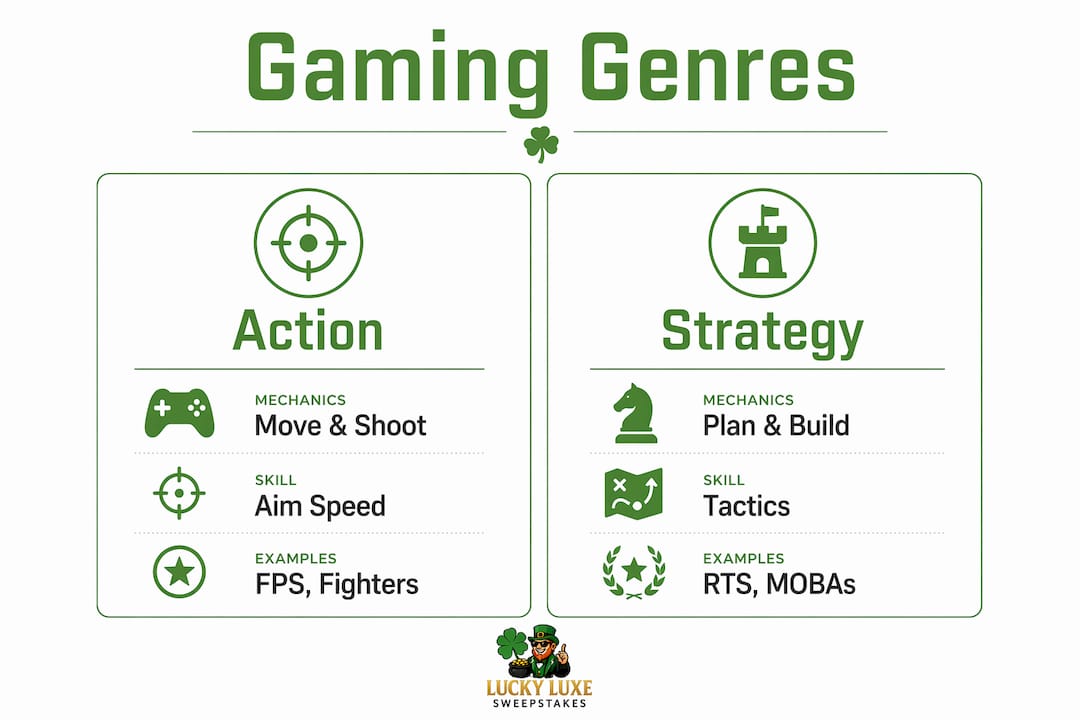
The primary gameplay loop in each genre, whether that is move-aim-fire in FPS or quest-progress-socialize in MMORPGs, signals the exact cognitive and motor demands a game will place on you every session. Rapid genre taxonomy growth means close genre labels do not always imply similar experiences, so mapping expected gameplay skills carefully before committing is worth the extra five minutes of research.
Pro Tip: Before downloading any game, search "[game title] gameplay loop explained" on YouTube. Watch three minutes of actual play, not a trailer. Trailers sell atmosphere; gameplay footage reveals the repetitive core you will live with for hours.
Single-player vs. multiplayer: how session format shapes your experience
Session format divides online games into single-player and multiplayer, and this distinction shapes gameplay experience, social interaction, and scheduling more than genre does. Single-player games deliver one player's authored experience with a defined beginning, middle, and end. Multiplayer games involve real-time or asynchronous interaction between players, often requiring you to be online at the same time as others.
Multiplayer itself splits into three meaningful types:
- Cooperative (co-op): Players work together toward a shared goal. Examples include Destiny 2 raids and It Takes Two. Social pressure is moderate because teammates depend on you, but the tone is collaborative rather than adversarial.
- Competitive: Players or teams oppose each other directly. Games like Valorant, FIFA Online, and Fortnite fall here. Skill gaps are visible, and community toxicity is a real risk in ranked modes.
- Social deduction: Games like Among Us require logic and bluffing rather than reflexes, creating a novel multiplayer experience that suits players who prefer wit over reaction time.
Practical considerations matter just as much as preference. Single-player games suit unpredictable schedules because you can pause and return without affecting anyone else. Multiplayer games require consistent time blocks, especially in team-based modes where dropping mid-match frustrates other players. Server reliance also means multiplayer games can become unplayable if a title loses its player base or shuts down servers, while single-player games remain accessible indefinitely.
Matching genre loop and session format as two independent filters is the most reliable method for avoiding the frustration of choosing a game that sounds appealing but plays nothing like what you wanted. Multiplayer games create continually evolving social ecosystems, while single-player games offer polished, finite experiences. Neither is superior. They serve different moods and schedules.
Pro Tip: Rate your social energy on a given week from 1 to 5. Score 1 to 2? Pick a single-player title. Score 4 to 5? Jump into a co-op or competitive session. Matching format to mood prevents the common trap of logging into a multiplayer game and resenting every interaction.
How content ratings and social features affect your game choice
ESRB ratings use six tiers, EC (Early Childhood), E (Everyone), E10+ (Everyone 10 and older), T (Teen), M (Mature 17+), and AO (Adults Only), each paired with content descriptors that specify exactly what type of content triggered the rating. For casual players selecting games for themselves or family members, these ratings are the fastest first filter available.
Content descriptors go beyond age tiers to flag specific elements relevant to online play:
- "Users Interact" signals that players can communicate with strangers in real time, which introduces social risks independent of the game's content rating.
- "In-Game Purchases" flags optional paid content, which matters for budget-conscious players or parents managing younger gamers.
- "Simulated Gambling" appears on games with loot boxes or prize wheels, relevant for players who want to avoid those mechanics.
- "Strong Language" and "Violence" descriptors clarify tone, helping you predict community behavior as much as on-screen content.
The critical limitation of ESRB ratings is that they do not cover user-generated content or player behavior in online spaces. A game rated T can host a deeply toxic community in its competitive modes. Community reputation metrics, sourced from platforms like Common Sense Media or Reddit community threads, complement ESRB ratings for a complete picture of social comfort and safety.
For family play or younger gamers, the practical approach is straightforward. Start with E or E10+ ratings, check for the absence of "Users Interact" descriptors, and read two or three recent community reviews focused on player behavior rather than game quality. A game like Minecraft sits at E10+ with optional multiplayer, giving families full control over social exposure. That combination of rating plus community context is more useful than either data point alone.
How to choose online games that match your interests and play style
Choosing the right game comes down to filtering on two independent axes: genre loop and session format. Two-axis filtering using genre loop and session format optimizes player satisfaction by eliminating games that look appealing on the surface but conflict with how you actually want to spend your time.
Follow this sequence before committing to any new title:
- Identify your loop preference. Ask yourself whether you prefer fast reflex challenges, long-term planning, creative building, or social problem-solving. Each maps directly to a genre family from the table above.
- Choose your session format. Decide whether you want a self-paced experience or a social one. Be honest about your weekly schedule and social energy.
- Watch gameplay footage, not trailers. Search YouTube for 10 to 15 minutes of unedited gameplay. Pay attention to the repetitive actions, not the cinematic moments.
- Read community reviews focused on player experience. Sites like Common Sense Media and Steam user reviews surface information about community toxicity, learning curves, and session length that marketing materials never mention.
- Start with free-to-play or demos. Games like Fortnite, Genshin Impact, and Path of Exile offer full free-to-play access. Demos on platforms like Steam let you test a game's loop before spending money.
- Use curated discovery tools. Featured games sections on gaming platforms organize titles by category and popularity, cutting discovery time significantly.
- Avoid repetitive gameplay traps. If a game starts feeling like a chore within the first three sessions, the loop is not a match for you. Knowing how to avoid repetitive games before you invest time saves real frustration.
The most common mistake casual players make is choosing games based on cultural popularity rather than personal loop preference. Fortnite is the most recognized battle royale on the planet, but if fast-paced survival under pressure is not your loop, no amount of social buzz will make it enjoyable. Popularity is a signal of quality, not a guarantee of personal fit.
Key takeaways
Online gaming categories are defined by gameplay loop and session format, and matching both to your personal preferences is the single most reliable path to consistent enjoyment.
| Point | Details |
|---|---|
| Loop over label | Understanding the core gameplay loop tells you more about fit than a genre name alone. |
| Two-axis filtering | Filter by genre loop and session format independently to avoid mismatches between mechanics and social structure. |
| ESRB plus community | ESRB ratings cover content but not player behavior; always check community reputation for multiplayer games. |
| Session format matters | Single-player suits flexible schedules; multiplayer suits social or competitive players with consistent time blocks. |
| Test before committing | Use free-to-play titles, demos, and gameplay footage to verify loop fit before investing significant time or money. |
Why most casual players pick the wrong games (and how to stop)
Most casual players I have observed make the same mistake: they pick games based on what their friends play or what is trending, then quit within a week feeling like gaming is not for them. The real issue is never the game. It is the mismatch between the game's loop and the player's actual preferences.
The category system exists precisely to prevent this. When you know that MOBAs like League of Legends demand 30 to 50 minute sessions of high-coordination team play, and that puzzle games like Candy Crush Saga offer two-minute sessions of low-stakes pattern matching, you can make an honest choice based on your life, not someone else's recommendation.
What I find genuinely underappreciated is how much session format affects enjoyment independent of genre. A player who loves RPG storytelling but has an unpredictable schedule will be miserable in World of Warcraft's raid-dependent endgame. The same player will thrive in a single-player action-RPG like Hades, which offers complete runs in 30 to 60 minutes with no social obligations. The genre is the same. The format is the difference.
My honest advice: spend 15 minutes mapping your loop preference and session format before you spend 15 hours in the wrong game. The categories are not gatekeeping. They are a shortcut to finding what you actually enjoy. Embrace both single-player and multiplayer options as tools for different moods, not competing philosophies.
— Skyline
Discover your next favorite game on Luckyluxe
If you have just mapped your genre preferences and session format, the next step is finding a platform that organizes games clearly enough to act on that knowledge.
Luckyluxe is built around exactly that kind of discovery. The platform features curated categories spanning slots, fishing games, and arcade options, organized so you can browse by game type rather than scrolling through an undifferentiated catalog. Luckyluxe highlights hot games and promotional titles regularly, so you always know what is worth trying right now. The platform also maintains a commitment to fair play and player support, meaning the environment is designed for casual enjoyment rather than frustration. Visit Luckyluxe to explore games matched to the categories you just learned about.
FAQ
What are the main online gaming categories?
The main online gaming categories include action, role-playing, strategy, simulation, sports, puzzle, adventure, and casual games, each defined by a distinct gameplay loop and player skill demand. Subgenres like FPS, MMORPG, battle royale, and MOBA sit within these broader families.
What is the difference between single-player and multiplayer online games?
Single-player games deliver a self-paced authored experience with no dependency on other players, while multiplayer games require real-time or asynchronous interaction with others and depend on active servers and player populations.
How do ESRB ratings help casual players choose games?
ESRB ratings assign age tiers from EC to AO and attach content descriptors like "Users Interact" and "In-Game Purchases" that flag specific risks relevant to online play. They are the fastest first filter for age-appropriateness, though community reputation must supplement them for multiplayer social safety.
What is a gameplay loop and why does it matter?
A gameplay loop is the core repetitive action a player performs throughout a session, such as move-aim-fire in FPS games or quest-progress-socialize in MMORPGs. Matching the loop to your preferences predicts enjoyment more accurately than genre labels alone.
How can I find online games that match my interests?
Filter by genre loop and session format as two independent criteria, watch unedited gameplay footage before downloading, and start with free-to-play titles or demos to test fit before committing time or money.