

Fair play in gaming is defined as competing honestly, following established rules, and respecting all participants without exploiting unfair advantages. The concept covers everything from avoiding cheats and bots to respecting opponents after a loss. Platforms like Chess.com and Riot Games have built entire enforcement systems around it. Understanding what fair play means shapes not just your win rate, but the quality of every match you play.
What does fair play mean technically in online gaming?
Fair play in gaming combines enforceable rules with technical enforcement measures to maintain trustworthy competition under adversarial conditions. The ethical side is straightforward. The technical side is where most players have blind spots.
The foundation of technical fair play is server authority architecture. The server acts as the definitive source of truth for all game state decisions, meaning the server controls hits and damage, not your local client. This design makes it impossible for a player to modify their game files and force the server to register a kill that did not happen. Your client sends inputs; the server decides outcomes.

Anti-cheat software operates on top of this architecture. Chess.com enforces gaming fair play rules by banning engines and bots during live play, because automated analysis gives a dishonest advantage that no human skill can match. Riot Games runs a comparable system in League of Legends, where live detection flags suspicious behavior patterns in real time.
Fair play enforcement relies on multiple layers working together:
- Server authority validates every client input before registering it as a game event
- Client-side anti-cheat scans for unauthorized software running alongside the game
- Statistical analysis flags accounts whose performance patterns fall outside human norms
- Community reporting surfaces behavior that automated systems miss
No single layer is sufficient. Anti-cheat is an ongoing arms race between developers and cheaters, which is why platforms invest in all four simultaneously.
Pro Tip: If you play on mobile, the fair play challenge is steeper. Mobile gaming requires hardened app protection plus server-side verification because client environments are easier to tamper with than PC builds.
How do different game types interpret fair play?
Fairness definitions vary by genre, and understanding that variation makes you a smarter player regardless of what you play. A fair match in a first-person shooter means something fundamentally different from a fair spin in an online slot.
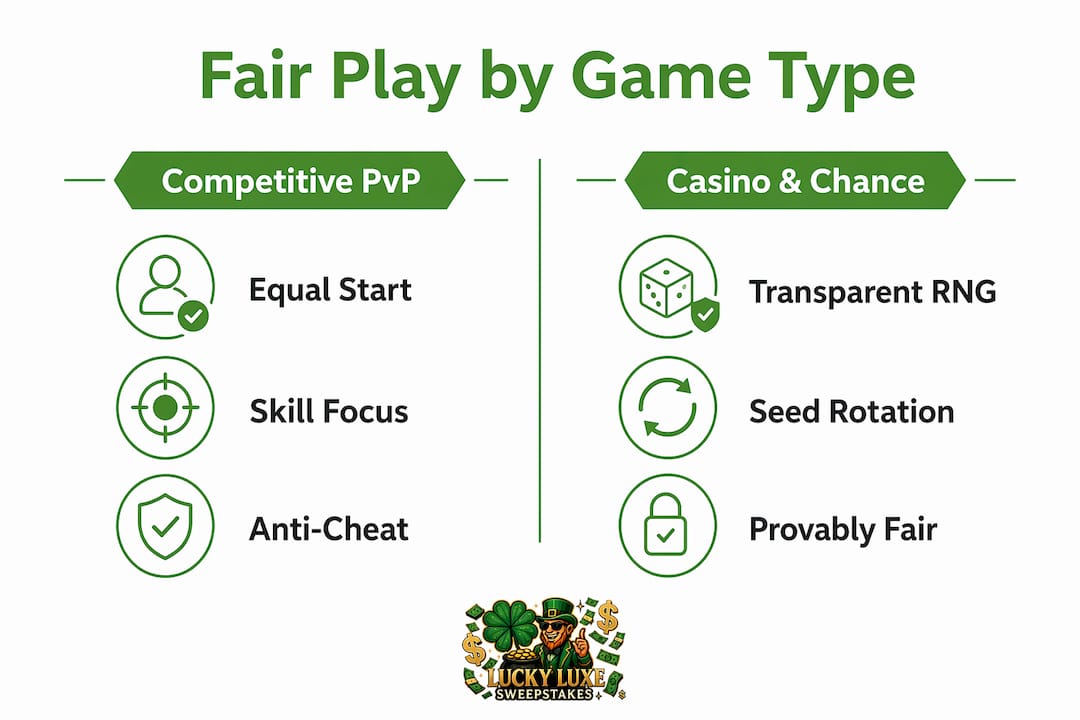
In symmetric PvP games like League of Legends or Counter-Strike, fair play centers on equal starting conditions. Both teams get the same tools, the same map information, and the same rules. Cheating in this context means breaking that symmetry, whether through aimbots, wallhacks, or match-fixing. The goal is competitive equality.
Casino-style and chance-based games define fairness through transparent randomness. Provably fair systems use commit-reveal cryptographic hashing to prove that outcomes were not manipulated after a bet was placed. The server publishes a hash of its seed before you bet, then reveals the seed after the result. You can verify the math yourself. This approach makes the fairness of each outcome independently auditable, which is a standard no PvP game needs to meet.
The table below shows how fair play principles differ across three major game categories.
| Game type | Core fairness goal | Primary enforcement method |
|---|---|---|
| Competitive PvP (e.g., League of Legends) | Equal tools and conditions for all players | Server authority, anti-cheat software, ban systems |
| Online chess (e.g., Chess.com) | No engine or bot assistance during play | Engine detection, statistical analysis, account bans |
| Casino/chance games | Unmanipulated, verifiable random outcomes | Provably fair RNG with cryptographic seed rotation |
Seed rotation matters in casino games specifically. Regular rotation of client seeds prevents any party from predicting future outcomes, which closes the window for bias or manipulation. It is a technical detail most players never see, but it is what makes the fairness claim credible.
The broader principle across all genres is the same: fair play means the outcome reflects skill, strategy, or genuine chance, not manipulation. How platforms achieve that differs based on what the game actually tests.
What challenges do platforms face in maintaining fair play?
Maintaining gaming fairness at scale is harder than most players realize. The two biggest problems are false positives and the constant evolution of cheating methods.
False positives occur when a legitimate player gets flagged as a cheater. Riot Games addressed this directly in League of Legends by building LP refund systems for false positives alongside its detection improvements. The same enforcement push that banned 24,000 accounts also refunded over 700,000 LP to innocent players who were harmed by griefing before detection caught it. That number illustrates how much collateral damage unfair behavior creates before it gets stopped.
The core challenges platforms face include:
- Threshold calibration: Setting detection sensitivity too high catches cheaters but also flags legitimate players; too low and cheaters slip through
- Client hardening: Protecting game code from reverse engineering without degrading performance for honest players
- Server load: Running real-time statistical analysis on millions of concurrent sessions requires significant infrastructure
- Appeals processing: Every wrongful ban needs a human review pathway, which does not scale easily
AI-based detection requires careful threshold tuning and human review to stay trustworthy. Automated systems catch volume; human reviewers catch nuance. Platforms that skip the human layer end up with enforcement that feels arbitrary to players, which erodes trust even when the bans are correct.
Pro Tip: If you receive an unexpected ban or penalty, check whether the platform has a formal appeals process before assuming the decision is final. Most major platforms, including Riot Games, maintain review mechanisms specifically because false positives happen.
Rollback systems are another underappreciated tool. When a cheater is removed from a match retroactively, a rollback restores the affected players' stats and rankings to where they would have been without the cheating. Without rollbacks, honest players absorb the cost of someone else's violation.
How can gamers promote fair play themselves?
Fair play is not only a platform responsibility. Your behavior directly shapes the experience for everyone in a match. Here are four concrete ways to support gaming ethics explained through your own actions.
-
Refuse to use third-party cheats or exploits. This includes aimbots, speed hacks, and any software that gives you information the game does not intend you to have. The short-term win is not worth the long-term damage to the community or your account standing.
-
Use in-game reporting tools. Every major platform provides a mechanism to flag cheating, harassment, or unsportsmanlike conduct. Reporting is not tattling. It is the primary way community-driven detection supplements automated systems. You can also find support resources to understand how reporting processes work on specific platforms.
-
Learn and respect the rules of each game you play. Fair play principles in games are not universal. What counts as an exploit in one game is an intended mechanic in another. Reading patch notes and community guidelines keeps you on the right side of that line.
-
Model positive behavior in chat and post-match interactions. Toxic behavior does not require a cheat code. Harassment, intentional feeding, and match abandonment all violate the spirit of fair competition even when they do not trigger anti-cheat systems. Platforms like Riot Games track behavioral patterns, not just technical violations.
Understanding why fair play matters in slot gaming and other chance-based formats adds another dimension. In those games, your role as a player is to choose platforms with verified fairness certifications rather than to police your own behavior during play.
Key takeaways
Fair play in gaming requires honest competition enforced through server authority, anti-cheat systems, and player behavior, with fairness defined differently across PvP, chess, and casino game formats.
| Point | Details |
|---|---|
| Server authority is the foundation | The server controls all game state decisions, making client-side manipulation ineffective. |
| Fairness definitions vary by genre | PvP games prioritize equal conditions; casino games prioritize verifiable random outcomes. |
| False positives are a real cost | Riot Games refunded over 700,000 LP to players harmed by undetected griefing before bans. |
| Multi-layer enforcement is required | No single anti-cheat method works alone; platforms combine server checks, software scans, and reporting. |
| Players share enforcement responsibility | Reporting violations and avoiding toxic behavior directly supports platform-wide fair play systems. |
Why fair play enforcement is more fragile than it looks
I have spent years watching how gaming communities respond to fairness failures, and the pattern is consistent. Players do not leave games because the anti-cheat is imperfect. They leave when they feel the platform does not care.
Riot Games' decision to publish the specific numbers behind its griefing detection update, 24,000 bans and 700,000 LP refunds, was not a technical milestone. It was a trust signal. Transparency about enforcement outcomes does more for community confidence than any ban wave ever could. Most platforms still do not do this, and the silence costs them.
The technology for fair play enforcement is genuinely impressive. Cryptographic seed verification in casino games, server authority architecture in live-service titles, and AI-driven behavior analysis are all real advances. But technology without accountability is just a black box. Players need to know the system is working, not just that it exists.
The part of gaming ethics explained least often is that fair play culture starts before the match loads. It starts with the platform's design choices, the transparency of its rules, and whether it treats wrongful penalties as a serious problem worth fixing. When platforms get that right, players follow. When they do not, no amount of anti-cheat software closes the gap.
— Skyline
Experience fair gaming at Luckyluxe
Luckyluxe is built around the principle that every player deserves a transparent, trustworthy gaming experience. Whether you are spinning slots, playing fishing games, or exploring arcade titles, the platform's commitment to fair play is built into how games are designed and delivered.
Luckyluxe uses verified fair play standards across its game catalog, so you are never left guessing whether outcomes are genuine. You can explore fair play certified slots to understand exactly what transparency looks like in practice. Ready to play on a platform that takes fairness seriously? Visit Luckyluxe and see the difference that genuine fair play standards make.
FAQ
What does fair play mean in gaming?
Fair play in gaming means competing honestly by following the rules, avoiding cheats or exploits, and respecting other players. It covers both ethical behavior and technical compliance with platform standards.
How do platforms like Riot Games enforce fair play?
Riot Games uses live cheating and griefing detection combined with remediation tools like LP refunds and account bans. Its system banned 24,000 accounts and refunded over 700,000 LP to affected players in one enforcement cycle.
What is provably fair RNG in casino games?
Provably fair RNG uses cryptographic hashing to prove that game outcomes were not altered after a bet was placed. Players can verify the server seed hash independently to confirm the result was genuine.
Why do false positives happen in anti-cheat systems?
False positives occur when detection thresholds flag legitimate player behavior as suspicious. Platforms reduce this risk through appeals processes, human review, and rollback systems that restore affected players' progress.
How can I support fair play as a player?
Avoid third-party cheats, use in-game reporting tools to flag violations, learn each game's specific rules, and maintain respectful behavior in chat and post-match interactions.