

A slot game cycle is defined as the complete unit of play from the moment a player initiates a spin to the moment the result is fully displayed on screen. This is the industry standard definition, and it has nothing to do with payout patterns or winning streaks. The UK Gambling Commission mandates a minimum 2.5-second gap between game cycles to reduce gambling intensity. That regulation exists to protect players from rapid, impulsive play, not to influence which symbols land. Understanding what a slot game cycle actually is separates smart players from those chasing myths that cost them money.
What is a slot game cycle, and how is it regulated?
A slot game cycle covers every step from spin initiation through reel animation to final result display. Regulators define this sequence precisely because controlling its speed directly affects how much a player can wager in a given time period.
The UK Gambling Commission's 2.5-second minimum cycle rule is the clearest example of cycle regulation in practice. That rule forces a pause between spins, slowing the pace of play and reducing the risk of rapid financial loss. The regulation targets speed, not outcomes. No governing body programs cycles to pay out at certain intervals.

Cycle regulation also shapes the player experience in ways most gamers never notice. A faster cycle feels more exciting but increases exposure. A slower cycle, enforced by law, gives players more time to assess their session and make deliberate choices. The slot game fairness indicators that reputable platforms publish reflect these regulatory requirements directly.
The term "game cycle" in the industry context refers strictly to timing and sequence. It does not describe a pattern of wins and losses. Confusing the two is the root of most slot myths.
- Cycle initiation: The player presses spin or activates autoplay.
- Processing: The Random Number Generator (RNG) instantly determines the outcome.
- Animation: Reels spin visually, but the result is already set.
- Result display: Symbols lock in and any win is credited.
- Minimum pause: Regulatory gap before the next cycle can begin.
Pro Tip: Track how long your sessions run, not how many spins you take. Cycle timing means more spins per hour than you might expect, so set a time limit before you start.
Is there such a thing as a payout cycle in slot machines?
No. There is no programmed payout cycle in any modern slot machine. This is the single most important fact for any player to understand about how slot games work.
Every spin outcome is generated independently by an RNG. The RNG produces results for millions of potential spins without any memory of previous results. A win on spin 50 has zero influence on spin 51. The machine does not track your session, your losses, or how long you have been playing.
"Slot machine animations are visual effects only. The outcome is determined the instant you press spin. The spinning reels are a display, not a decision. No pattern, streak, or cycle is programmed into the result sequence. Each spin is statistically independent of every other spin."
The belief in payout cycles is one of the most persistent myths in gambling. It persists because the human brain is wired to find patterns, even in random data. When a player wins after a long losing streak, it feels like the machine "was due." That feeling is real. The cause is not. Past spins do not affect future probabilities in any way.
The table below shows the difference between what players commonly believe and what the mechanics actually do.
| Myth about payout cycles | Actual RNG mechanics |
|---|---|
| Machines pay out after a set number of spins | Every spin outcome is independent |
| A cold machine is "due" for a win | Past results have no effect on future spins |
| Changing bet size triggers a payout cycle | Bet size affects win amount, not outcome probability |
| Long losing streaks mean a jackpot is near | Loss streaks are normal variance, not a signal |
| Autoplay and manual spin produce different cycles | Both use the same RNG with identical probabilities |
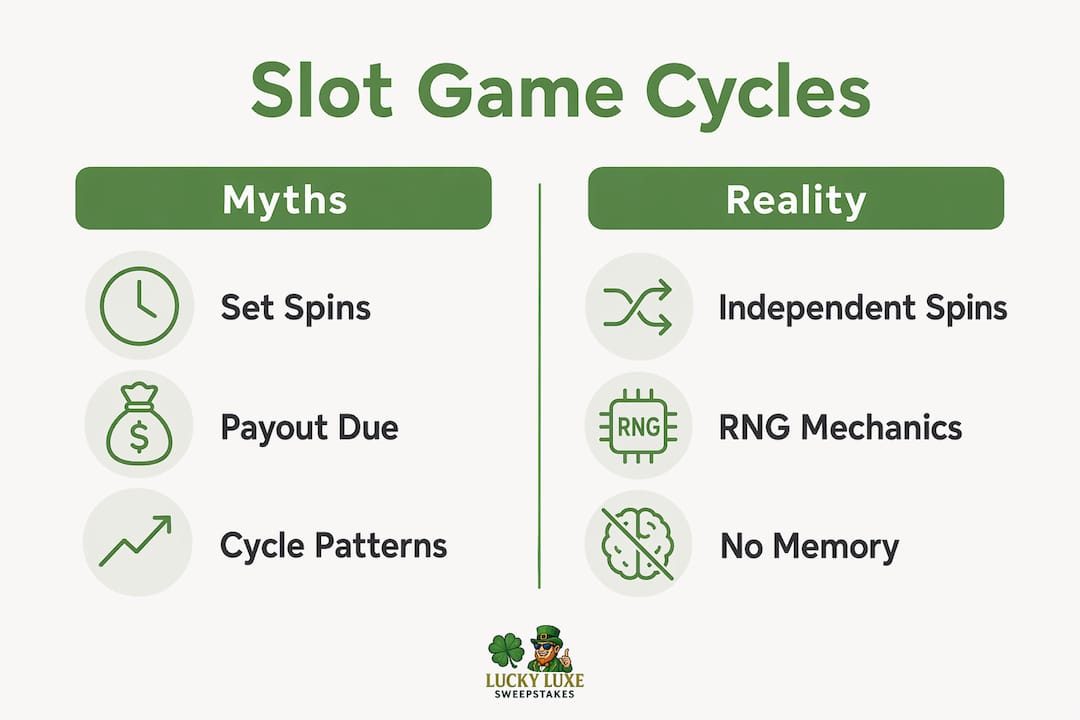
Session length and past spins have no impact on internal RNG mechanics or outcome probabilities. That fact alone dismantles every strategy built around "waiting out" a machine.
How do RTP and volatility relate to slot game cycles?
RTP (Return to Player) and volatility are the two real mathematical forces shaping your slot experience. Neither creates a cycle. Both are frequently mistaken for one.
RTP is a theoretical long-term average. A game with 95% RTP returns $95 for every $100 wagered across millions of spins. That figure tells you nothing about your next 20 spins. In a short session, you could win big or lose everything, and both outcomes are consistent with a 95% RTP game. The math only stabilizes over an enormous number of spins.
Volatility defines the shape of your session experience. High volatility means fewer, bigger wins. Low volatility means more frequent, smaller wins. Neither type follows a cycle. A high-volatility game can go 100 spins without a significant win, then pay out three times in a row. That is not a cycle. That is variance behaving exactly as the math predicts.
Players often mistake volatility patterns for cycles because the swings feel meaningful. A long dry spell followed by a big win feels like a programmed sequence. Players often mistake long-term RTP math and session variance for due wins or cycles. The reality is that variance creates unpredictable short-term results by design.
- Low volatility games: Frequent small wins, slower bankroll depletion, good for longer sessions.
- Medium volatility games: Balanced win frequency and size, suits most player styles.
- High volatility games: Rare but large wins, requires a larger bankroll to absorb dry spells.
Pro Tip: Before you play any slot, check its volatility rating and RTP. Use that information to set your session budget. A high-volatility game needs a bigger bankroll cushion than a low-volatility game at the same stake.
Understanding bankroll management for online slots becomes far easier once you stop expecting cycles and start planning for variance.
Why does understanding game cycles matter for real players?
Misconceptions about slot machine payout cycles cause real financial harm. Players who believe a machine is "due" will chase losses, increase bets, and extend sessions beyond their budget. None of those behaviors improve their odds. All of them increase their risk.
Knowing that cycle regulation controls speed, not outcomes, changes how you approach a session. The mandatory pause between spins is not a sign the machine is resetting or preparing a payout. It is a player protection measure. Use that pause deliberately. Check your balance. Decide whether to continue.
Responsible play behaviors built on accurate knowledge include:
- Set a session time limit before you start, not after you are already playing.
- Choose games by volatility and RTP, not by how long since they last paid out.
- Treat every spin as independent. A losing streak does not predict a win.
- Use autoplay limits where available to cap spins per session automatically.
- Stop when you hit your budget limit, regardless of how the last few spins felt.
The responsible online gaming practices that regulators and reputable platforms promote are built on exactly this understanding. Cycle myths undermine those practices by giving players a false reason to keep going.
Regulators use game cycle speed limits as a harm reduction tool. They slow play to reduce the number of decisions a player makes per hour. That is the only thing a game cycle controls. Your job as a player is to use that built-in pause to make better decisions.
Key Takeaways
A slot game cycle is a regulated timing sequence, not a payout pattern. RNGs make every spin independent, and volatility explains session variance far better than any cycle theory.
| Point | Details |
|---|---|
| Game cycle definition | A cycle covers spin initiation to result display, regulated for speed, not outcomes. |
| No payout cycles exist | RNGs generate each spin independently, with no memory of past results. |
| RTP is long-term math | A 95% RTP applies over millions of spins, not your current session. |
| Volatility explains swings | High volatility produces rare big wins; low volatility produces frequent small wins. |
| Regulation protects players | The 2.5-second minimum cycle gap slows play to reduce impulsive wagering. |
The myth that just won't die
The payout cycle myth persists because it is emotionally satisfying. Believing a machine is "due" gives players a sense of control in a game that is entirely random. I understand the appeal. After a long losing streak, the idea that a win is coming feels logical. The math says otherwise, and the math always wins in the end.
What I find genuinely useful is the regulatory framework around cycle timing. The UK Gambling Commission's 2.5-second rule is not glamorous, but it is one of the most practical player protections in the industry. It forces a moment of pause that most players ignore. That pause is your best tool for staying in control of a session.
The players who enjoy slots most consistently are the ones who treat RTP and volatility as their actual guides. They pick games that match their bankroll and their tolerance for dry spells. They do not extend sessions because they feel a win is overdue. They know that feeling is noise, not signal.
Responsible gaming education works when it replaces myths with mechanics. Once you understand that a game cycle is a timing standard and nothing more, you stop chasing patterns that do not exist. That shift in thinking is worth more than any betting system or "hot machine" tip you will ever read.
— Skyline
Fair slots with real cycle standards at Luckyluxe
Players who understand game cycles deserve a platform that takes those standards seriously.
Luckyluxe operates with a commitment to fair play and player protection built into every game on the platform. The slots available through Luckyluxe follow regulated cycle standards, giving players the pacing and transparency they need to make informed decisions. Whether you prefer low-volatility games for longer sessions or high-volatility titles for bigger swings, Luckyluxe offers a wide selection of slots designed around genuine fairness. The platform also features a referral program and support resources to keep your experience rewarding from the first spin.
FAQ
What is a slot game cycle in simple terms?
A slot game cycle is the full sequence from when you press spin to when the result appears on screen. Regulators control how fast this cycle can repeat, but it has no connection to payout patterns.
Do slot machines have a payout cycle that players can predict?
No. Modern slot machines use RNGs that generate each spin outcome independently. No past result influences the next spin, so no payout cycle exists to predict.
Why does the UK Gambling Commission regulate game cycle speed?
The UK Gambling Commission requires a minimum 2.5-second gap between game cycles to slow play pace and reduce gambling intensity. The rule protects players from rapid, impulsive wagering.
What is the difference between RTP and a slot cycle?
RTP is a long-term mathematical average showing how much a game returns over millions of spins. A game cycle is a timing sequence. The two concepts are unrelated.
How does volatility affect what I experience during a slot session?
High-volatility slots pay out less often but in larger amounts. Low-volatility slots pay out more frequently in smaller amounts. Neither type follows a cycle. Both reflect pre-programmed mathematical profiles.