

Legacy arcade games are fast-paced, score-driven games built around reflex challenges, immediate feedback, and competitive play. They define a category of gaming that spans physical cabinets from the late 1970s through the 1990s and a design philosophy that still shapes how games are built today. Titles from Atari, Capcom, and Namco established the core genres: shooters, racing, platformers, and puzzle games. These games share a fixed challenge architecture where skill determines session length, not a story or unlock system. Understanding the legacy arcade means understanding the foundation of modern gaming culture.
What are the design principles behind legacy arcade games?
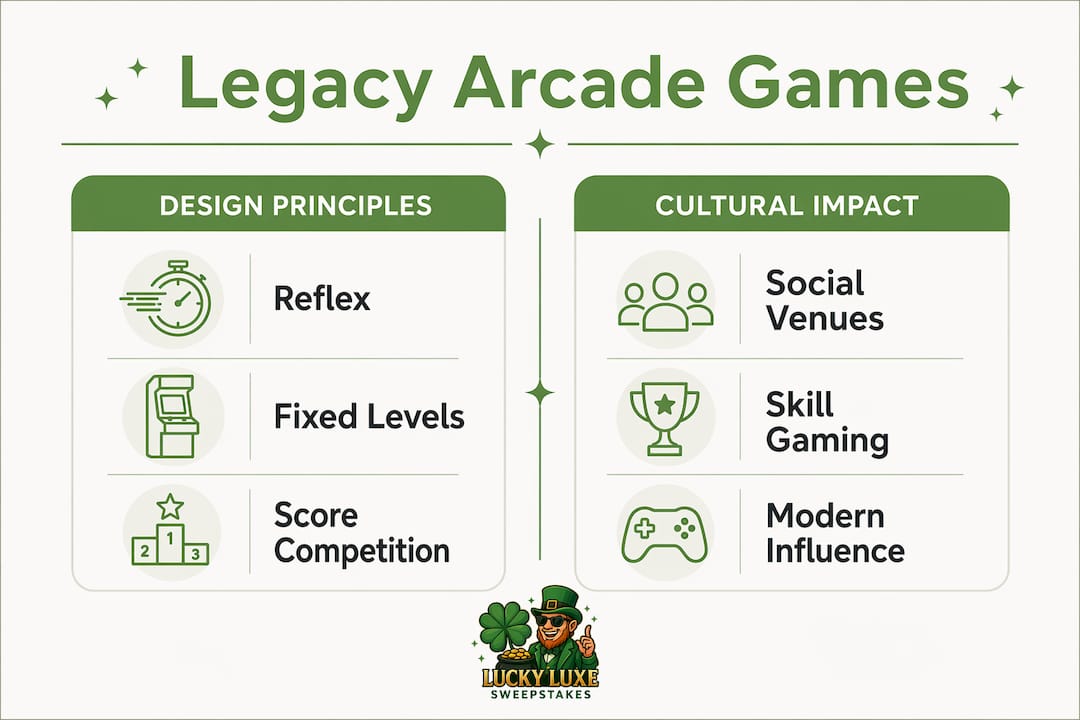
Arcade-style games rely on reflex challenges, immediate feedback, and score-driven competition. This separates them from narrative-heavy console titles, which reward patience and progression. Classic arcade machines ask one question on every screen: how long can you survive?
The defining structural feature is the fixed challenge architecture. Every level, enemy wave, or obstacle pattern is predetermined. The game does not adapt to you. You adapt to it. That constraint forces mastery through repetition, which is exactly why players pump quarter after quarter into the same machine.
The infinite difficulty curve is the second pillar. Sessions can last a few minutes or several hours depending entirely on player skill. There is no ceiling. A beginner dies on stage two. An expert reaches stages most players never see. This design creates a natural ranking system without any formal leaderboard infrastructure.
Short session design is the third principle. A single run in a retro gaming arcade takes minutes, not hours. That brevity makes the games easy to pick up and brutally hard to master. Players return because the barrier to starting is zero and the ceiling for improvement is infinite.
- Fixed challenge architecture: Obstacles and enemies follow set patterns, rewarding memorization and muscle memory.
- Infinite difficulty curve: Skill, not time investment, determines how far a player progresses.
- Immediate feedback loops: Every hit, miss, and score change registers in real time, keeping players locked in.
- Short session design: Runs last minutes, making restarts feel low-cost and encouraging repeated attempts.
- Score-driven competition: A number on the screen replaces narrative reward, creating universal motivation.
Pro Tip: Apply the "front-loaded fun" test to any game you build or play. If a new player is not engaged within the first 30 seconds, the arcade design principle has failed. The best classic arcade machines deliver their core thrill before the first life is lost.
How did legacy arcade games shape gaming culture?
The golden age of arcade gaming, running from the late 1970s through the late 1990s, produced more than popular games. It built a social infrastructure that predates online multiplayer by two decades. Physical arcade venues were the original gaming communities.
High-score leaderboards were the mechanism. A name on a cabinet screen in 1982 carried real social weight in a neighborhood. Players traveled to specific arcades because a particular machine held a record worth chasing. That local competition created loyalty to venues and to specific games in ways that digital platforms still try to replicate.
"Beyond gameplay, the golden age arcades were social hubs where shared leaderboards fostered community competition long before online gaming existed. The cabinet itself was the server, and the venue was the network."
The social function of arcades was not accidental. Venue operators understood that competition kept players spending. They arranged machines to encourage watching as much as playing. Spectators became competitors. Competitors became regulars.
A critical nuance often overlooked: arcade venues historically separated skill-based games from gambling machines. This legal distinction shaped where cabinets were placed, who could access them, and how venues were licensed. Family arcades carried skill games. Bar arcades carried a different mix. That separation influenced the culture and demographics of arcade gaming through the 1980s and 1990s, and it still affects how modern venues apply for operating licenses today.
Modern public venues like Arcade Legacy in Cincinnati span over 15,000 square feet and function as both museums and community centers. They combine hundreds of classic and modern games with bar services and organized tournaments. These spaces preserve the social spirit of the original arcade era while adding amenities that make them destinations rather than pit stops.
What does the legacy arcade experience look like today?
The retro gaming arcade experience now splits into two distinct formats: home cabinets and public venues. Both serve the same nostalgia, but they deliver it differently.
Home cabinets
The Capcom Legacy Edition arcade cabinet from Arcade1Up retails around $392 and includes 12–14 classic games on a 17-inch LCD with real-feel controls built for local multiplayer. The cabinet weighs about 80 pounds and features a light-up marquee and a custom riser for comfortable standing play. That price point puts a genuine vintage arcade games experience in a living room without requiring a collector's budget.
Assembly takes 1–2 hours and involves proprietary hardware that differs from standard consumer electronics. Owners who skip the setup instructions often run into alignment issues with the control panel. Ventilation matters too. A cabinet running in a closed closet or tight corner will overheat faster than one with open airflow on at least two sides.
Pro Tip: Before buying a home cabinet, measure your floor space with the riser included. Most cabinets need a minimum 2-foot clearance on each side for comfortable two-player use and adequate airflow.
Public venues
Public venues offer scale that no home setup can match. Hundreds of machines, pinball tables, tournament brackets, and bar service create an environment that mirrors the original arcade social experience. Entry fees vary by venue, but most operate on a pay-once-play-all model that removes the quarter-pressure of the original era.
| Feature | Home cabinet | Public venue |
|---|---|---|
| Game selection | 12–14 titles per cabinet | Hundreds of titles |
| Social experience | Local multiplayer, household | Community tournaments, strangers |
| Cost model | One-time purchase (~$392) | Entry fee or per-play |
| Space required | Single room corner | Not applicable |
| Maintenance | Owner-managed | Staff-managed |
| Atmosphere | Personal, on-demand | Communal, event-driven |
How do legacy arcade mechanics influence modern gaming?
"Arcade" is a design philosophy, not just a genre. Industry analysts define it as an approach that drives retention through score chasing, fast restarts, and clear feedback loops. That philosophy now appears across mobile games, indie titles, and mainstream releases on every platform.
The influence shows up in specific mechanics:
- Leaderboards: Games like Vampire Survivors and Geometry Wars use global and friend leaderboards that mirror the cabinet high-score board directly.
- Fast restarts: Roguelikes such as Dead Cells and Hades borrow the arcade principle that dying should feel cheap and restarting should feel instant.
- Score chasing: Mobile titles use point multipliers and combo systems lifted directly from classic arcade machines.
- Session-length design: Casual mobile games are built around 3–5 minute sessions, matching the arcade run length that kept players returning.
- Skill-based progression: Games that gate advancement behind demonstrated skill rather than time played follow the arcade model precisely.
The front-loaded fun design philosophy is the most transferable lesson. Modern developers use it to hook players in the first session before any progression system activates. Retro gaming enthusiasts recognize this immediately. The first 30 seconds of a well-designed mobile game feel like the first 30 seconds of Pac-Man or Galaga. That is not coincidence.
Esports and speedrunning communities extend the arcade ethos further. Speedrunning is score chasing with a clock. Competitive fighting game circuits are high-score leaderboards with brackets. The types of online arcade games available today trace their DNA directly to the fixed challenge architecture of classic arcade machines. The vocabulary has changed. The design logic has not.
Key Takeaways
Legacy arcade games define a design philosophy built on reflex challenges, fixed architecture, and score-driven competition that continues to shape every major gaming platform in 2026.
| Point | Details |
|---|---|
| Core design principle | Fixed challenge architecture and infinite difficulty curves separate arcade games from narrative titles. |
| Cultural origin | Golden age arcades (late 1970s to late 1990s) built social gaming communities through local leaderboards. |
| Home cabinet entry point | Cabinets like the Capcom Legacy Edition retail around $392 and require 1–2 hours of assembly. |
| Modern influence | Leaderboards, fast restarts, and score chasing in contemporary games trace directly to arcade design. |
| Venue evolution | Public arcade venues now span thousands of square feet, combining classic games with bar services and tournaments. |
Why arcade design still earns my respect
I have played thousands of hours across modern open-world games, narrative RPGs, and live-service titles. None of them taught me more about game design than 20 minutes on a well-tuned arcade cabinet. The elegance is almost brutal. No tutorial. No waypoint. No hand-holding. The game communicates entirely through what kills you.
Owning a home cabinet changed how I think about space and commitment. The cabinet does not disappear into a menu. It sits in the room and demands attention. That physical presence creates a different relationship with the games than a digital library ever does. You walk past it. You stop. You play three rounds before dinner. That is the arcade-style engagement loop working exactly as designed.
The part that surprises most people: arcade culture is not nostalgia for a simpler time. It is nostalgia for a harder time. These games were genuinely difficult. The community that formed around them was built on shared struggle and public skill. That combination is rare in modern gaming and worth preserving deliberately.
— Skyline
Luckyluxe and the arcade games worth your time

Luckyluxe brings the arcade spirit into a platform built for players who want fast, skill-rewarding gameplay without the quarter slot. The game library at Luckyluxe includes arcade-style titles alongside slots and fishing games, all designed around the same core principle that made classic arcade machines great: clear rules, immediate feedback, and real competition. Luckyluxe updates its featured games regularly, so the selection stays fresh. If you want to understand online gaming categories and find titles that match the arcade design philosophy, Luckyluxe is the right place to start.
FAQ
What is a legacy arcade game?
A legacy arcade game is a coin-operated or cabinet-style game built around reflex challenges, score-driven competition, and fixed challenge architecture. The term also describes the design philosophy these games established, which now appears across modern digital platforms.
What genres count as arcade style games?
Core arcade style genres include shooters, racing games, platformers, and puzzle games. All share immediate feedback loops, short session design, and skill-based progression rather than story-driven advancement.
How much does a home legacy arcade cabinet cost?
Entry-level home cabinets like the Capcom Legacy Edition retail around $392 and include 12–14 classic games. Assembly takes 1–2 hours and requires planning for space and ventilation.
How did arcades influence modern gaming?
Arcade design principles, including leaderboards, fast restarts, and score chasing, appear directly in modern indie games, mobile titles, and esports formats. The front-loaded fun philosophy remains the standard for player retention in contemporary game development.
What is the difference between skill-based and gambling arcade machines?
Skill-based arcade games reward player ability and have no random payout mechanism. Gambling machines involve chance and are subject to different licensing rules. This legal distinction shaped arcade venue design and demographics throughout the 1980s and 1990s.