
Hit frequency is the percentage of spins that return any payout at all, including returns smaller than your original bet. According to PokerNews, it measures how often you'll see a win animation, not how much you'll collect or whether you'll come out ahead. That distinction matters more than most players realize.
Key things to know upfront:
- Hit frequency counts any payout above zero, including sub-stake returns that still leave you down on the spin
- A high hit rate does not mean you'll profit faster or more often
- Hit frequency is independent from RTP and volatility, and each metric answers a completely different question
- Sources like AGLC and PokerNews confirm it's calculated over long samples and cannot predict your next session
- Luckyluxe publishes game information to help players understand these mechanics before they spin
Key Takeaways
Hit frequency measures how often any payout appears, not how often you profit, and using it alongside RTP and volatility gives you a complete picture of what a slot session will actually feel and cost.
| Point | Details |
|---|---|
| Hit frequency definition | Percentage of spins returning any payout above zero, including sub-stake returns. |
| Main limitation | High hit frequency does not mean profitable play; LDWs count as hits while still reducing your balance. |
| Relationship to other metrics | RTP measures long-run cost; volatility measures swing size; hit frequency measures pacing and animation frequency. |
| Typical range | Most slots fall between about 20% and 35% hit frequency; regulator sources give a broader range of roughly 3%–40% depending on game design, with above 35% considered high. |
| How to use it | Combine with RTP and volatility to match a game to your bankroll size and entertainment preference. |
Table of Contents
- What does hit frequency mean in slots, exactly?
- How hit frequency, RTP, and volatility each answer a different question
- Why hit frequency can't predict what happens in your next session
- How hit frequency shows up while you're actually playing
- How to use hit frequency when planning your session
- Where to find hit frequency data, and what to do when it's not listed
- Common misconceptions players have about hit frequency
- About this article and Skyline
- A slot player's honest take on hit frequency
- Sources
What does hit frequency mean in slots, exactly?
Hit frequency equals the number of spins that produce any win divided by total spins, expressed as a percentage. The Wikigamia encyclopedia describes the formal calculation as requiring the weighted probability distribution across all virtual reel positions, which is why studios with access to PAR sheets can compute it precisely while players estimating from live sessions are working with approximations.
The math is simple once you strip it down:
Hit Frequency = Spins with any win ÷ Total spins
A hit frequency of roughly one in every four spins producing a payout means you can expect about 25 hits over 100 spins and roughly 75 hits over 300 spins. But "hit" here includes a spin where you bet $1.00 and receive $0.20 back. You still lost $0.80 on that spin. The counter ticked up, the animation played, the sound fired, and you're still down.
That gap between a "hit" and a profitable spin is where players get tripped up.
| Metric | What It Measures | Example Value |
|---|---|---|
| Hit frequency | Any payout > $0 per spin | 28% |
| Win rate | Spins where payout exceeds stake | 20% |
| RTP | Long-run % of total bets returned | 96% |
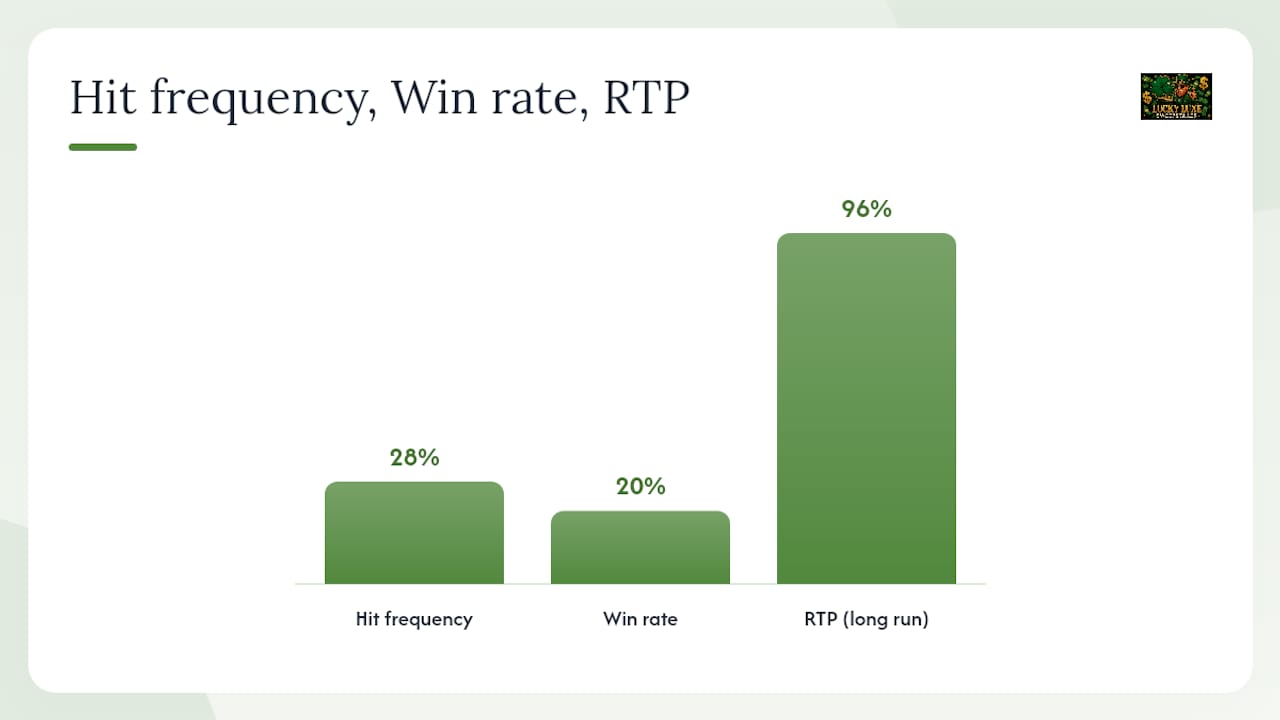
SlotDecoded's analysis shows that on games with 20–40 paylines, win rate typically runs 8–15 percentage points below hit frequency, because multi-line staking inflates the number of partial returns without improving actual profitability per spin.
How hit frequency, RTP, and volatility each answer a different question
These three metrics get conflated constantly, and conflating them leads to bad session decisions.
- RTP answers: "What percentage of my total bets will come back to me over thousands of spins?" A 96% RTP means the house edge is 4% long-run.
- Volatility answers: "How big are the swings? Will I see frequent small wins or rare large ones?" High volatility means fewer hits but larger potential payouts.
- Hit frequency answers: "How often will I see any return animation during play?" It's about pacing and feel, not profitability.
Hit frequency tells you how often the game acknowledges a spin. RTP tells you what the game actually costs you. Volatility tells you how bumpy the ride will be. You need all three to understand a game, and none of them alone is enough.
Use RTP to estimate your expected cost per session. Use volatility to match the game's variance to your bankroll. Use hit frequency to decide whether you want a session that feels active and frequent or one that runs quiet for stretches before a bigger payout. For a deeper look at reading payout signals, the Luckyluxe guide on identifying high-payout slot games walks through how these metrics interact in practice.
Why hit frequency can't predict what happens in your next session
Hit frequency is calculated as a statistical expectation over very large samples of spins, and does not guarantee results for shorter sessions. A game with 30% hit frequency doesn't promise you'll hit on 3 of every 10 spins tonight. Random number generators produce each spin independently, with no memory of what came before.
That means:
- You can spin 40 times on a high-HF game and hit fewer than 5 times
- You can spin 20 times on a low-HF game and hit 8 times
- Neither outcome "corrects" toward the average in your next session
Variance is the mechanism. Short sessions amplify it. The longer you play, the closer your observed hit rate approaches the published figure, but "longer" here means tens of thousands of spins, not a one-hour session. The AGLC gaming information page notes that hit frequency ranges can span roughly 3%–40% depending on game design, and that randomness governs every individual outcome regardless of the long-run average.
Pro Tip: Never use hit frequency to decide when to keep spinning or when to stop. The RNG has no streak memory. A dry run on a high-HF game is not "due" to correct, and a hot run on a low-HF game is not a signal the game has changed.
For more on how session variance works, the Luckyluxe post on slot game cycles explains why perceived patterns in sessions don't reflect the underlying math.
How hit frequency shows up while you're actually playing
The most visible form is the Loss Disguised as Win, or LDW. You bet $2.00 across 20 lines ($0.10 per line). Three lines pay. Total return: $1.40. The game plays a win animation, the coins cascade, the sound effect fires. You're down $0.60. That spin counted as a hit.
Multi-line games are designed this way. More paylines mean more chances for at least one line to pay something, which raises hit frequency without raising profitability. SlotDecoded specifically identifies this as the core reason hit frequency and win rate diverge so sharply on 20–40 payline games.
In-game signs that suggest a higher hit frequency design:
- Frequent small coin animations after nearly every spin
- Constant sound triggers even when your balance is dropping
- High bonus-trigger rates (free spins, mini-games activating often)
- Payline win displays showing multiple small line wins per spin
None of these signals mean the game is profitable. They mean the game is designed to feel active. That's a legitimate entertainment preference, but it's worth knowing what you're actually responding to.
How to use hit frequency when planning your session
Hit frequency is an entertainment filter, not a profit tool. Here's how to apply it practically:
- **Set your bankroll first, using A 94% RTP costs more per spin than a 97% RTP% RTP at the same bet size. That's your baseline.
- Match volatility to your bankroll size. High volatility needs a larger bankroll to survive the dry stretches. Low volatility is more forgiving for shorter sessions.
- Use hit frequency to tune session feel. Want frequent feedback and activity? Look for hit frequency above 25%–30%. Prefer fewer, larger moments? Lower hit frequency with higher volatility suits that.
- Adjust bet size accordingly. Lower bets on high-HF games extend session time and reduce per-spin cost. Higher bets on low-HF games only make sense with a bankroll that can absorb long quiet stretches.
- Factor in bonus frequency. A game with a low base-game hit rate but frequent bonus triggers may still feel active. The Luckyluxe bonus feature checklist helps players weigh this tradeoff.
Pro Tip: Combine RTP, volatility, and hit frequency together before choosing a game. If a game shows 96% RTP, medium volatility, and 28% hit frequency, you can roughly estimate a session will feel moderately active with manageable swings. That's more useful than any single metric alone.
SlotsUp's glossary notes that most slots fall between about 20% and 35% hit frequency, with anything above 35% considered high. Regulator sources broaden the range to roughly 3%–40%%, depending on game design, so use this wider reference when comparing games.
Where to find hit frequency data, and what to do when it's not listed
Hit frequency isn't always published. Many studios don't disclose it, and casinos vary in what they surface. Here's where to look:
- Game help screens: Some titles list HF, volatility, and RTP directly in the paytable or info section
- Third-party review sites: Sites like SlotsUp and SlotDecoded often publish or estimate HF from testing
- Regulator pages: The AGLC gaming information page provides regulator-level context on HF ranges
- PAR sheets: Theoretical performance sheets exist but are rarely public; some jurisdictions require disclosure
When no figure is published, you can estimate from a long play sample. Track wins and total spins over at least 200–300 spins. Divide wins by total spins. That estimate will be rough, but it gives a directional read. Red flags: a site claiming a specific HF figure without a credible source, or a figure that seems implausibly high (above 50%) should be viewed skeptically%) without a credible citation. The Luckyluxe guide on spotting fair-play certified slots covers how to verify game disclosures more broadly.
Common misconceptions players have about hit frequency
- "Higher hit frequency means I'll win money faster." No. Higher HF means more animations, not more profit. Sub-stake returns still reduce your balance.
- "Hit frequency equals RTP." They measure completely different things. A game can have 35% HF and 94% RTP, meaning frequent small returns that still cost you long-run% of every bet long-run.
- "Hit frequency predicts my next spin." The RNG produces each spin independently. Past hit patterns have zero influence on the next outcome.
- "If a game feels like it's paying a lot, it has high HF." LDWs create that feeling on multi-line games even when most spins are net losses.
- "Studios always publish accurate HF figures." Many don't publish at all, and when they do, figures are calculated over long samples that may not reflect short-session experience.
About this article and Skyline
Skyline is a slots and player strategy writer at Luckyluxe, focused on translating game mechanics into practical session guidance. This article draws on regulator sources (AGLC), industry glossaries (SlotsUp, Wikigamia), and independent analysis (PokerNews, SlotDecoded) to give players a grounded, math-backed understanding of hit frequency.
Luckyluxe publishes player education resources across slots, arcade, and fishing game formats. For players who want to go deeper on related mechanics, the slot game fairness indicators checklist and the fair play explainer are useful next reads.
For technical depth, the AGLC gaming information page and the Wikigamia hit frequency entry both provide regulator-level and encyclopedic detail on how HF is formally defined and calculated.
A slot player's honest take on hit frequency
Playing a high-HF game for the first time, the activity feels reassuring. Wins tick up constantly, the sounds keep firing, and it's easy to feel like the session is going well. Then you check your balance. It's down 30% after 40 minutes, even though the win counter showed hits on more than a quarter of all spins. Most of those "wins" returned less than the bet.
That experience shifted how I use HF entirely. It's now an entertainment filter. If I want an active, feedback-rich session, I look for higher hit frequency and lower volatility, and I lower my bet size to match. If I'm in for a longer, quieter session with bigger swings, I go lower HF and accept the dry stretches. Either way, I check RTP first, because that's the number that actually tells me what the session will cost.
Sources
- Hit Frequency (Slots) Definition & Example | Does it Matter? | PokerNews
- Hit Frequency Win Rate RTP: What Is the Difference?
- Gaming information | AGLC
- What is Hit Frequency? | SlotsUp
- Wikigamia