

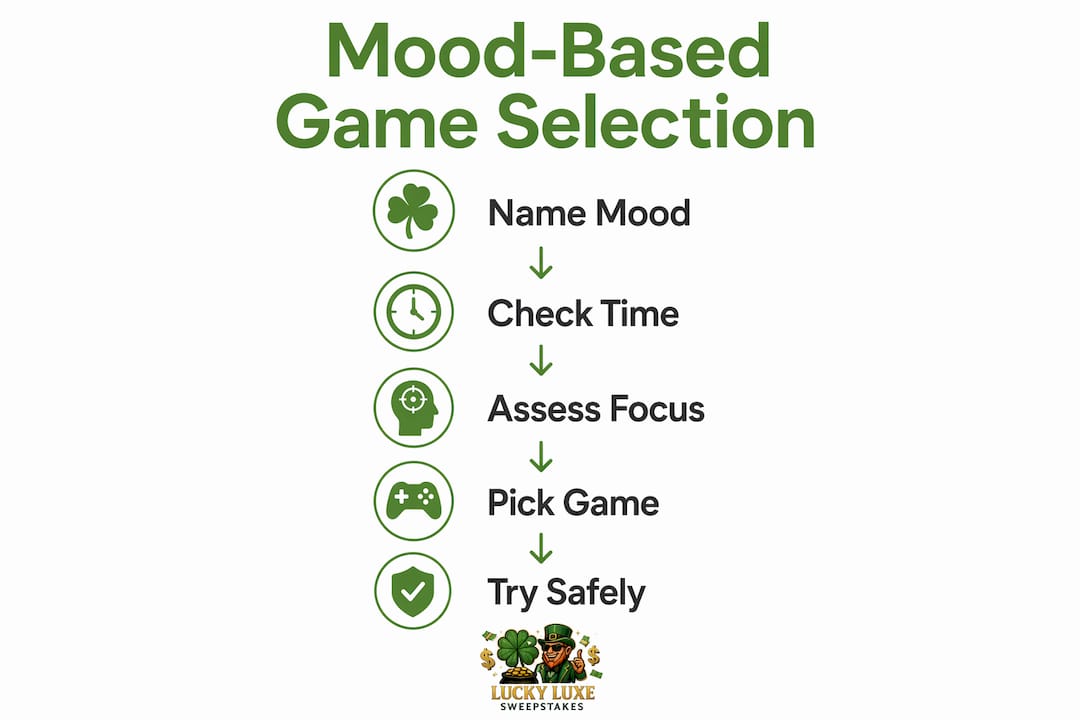
Pick your mood, check your time and focus, then match to a game type. That's the whole method. Vibe-based discovery consistently outperforms genre browsing or top-seller lists for emotional satisfaction, because it accounts for what you actually have to give right now, not just what looks appealing. The four variables that decide everything:
- Current emotional mood (chill, wired, social, creative)
- Available time (15 minutes, 30–60 minutes, or 2+ hours)
- Focus level (low, medium, high)
- Social vs. solo preference
Quick action: Name your mood out loud, pick a time window, and check Luckyluxe's hot-game highlights for a low-commitment first try.
Mood-based game recommendations reduce decision paralysis by forcing honest answers about your current mental bandwidth, not your ideal-day preferences. That distinction is what makes the method actually work.
Table of Contents
- How do you choose a game matching your mood in 60 seconds?
- Which game type actually matches each mood?
- How do you match a game to your available time and energy?
- How can you try a game safely before committing?
- What are the signs a game is a poor mood fit?
- Key Takeaways
- Why mood-first beats genre-first every time
- Luckyluxe puts mood-based discovery into practice
- Useful sources
How do you choose a game matching your mood in 60 seconds?
- Name your mood. Chill? Wired? Lonely? Creative? Be specific. "Fine" doesn't help you pick anything.
- Pick your time window. 15 minutes, 30–60 minutes, or 2+ hours. Be honest, not optimistic.
- Rate your focus. Low (you're half-watching TV), medium (you can concentrate for short bursts), or high (you're locked in).
- Decide: solo or social? Do you want company, competition, or quiet?
- Map to a game type. Chill + low focus + solo = quick slots or fishing. Wired + high focus + social = tournament or arcade challenge. Creative + medium focus = casual puzzle or building-style arcade.
- Check stop-friendliness. Can you exit cleanly in your time window? If not, it's the wrong game for right now.
- Test with a promo or hot-game highlight. Luckyluxe surfaces promotional game highlights and featured sections so you can try a recommended title without spending Gold Coins upfront.
Pro Tip: Be honest about your capacity. If you're tired or distracted, admit it before step one. Picking a high-focus game when you're running on empty is how sessions turn frustrating fast. MyPlayMode's research frames it well: treat a game like your favorite sweater, not a performance test.
Which game type actually matches each mood?
Platforms group games into emotional categories for a reason: the same title that feels thrilling on a Friday night can feel exhausting on a Tuesday after work. Here's how the four core moods map to game types.

Relaxing/Chill
You want low stakes, repetitive satisfaction, and zero pressure. Soothing games prioritize simple, repetitive tasks and atmosphere over scores or progression, which is exactly what makes them restorative.
- Quick slots with low-volatility settings: short spin cycles, no complex bonus chains
- Fishing/idle games: tap-and-wait mechanics, ambient audio, no time pressure
- Laid-back puzzle: match-three or sorting games with no countdown timer
Session scenario: 20 minutes before bed, phone in hand, no real goal. A fishing game or a gentle slot with auto-play fits perfectly.
Intense/Adrenaline
You want a pulse. Something that rewards fast decisions and keeps you leaning forward.
- Fast arcade games: quick reaction rounds, score-chasing, short loops
- High-volatility slots: bigger swings, longer tension before a payout
- Tournament play: head-to-head competition with a real endpoint
Session scenario: You've got 45 minutes and you're already energized. A timed arcade challenge or a tournament slot gives that rush without requiring a two-hour commitment.
Social
You want to feel connected, even loosely. Leaderboards, shared rooms, or cooperative mechanics all count.
- Tournament or multiplayer arcade: compete against real players, see live rankings
- Social slots with shared jackpots: the communal element adds stakes without isolation
- Referral-linked play: inviting a friend and playing alongside them, even asynchronously
Session scenario: Weekend afternoon, friends are busy, but you want the feeling of playing with someone. A live tournament on Luckyluxe scratches that itch.
Creative
You want to build, express, or solve something. Creative-vibe players are 30% more likely to extend their sessions, so watch your time here.
- Casual puzzle or building-style arcade: design-your-own elements, open-ended outcomes
- Themed slot series: narrative-driven games where the story unfolds across rounds
Pro Tip: The mismatch trap is "beautiful but demanding." A visually rich game with complex bonus mechanics looks relaxing but requires real focus. If a game has a tutorial longer than two minutes, it's probably not a chill pick.
How do you match a game to your available time and energy?
Stop-friendliness is the most underrated variable in game selection. A game you can't exit cleanly in your window will leave you more stressed than when you started.
| Time Window | Recommended Game Type | Stop-Friendly? | Quick Note |
|---|---|---|---|
| 15 minutes | Quick slots, idle fishing | Yes | Auto-save, no mid-round commitment |
| 30–60 minutes | Arcade challenge, casual puzzle | Usually | Check for natural break points |
| 2+ hours | Tournament, narrative slots, social play | Varies | Confirm session length before starting |
Focus level matters just as much as time. Low focus pairs with tap-and-go mechanics where a missed spin costs nothing. Medium focus handles short arcade rounds or puzzle sequences. High focus is the only state where tournament play or strategy-heavy arcade actually feels good.
Platforms that surface stop-friendliness cues alongside time estimates reduce wasted play and improve satisfaction. When Luckyluxe's featured games sections highlight a title, check whether it shows session-length context before you click in.
For a deeper look at planning sessions around your schedule, the casual gaming session planning guide breaks down time-window strategies in more detail.
How can you try a game safely before committing?
The fastest way to confirm a mood match is a short test run with no real cost on the line.
- Daily bonuses and free Gold Coins: Luckyluxe offers daily bonus claims so you can spin without dipping into a purchase.
- Promo Sweeps Coins: received through promotions or Gold Coin purchases, these let you play sweepstakes-eligible rounds at no extra cost.
- Hot-game highlights: the platform's featured section surfaces titles that are trending or newly promoted, reducing the time you spend scrolling before finding something worth trying.
- Short demo rounds: some titles allow a few free rounds before any commitment, giving you a feel for the mechanics and pacing.
- Referral rewards: invite a friend and both of you get bonus play credit, which is a low-friction way to test social game modes together.
PlayNxt's workflow shows how this can work in under 30 seconds: pick time, pick mood, get 1–3 recommendations with stop-friendly notes. Luckyluxe's hot-game highlights follow the same logic, surfacing context alongside the title.
Pro Tip: Set a 10–15 minute "tester" timer when you try a new game. When it goes off, run a quick gut check: Did the mood match? Did it drain you or restore you? Keep or switch. That's the whole post-test checklist.
What are the signs a game is a poor mood fit?
A bad mood match usually announces itself within the first five minutes. The problem is that most players push through instead of switching.
Red flags to watch for:
- Rising frustration after two or three rounds with no satisfying moment
- Feeling locked in because progress requires a longer session than you planned
- Reward loops that push you toward spending more to unlock the next step
- Social features that feel competitive in a stressful way rather than fun
How to step away cleanly:
- Pause at the next natural break point (end of a round, not mid-spin).
- Switch to a low-focus game: idle fishing or a simple slot resets your baseline fast.
- Claim a promotion or daily bonus on a different title so the switch feels like a fresh start, not a loss.
- If a session has already gone longer than planned, close the app entirely and return tomorrow.
Luckyluxe's support resources and responsible gaming tools are available if you need to set limits or take a break. Prioritize enjoyment. Chasing an unfamiliar reward in a game that already feels wrong is the clearest sign to stop.
Safety reminder: Play for the experience, not to recover a bad session. If a game is making your mood worse, switching is the right call, not a failure.
Key Takeaways
Matching a game to your mood comes down to four honest answers: current emotional state, available time, focus level, and social preference.
| Point | Details |
|---|---|
| Name your mood first | Specific mood labels (chill, wired, social, creative) lead to better game picks than genre browsing. |
| Time and focus decide stop-friendliness | A 15-minute window needs a game you can exit cleanly; a 2-hour window opens up tournaments and narrative play. |
| Test before committing | Use daily bonuses, promo Sweeps Coins, or hot-game highlights to confirm a mood match at no extra cost. |
| Red flags mean switch, not push | Rising frustration or forced long sessions are signals to exit, not reasons to keep going. |
| Luckyluxe makes testing low-risk | Hot-game highlights, daily bonuses, and Sweeps Coin promos let you run the 60-second checklist with real games, not just theory. |
Why mood-first beats genre-first every time
The conventional wisdom in casual gaming is to browse by genre or pick whatever's trending. That approach works fine when you have energy and time to spare. It fails badly when you're tired, short on time, or just need something that fits right now.
Vibe-based discovery works the same way a good music playlist does: it meets you where you are, not where you wish you were. The 60-second checklist in this guide isn't a gimmick. It's a forcing function that makes you answer the one question most players skip entirely: what do I actually have to give this session?
The players who get the most out of social casino games aren't the ones who play the longest. They're the ones who pick the right game for the right moment, test it cheaply, and exit before it turns sour. That's the whole skill. Try the checklist before your next session and see how different it feels to start with a clear answer instead of a scroll.
Luckyluxe puts mood-based discovery into practice
Luckyluxe gives you the tools to run the 60-second method with real games, not hypotheticals. Hot-game highlights surface trending titles with enough context to judge fit before you click in. Daily bonuses and promo Sweeps Coins mean your first test of any mood-matched game costs you nothing extra. The referral program adds a social layer if your mood calls for it. Slots, fishing, and arcade options cover every mood category in this guide, from a five-minute chill spin to a full tournament session.
Pick your mood, check the hot-game highlights on Luckyluxe, and run the checklist. Your first test is on the house.
Useful sources
The following sources informed this guide and are worth reviewing for deeper methodology or additional game examples.
- Gameopedia — Find Games by Emotion: Research on vibe-based discovery and why emotional resonance outperforms popularity-based recommendations.
- MyPlayMode — Smart Game Recommendations: Practical framework for the four selection variables and the importance of honest capacity assessment.
- GGDB — Play by Mood: Platform implementation of mood categories (Relaxing, Intense, Social, Creative) with real game examples.
- PlayNxt — App Store: Compact mood-to-recommendation workflow with stop-friendly notes, useful as a model for the 60-second method.
- Apple App Store Editorial — Games to Soothe Your Mood: Curated examples of restorative game mechanics and why simple, repetitive tasks reduce stress.