

FAQs on gaming platforms are defined as structured self-service resources that give players immediate answers to common questions without interrupting gameplay. The role of FAQs in gaming platforms goes far beyond a simple help page. These tools directly affect whether a player stays engaged or quits in frustration. Platforms like GameFAQs have proven this for decades, and today's AI-powered in-game support systems are taking that function to a new level. The global gaming market reached $455 billion in 2024. At that scale, a player who leaves because they can't find a quick answer represents real, measurable revenue loss.
How do FAQs improve player experience and retention on gaming platforms?
FAQs solve the most common problem in gaming support: players need answers fast, and they need them without leaving the game. A player stuck on a payment issue, a broken quest, or a confusing mechanic will not wait 24 hours for an email reply. They will quit. A well-placed FAQ prevents that exit.
In-game support systems that surface contextually relevant answers achieve deflection rates over 90%. That means more than 9 out of 10 player issues get resolved without a human agent ever getting involved. That is not just an efficiency win. It is a player retention win.
The benefits of FAQs for gamers break down into three clear categories:
- Instant availability. FAQs work at 3 a.m. on a holiday weekend. Human support does not.
- Reduced frustration. Players who find answers quickly stay in a positive emotional state and keep playing.
- Lower support costs. Studios redirect agent time toward complex issues that actually need a human.
Gaming customer support differs fundamentally from standard service. It demands emotional intelligence, product expertise, and near-instant responses to maintain player loyalty. FAQs carry the first layer of that demand automatically.
Pro Tip: If you hit a wall mid-session, check the in-game help menu before closing the app. Most modern platforms surface FAQ answers directly in the interface, so you never lose your progress or game state.

What makes modern gaming FAQs different from traditional FAQ pages?
Traditional FAQ pages are static lists of questions sorted by category. You search a keyword, scan a list, and hope something matches. Modern gaming FAQs work nothing like that.
The shift is from keyword matching to context awareness. SDK-based support tools now detect your current game state, your account status, and even what screen you are on. They surface the most relevant FAQ content automatically, before you even type a question. That context-aware approach significantly improves resolution efficiency compared to separate help portals.
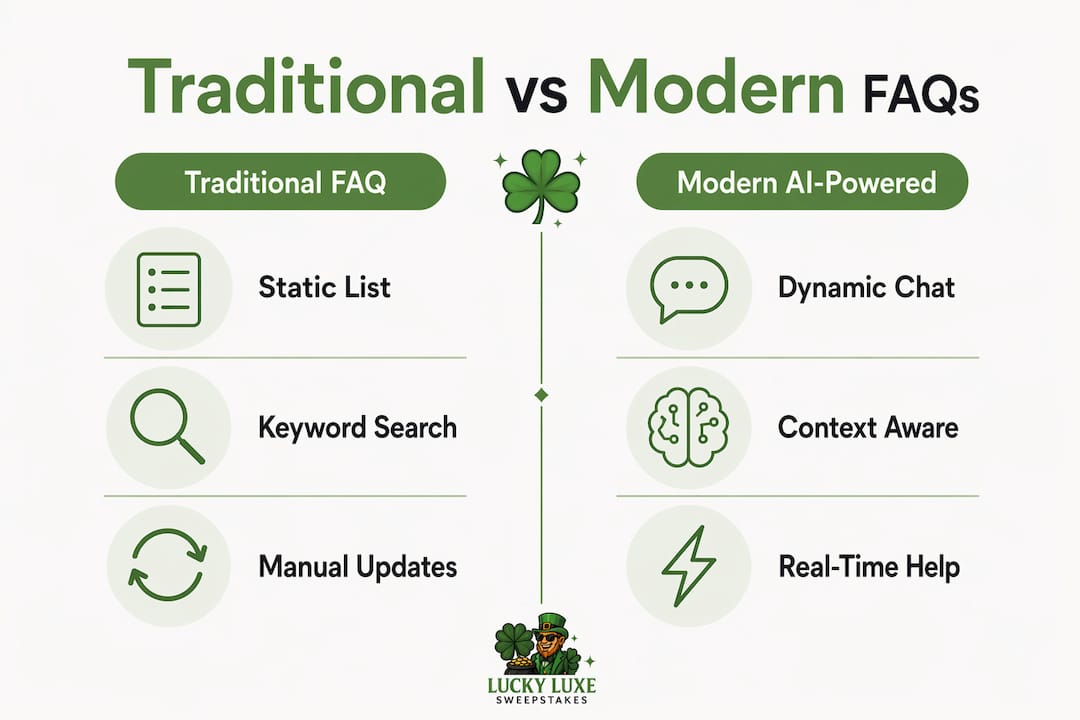
AI-powered systems take this further. Tools like Instadesk's "Ask AI a Question" feature transform FAQs from static pages into dynamic conversational assistants that interpret natural language and maintain dialogue context. You can type "why did my coins disappear after the update" and get a direct, specific answer instead of a list of 40 vaguely related articles.
| Feature | Traditional FAQ | Modern AI-Powered FAQ |
|---|---|---|
| Format | Static list | Conversational, dynamic |
| Search method | Keyword matching | Natural language processing |
| Context awareness | None | Detects game state and account status |
| Availability | Separate help portal | Embedded inside the game interface |
| Update speed | Manual, infrequent | Continuous, patch-synced |
The shift to AI conversational assistants eliminates the friction of keyword-based searches entirely. Players ask questions the way they think, not the way a database is organized. That change alone reduces abandonment at the support stage.
Pro Tip: When using an AI-powered in-game FAQ, phrase your question as you would ask a friend. "How do I unlock the bonus round?" works better than "bonus round unlock method."
How do community-created FAQs and guides add value to gaming platforms?
Official FAQs cover the basics. Community-created guides cover everything else. GameFAQs has hosted over 1.5 million active questions and answers since 1995, serving players across PlayStation, Xbox, Nintendo, and PC. That volume exists because official documentation consistently leaves gaps.
Players rely on guides and FAQs primarily because modern games are more ambitious and complex, requiring decision-making that official tutorials never cover. A game's built-in tutorial teaches you the controls. A community FAQ teaches you which skill tree actually works, which side quest is worth your time, and which boss mechanic the developers forgot to explain. That is a different category of knowledge entirely.
Community guides also fill a practical gap for players with limited time. Not everyone can spend 80 hours experimenting. A well-written community FAQ compresses that experimentation into a 10-minute read. That reduction in effort-to-reward gaps makes games more accessible without changing the game itself.
Reliability is the one real challenge with community content. Experienced players actively check FAQ version compatibility and community feedback to confirm guides remain accurate after patches. A guide written for version 1.0 may be completely wrong after a major update. The best community platforms address this with version tags, patch notes references, and active comment sections where players flag outdated information.
The practical value of community FAQs includes:
- Strategy depth. Guides cover mechanics, builds, and secrets that official sources ignore.
- Update tracking. Active communities flag when content becomes outdated after patches.
- Accessibility. Players with limited time get the same knowledge as those who grind for hundreds of hours.
- Cross-platform coverage. Platforms like GameFAQs aggregate knowledge across every major gaming system.
Understanding how to access support resources while gaming means knowing when to use official FAQs and when to turn to community guides. Both serve different needs, and the best players use both.
What are best practices for designing effective FAQs on gaming platforms?
Effective FAQ design starts with one rule: put the answer where the player already is. A FAQ buried three menus deep inside a settings panel will not get used. A FAQ that appears automatically when a player pauses on a confusing screen will.
1. Use contextual surfacing. Integrate FAQ delivery directly into the gameplay interface via SDK. When a player opens their inventory for the first time, surface the inventory FAQ automatically. Do not wait for them to search.
2. Communicate transparently during updates. Transparent communication during live game updates including maintenance announcements, known issues, and workarounds is critical to prevent negative community rumors. Update your FAQ the moment a patch goes live. Players who find a current, accurate answer during a live event stay calm. Players who find outdated information go to social media to complain.
3. Include actionable workflows. A FAQ that says "contact support for password issues" is not a FAQ. It is a redirect. The best FAQs walk players through the actual steps: reset your password here, check your purchase history here, verify your account here. Luckyluxe's platform support center demonstrates how self-service options reduce support ticket volume when workflows are genuinely actionable.
4. Version and date every entry. Players verify FAQ accuracy by checking version numbers and patch note compatibility. An undated FAQ is an untrustworthy FAQ. Add the patch version and last-updated date to every entry.
5. Build in feedback loops. A simple "Was this helpful?" prompt at the end of each FAQ entry generates data on what is working and what is not. Use that data to prioritize rewrites.
Pro Tip: If you manage a gaming platform, treat your FAQ as a living document. Schedule a review after every major patch. Outdated answers erode player trust faster than no answer at all.
Key takeaways
FAQs on gaming platforms are the single most cost-effective tool for reducing player frustration and protecting retention in a $455 billion industry.
| Point | Details |
|---|---|
| Deflection rates exceed 90% | In-game FAQs resolve the vast majority of player issues without human agent involvement. |
| Context-aware delivery matters | SDK-based FAQs that detect game state outperform separate help portals in resolution speed. |
| Community guides fill official gaps | Platforms like GameFAQs host over 1.5 million entries covering strategy and mechanics official docs skip. |
| Version accuracy is non-negotiable | Players check patch compatibility before trusting any FAQ; undated entries lose credibility fast. |
| Transparent update communication | Updating FAQs during live events prevents misinformation and protects player trust. |
Why I think most platforms still underinvest in FAQs
The data on FAQ effectiveness is not subtle. Deflection rates above 90%, direct ties to player retention, and a $455 billion market that depends on keeping players engaged. And yet, most gaming platforms still treat their FAQ section as an afterthought updated once a quarter by someone who is not a player.
I have watched players abandon games mid-session over issues that a single clear FAQ entry would have resolved in 30 seconds. That is not a support problem. That is a design problem. The FAQ was either missing, outdated, or buried where no frustrated player would ever find it.
The shift toward AI-powered, context-aware support is the right direction. But the technology only works if the underlying content is accurate, current, and written by people who actually understand how players think. A chatbot trained on a stale FAQ is worse than no chatbot at all. It gives confident wrong answers, and that destroys trust faster than silence.
My advice to players: treat community guides on platforms like GameFAQs as your first stop for strategy and mechanics. Use official in-game FAQs for account issues, payment questions, and known bugs. Check the version number on any guide before you follow it. And if a platform's FAQ consistently fails you, that tells you something real about how much that platform values your time.
The platforms that invest in great FAQ systems are the ones that understand gaming is emotional. A player who gets a fast, accurate answer stays in a good mood and keeps playing. A player who hits a wall and finds nothing useful logs off and might not come back.
— Skyline
Luckyluxe and the support experience players actually need
Luckyluxe builds its player experience around the idea that great support should never pull you away from the game. The platform offers slots, fishing games, and arcade options alongside a support structure designed to answer common questions quickly and clearly.
When you run into a question about your account, a promotion, or how a specific game works, Luckyluxe's support resources are built to get you back to playing fast. The platform's FAQ and help features reflect the same principles this article covers: fast answers, clear workflows, and content that stays current. Visit Luckyluxe to see how integrated player support changes the experience from the first session. Whether you are a casual player or a regular, the difference between a platform that answers your questions and one that does not shows up immediately.
FAQ
What is the role of FAQs in gaming platforms?
FAQs on gaming platforms serve as self-service resources that give players immediate answers to common questions without interrupting gameplay. They reduce player frustration, lower support costs, and directly protect player retention.
How do in-game FAQs differ from a standard help website?
In-game FAQs use SDK integrations to detect your current game state and surface relevant answers automatically, while standard help websites require you to leave the game and search manually. Context-aware delivery resolves issues faster and keeps players engaged.
Are community FAQs like GameFAQs reliable?
Community FAQs are reliable when they include version numbers, patch compatibility notes, and active comment sections where players flag outdated content. Always check the last-updated date and patch version before following any guide.
How often should gaming FAQs be updated?
FAQs should be updated with every major patch or live event. Outdated FAQ entries lose player trust quickly, especially when players can verify version compatibility themselves.
Why do players use guides and FAQs instead of figuring things out alone?
Modern games are more complex than official tutorials cover, and community guides reduce the effort-to-reward gap for players with limited time. Using a guide is an adaptation to game complexity, not a shortcut.