

An active referral is a referred lead or account that has met the specific activity requirement a program sets, usually a completed purchase, verified signup, or ongoing paid status, and therefore qualifies for billing, commission, or payout. That's the working definition across billing platforms, partner agreements, and clinical programs alike, even though the exact trigger event changes by industry.
Three quick examples show how differently this plays out:
- SaaS billing: ReferralRock counts a referral as active once it has a qualifying event within the billing cycle, and each one counts only once per month no matter how many events occur.
- Partner contracts: LawInsider's collected contract definitions describe an active referral as a client whose ongoing transactions generate partner revenue, often verified through automated platform checks.
- Sweepstakes and gaming platforms: on Luckyluxe, a referred player typically needs to complete signup and meet a minimum play or purchase threshold before the referral counts toward a reward, a pattern you'll see across most consumer referral programs, including our own referral link tracking.
The term shows up constantly in program terms and conditions, but almost nobody defines it the same way twice. That inconsistency is exactly why it's worth understanding the mechanics, not just the phrase.
Key Takeaways
An active referral is a referred contact that has met a program's defined activity trigger, such as a paid transaction or verified signup, and therefore counts toward billing, commission, or reward.
| Point | Details |
|---|---|
| Signup isn't activity | A referral only becomes active after it clears the program's specific trigger, not at the moment of signup. |
| Counting resets by cycle | Most programs, including ReferralRock's Monthly Active Referrals model, count each referral once per billing cycle. |
| Review windows protect payouts | A 45 to 60 day review period is common to confirm genuine activity before releasing partner rewards. |
| Contracts need named triggers | Push for a specific, verifiable trigger event and stated review window in any partner agreement you sign. |
| Warm handoffs raise conversion | Nonprofit and clinical programs show that follow-up accountability, not just referral, drives real outcomes. |
Table of Contents
- What Is an Active Referral, and How Do Programs Count It?
- Why the Definition Affects Billing and Partner Payouts
- How Active Referral Shows Up Across Different Industries
- How Long Does an Active Referral Stay Active?
- A Practical Checklist for Converting Referrals Into Active Ones
- What Program Owners and Partners Should Actually Push For
- Frequently Asked Questions
- Sources
What Is an Active Referral, and How Do Programs Count It?
Every program builds its own trigger for what turns a referred contact into a counted, billable referral. The event varies, but it almost always ties back to something measurable rather than a human judgment call.
The most common triggers you'll run into:
- A completed purchase or first payment, common in e-commerce and subscription software.
- Account verification, where the platform confirms identity or eligibility before counting the referral.
- Trial-to-paid conversion, the standard SaaS pattern.
- A minimum usage or transaction threshold within a set window.
- An automated activity check, like a login streak or a recorded transaction event.
Oli Health's referral terms illustrate this well: a referred customer only becomes an "Active Referral" once they're on a paid, eligible plan, have completed signup, have moved past any trial or refund period, and remain in good standing. Miss any one of those conditions and the referral simply doesn't count yet.
ReferralRock frames this at the program level with a metric called Monthly Active Referrals (MAR): the total count of active referrals during a given billing cycle. A referral is either active or inactive in that period, and it counts once per cycle regardless of how many qualifying actions it generates. That single detail trips up a lot of partnership managers who assume repeat activity multiplies the payout.
"A referral is active when it has a qualifying event, and it counts once per month even if multiple events occur." This is the core mechanic behind Monthly Active Referrals, and it's the single most misunderstood rule in referral billing.
Here's the distinction that matters most for anyone reading a contract: signup is not the same as activity. A referred user creating an account is a lead. That same user hitting the platform's activity threshold, whether that's a paid transaction, a verified login pattern, or a minimum spend, is what converts the lead into something billable. If you only track signups, you're measuring the wrong number.
Why the Definition Affects Billing and Partner Payouts
The gap between "referred" and "active" is where money either gets paid correctly or gets disputed. Get the counting rules wrong, and you'll either overpay partners or underpay them, both of which erode trust fast.
Monthly Active Referrals directly shapes invoice totals and plan eligibility on billing platforms. A program that counts 40 active referrals in a cycle bills or rewards based on that number, not on the raw count of everyone who ever clicked a referral link. That's a meaningful difference when a partner assumes every signup counts toward their tier.
Payout timing depends on review windows, too. ActiveCampaign's Refer A Friend program requires the referred person to become a paid, active customer, and it applies a review period, commonly around 60 days, before releasing the reward. That delay isn't bureaucratic friction. It confirms the referred account is sticking around rather than canceling the moment the reward clears.
A few practical consequences worth flagging:
- Active-referral churn affects forecasting: if referred accounts cancel after the review period, your projected revenue from that partner channel shrinks.
- Retention-based discounts and tiered rewards often key off ongoing active counts, not lifetime totals, so a partner's benefit can drop if their referred base goes quiet.
- Fraud protection depends on the review window; too short, and bad actors game the system, too long, and legitimate partners get frustrated waiting on their payout terms.
Pro Tip: When negotiating a partner agreement, push to get the review window and the exact activity trigger written into the contract, not just referenced as "standard terms." A 45-day window with a clear, single trigger event is far easier to audit than a vague 30-to-60-day range tied to "ongoing engagement."
How Active Referral Shows Up Across Different Industries
The phrase travels well beyond SaaS billing. Once you see the pattern, you'll recognize it in nonprofit case management, affiliate contracts, and even public-health fieldwork.
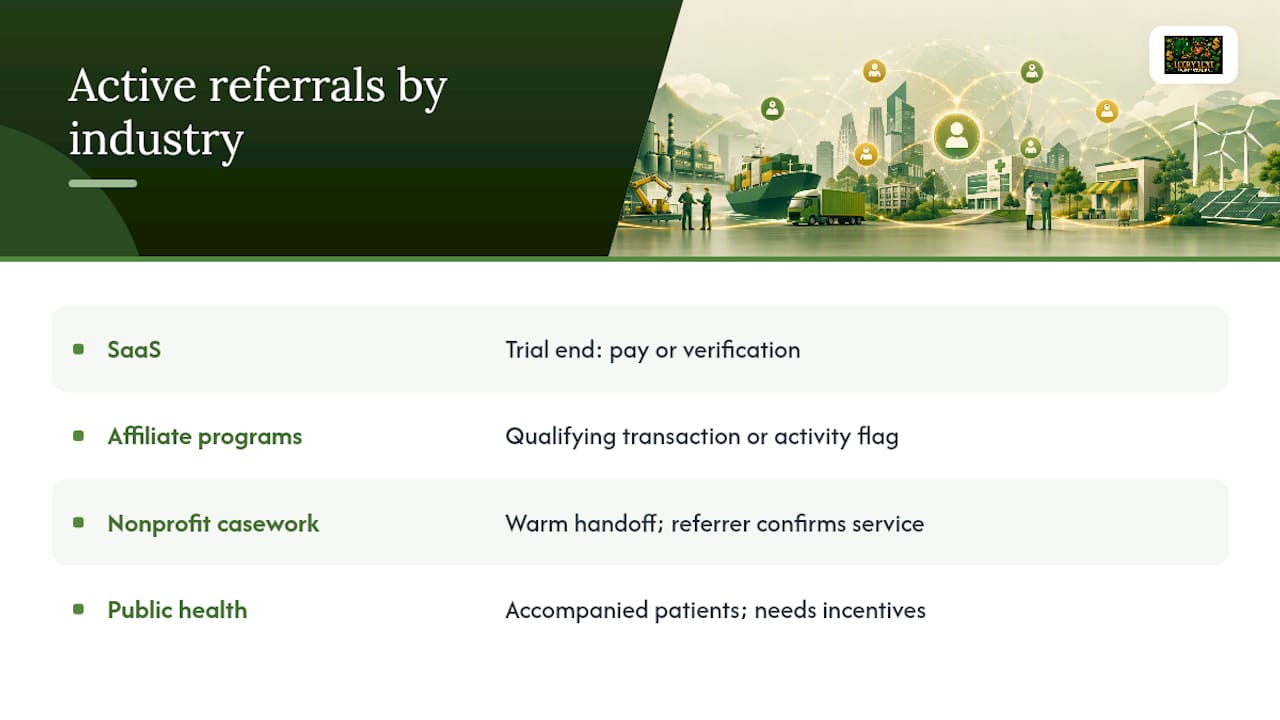
In SaaS, the rule is almost always trial-then-pay. A referral doesn't count until the trial ends and the customer either pays or clears a verification check, which is exactly how Oli Health structures its program to protect against referrals that vanish before converting.
In affiliate and partner programs, commission usually hinges on a qualifying transaction. LawInsider's contract examples repeatedly tie "active" status to a minimum transaction count or a platform-verified activity flag rather than a simple signup date. That protects the paying business from rewarding referrals that never generate real revenue.
Nonprofits use a different model entirely, one built on human follow-through rather than automated checks. United Against Poverty describes an active referral as a warm handoff, where the referring organization stays involved to confirm the client actually reached the appointment and received the service, rather than just handing over a phone number and hoping.
"The referrer stays involved to ensure services are delivered rather than only providing a contact list." That accountability is what separates a warm handoff from a name on a spreadsheet, according to United Against Poverty.
Public health takes the warm handoff even further. A Burkina Faso study on tuberculosis case-finding found that traditional health practitioners who physically accompanied patients to clinics increased confirmed case detection, though the researchers noted the model's sustainability depended heavily on incentives and staff buy-in at the receiving facilities. The lesson translates directly to commercial programs: an "active" referral that requires real effort from the referrer tends to convert better, but it also needs a support structure to keep functioning.
How Long Does an Active Referral Stay Active?
Most programs anchor active status to the billing cycle, meaning a referral that qualifies in March doesn't automatically carry that status into April. It has to keep meeting the activity criteria each period, or its status resets.
Review periods add another layer on top of that cycle. A 60-day review window is common industry practice for confirming genuine, sustained activity before a reward gets paid out. That window exists specifically to catch referred accounts that sign up, trigger a payout event, then cancel almost immediately, a pattern that costs programs money if there's no buffer.
Several conditions commonly cause an active count to drop:
- Subscription cancellation during or shortly after the review period.
- A refund that retroactively invalidates the original qualifying transaction.
- Extended inactivity, such as a paid account that stops logging in or transacting.
- Failure to clear identity or eligibility verification after initial signup.
Trial-period edge cases cause the most disputes. A referred user who converts to paid on day 29 of a 30-day trial, then cancels on day 35, can create real disagreement about whether that referral ever counted as active in the first place. Programs that spell out the exact trigger event, and log the timestamp of that event, avoid most of these arguments before they start.
A Practical Checklist for Converting Referrals Into Active Ones
Turning a referred lead into a counted, billable active referral takes deliberate process design, not luck. Here's a sequence that works across most program types.
- Define the activity trigger explicitly in your terms. Name the exact event, whether it's a payment, a verified account flag, or a transaction count, so there's no ambiguity later.
- Instrument tracking at the source. Make sure your platform logs the trigger event with a timestamp and a source ID, so disputes can be resolved by pulling a record instead of relying on memory.
- Build in verification and anti-fraud checks. Automated identity or payment verification catches most abuse before it becomes a billing problem.
- Set a review window that fits your risk tolerance. A shorter window pays partners faster but raises fraud exposure; a longer one protects revenue but frustrates partners waiting on rewards.
- Automate notifications and payouts. Manual tracking scales poorly and is where most billing disputes originate.
Sales and success teams can push conversion higher with a few tactical moves: timed onboarding emails near the end of a trial period, incentives that reward the referred user for completing the qualifying action, and warm handoffs where a real person confirms the referred contact actually engaged. These tactics matter as much as the technical tracking, since a well-designed referral link strategy still depends on someone following up.
Pro Tip: Audit your active-referral log monthly, not just at renewal time. Catching a verification gap or a missed trigger event early is far cheaper than reconciling a disputed payout six months later.
- Log every qualifying event with a timestamp and unique source ID.
- Cross-check payout amounts against the review-window rules before releasing funds.
- Give partners read access to their own referral dashboard so disputes surface early, not after invoicing.
What Program Owners and Partners Should Actually Push For
Most referral disputes trace back to vague contract language, not bad faith. If a partner agreement says "active referral" without defining the trigger event, the review window, or the counting cycle, both sides are guessing until something goes wrong.
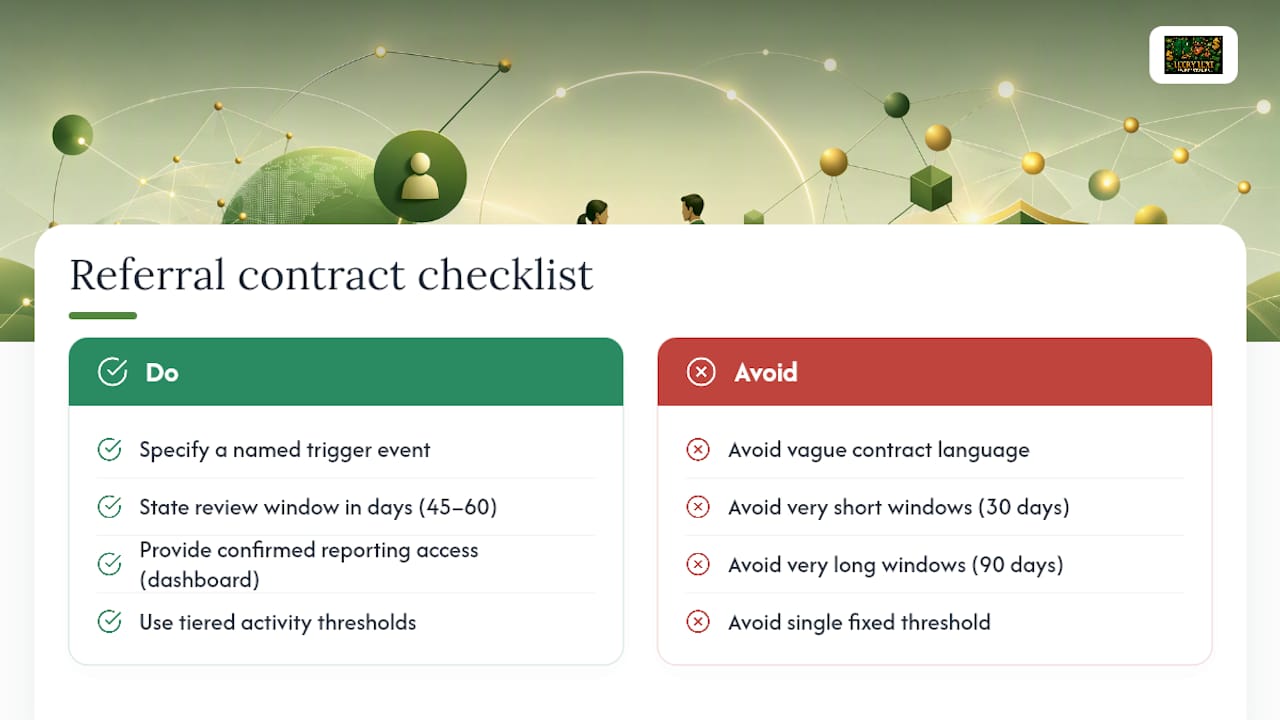
The tradeoff that matters most is review-window length against fraud exposure. A 30-day window moves fast but invites gaming; a 90-day window is safer but delays partner cash flow long enough to sour relationships. Something in the 45 to 60 day range, tied to a single clear trigger event, tends to satisfy both sides without inviting abuse.
Activity thresholds deserve the same scrutiny. A threshold set too high excludes legitimate, lower-volume partners who still bring real value. A threshold set too low invites low-quality referrals that never generate lasting revenue. Neither extreme serves the program well, and the fix is usually a tiered structure rather than a single bar everyone has to clear.
Transparent, real-time dashboards solve more disputes than any legal clause. When a partner can see exactly which referrals are active, pending, or disqualified, and why, most billing arguments never happen in the first place. If you're reviewing a referral contract, look for three things before signing: a named, verifiable trigger event, a stated review window with an actual number of days, and confirmed reporting access. If any of those three is missing or vague, negotiate for it before you commit.
Frequently Asked Questions
What does active referral mean in a billing context? It means a referred account or lead has met the specific activity requirement a program defines, usually a payment or verified transaction, so it counts toward that billing cycle's total.
How is an active referral different from a regular referral? A regular referral is just a name or contact passed along. An active referral has cleared a defined trigger event, like a completed purchase or verified signup, that makes it billable or reward-eligible.
Do active referral counts reset every month? Usually, yes. Most billing metrics like Monthly Active Referrals count activity within a single cycle, so a referral has to keep meeting the criteria each period to stay counted.
Why do programs use a review period before paying rewards? A review period, often around 60 days, confirms the referred account stays active rather than canceling right after triggering a payout, which protects the program from fraud and short-lived signups.
Can a refund cancel an active referral after it's already counted? Yes. Many programs retroactively invalidate a referral's active status if the qualifying transaction gets refunded, which is why logging timestamps and source IDs matters for resolving disputes later.
Sources
A handful of primary documents anchor most of the definitions covered here, and each one is worth reading in full if you're drafting or reviewing referral terms.
- Monthly Active Referrals Explained
- Active Referral definition | Law Insider
- Referral Program Terms & Conditions | Oli Health
- Refer A Friend program — ActiveCampaign
- Active referral system — United Against Poverty
- Active referral model and TB case-finding — PMC