

Secure login in gaming is defined as a multi-layered authentication process that verifies your identity beyond a simple password to protect your account, in-game assets, and personal data from unauthorized access. Modern platforms use MFA, biometrics, and session security to block account theft, fraudulent transactions, and data breaches. The industry standard term for this system is Multi-Factor Authentication, or MFA. Microsoft reports that enabling MFA blocks up to 99.9% of automated account compromise attacks. That single number explains why secure login is no longer optional for any serious gamer.
What does secure login mean in gaming platforms?
Secure login in gaming means the platform confirms you are who you say you are using more than one verification step. A password alone is a single point of failure. Add a second factor, such as an authenticator app code, biometric scan, or hardware key, and attackers need to defeat multiple independent barriers at once.
Modern gaming platforms build secure login around three core layers:
- Password layer: Your first credential, ideally unique and complex, stored as a salted hash the platform never exposes in plain text.
- MFA layer: A time-sensitive code from apps like Google Authenticator or Authy, a biometric check, or a push notification to a trusted device.
- Session management layer: Short-lived tokens and same-site cookie policies that expire active sessions quickly, limiting damage if credentials are ever exposed.
Beyond these three layers, platforms also apply adaptive authentication. Adaptive authentication assigns real-time risk scores from signals like IP reputation, device fingerprints, and login time. A login from your usual device at your usual time scores low risk and passes through with no extra friction. A login from an unfamiliar country at 3 a.m. triggers a step-up challenge. This approach keeps security strong without annoying players during normal sessions.
Pro Tip: Set up an authenticator app like Google Authenticator or Microsoft Authenticator rather than relying on SMS codes. SMS is vulnerable to SIM swap attacks, while app-based codes stay on your device.

What are the common threats to gaming accounts?
Gaming accounts hold real financial and identity value. Skins, currencies, linked payment methods, and personal data make them targets comparable to bank accounts. Attackers know this, and they use several proven methods to break in.
The four most common attack patterns are:
- Credential stuffing: Attackers take username and password lists leaked from other breaches and try them automatically against gaming platforms. Platforms counter this with rate limiting, IP velocity checks, and breached-password detection.
- Phishing: Fake login pages that look identical to real ones capture your credentials the moment you type them. MFA stops most phishing attacks because the stolen password alone is not enough to log in.
- SIM swapping: Attackers convince your carrier to transfer your phone number to their SIM, intercepting SMS verification codes. This is why app-based MFA and passkeys are stronger than SMS fallback.
- Social engineering: Attackers impersonate support staff or friends to trick you into handing over codes or resetting your password on their behalf.
"Credential stuffing, phishing, SIM swap, and token leakage are common attack patterns targeting gaming logins, requiring scalable defenses and user education." — Authentication in gaming platforms
Adaptive MFA challenges triggered by unusual login behavior catch most of these attacks before they succeed. A login attempt from a new device in a different country will trigger an immediate step-up verification, stopping automated attacks cold even when credentials have been stolen.
Secure login methods compared: which one protects you best?
Not all secure login methods offer the same level of protection. The table below compares the most common options available to gamers in 2026.
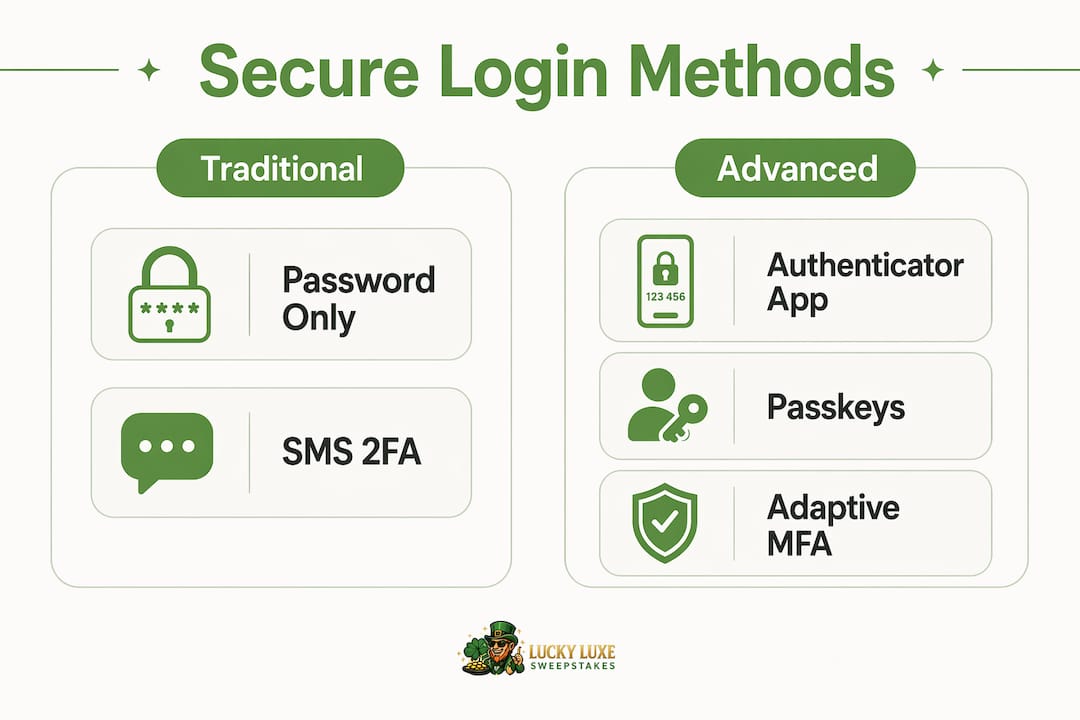
| Method | Protection level | Phishing resistant | User friction |
|---|---|---|---|
| Password only | Low | No | Very low |
| Password + SMS code | Medium | Partial | Low |
| Password + authenticator app | High | Mostly yes | Low |
| Password + biometrics | High | Yes | Very low |
| Passkeys (FIDO2/WebAuthn) | Very high | Yes | Very low |
| Adaptive MFA | High to very high | Yes | Minimal |
Passkeys using FIDO2/WebAuthn are the strongest option currently available. They use public-private key encryption stored on your device, making them immune to phishing because there is no password to steal or intercept. Platforms like those built on the PlayerNetwork standard already support passkey login as a primary method.
Adaptive MFA sits in a practical sweet spot for most gamers. It applies frictionless access during normal behavior and escalates verification only when something looks wrong. Forcing MFA on every single login frustrates players and hurts onboarding conversion. Requiring it only on high-risk actions, such as purchases or linking a new device, keeps security tight where it counts.
Platforms are also moving away from forced MFA compliance toward incentive-based adoption. In-game rewards for enabling MFA increase player security without driving users away. That approach works because players respond to positive reinforcement better than mandatory friction.
Pro Tip: If your gaming platform offers passkey login, switch to it now. Passkeys are faster than typing a password and far more secure than any SMS-based two-factor method.
How to secure your gaming account with safe login practices
Knowing the theory matters less than acting on it. These practices directly reduce your risk of account compromise.
- Use a unique, strong password for every gaming account. A password manager like 1Password or Bitwarden generates and stores complex passwords so you never reuse credentials across platforms.
- Enable MFA immediately. Go to your account security settings and turn on two-factor authentication. Choose an authenticator app over SMS wherever the option exists.
- Recognize phishing attempts. Legitimate platforms never ask for your password or MFA code via email, chat, or support tickets. Any message requesting login credentials is a red flag.
- Audit linked accounts and authorized devices. Review which third-party apps and devices have access to your account. Remove anything you do not recognize or no longer use.
- Secure your account recovery options. Use a dedicated email address for gaming accounts and protect that email with its own MFA. A weak recovery email is a backdoor into your main account.
- Watch for security notifications from your platform. Alerts about new device logins or password changes are your early warning system. Act on them immediately.
The most overlooked practice is the recovery email. Most players lock down their main account but leave the recovery address wide open. Attackers know this. Securing your recovery path is as important as securing the account itself.
Key takeaways
Secure login in gaming requires layered authentication, adaptive risk controls, and phishing-resistant methods like passkeys to protect accounts from credential theft and automated attacks.
| Point | Details |
|---|---|
| MFA blocks most attacks | Enabling MFA reduces automated account compromise by up to 99.9%. |
| Passkeys are the strongest method | FIDO2/WebAuthn passkeys are immune to phishing and faster than passwords. |
| Adaptive MFA reduces friction | Risk-based step-up authentication challenges only suspicious logins, not every session. |
| Recovery options are a weak link | Securing your recovery email with its own MFA closes a common backdoor attackers exploit. |
| Incentives drive adoption | Platforms offering in-game rewards for enabling MFA see higher security compliance without user drop-off. |
Why I think most gamers are protecting the wrong thing
I have watched the security conversation in gaming focus almost entirely on the login screen itself. Players obsess over password strength, and platforms push MFA hard at signup. Both matter. But the real vulnerability I keep seeing is the recovery chain sitting behind the account.
Most gamers treat their recovery email like a throwaway address. They set it up once, forget about it, and never apply MFA to it. Attackers do not need to crack your gaming password if they can reset it through an unprotected Gmail account you created in 2015. The login screen is the front door. The recovery email is the unlocked window around the side.
Adaptive authentication is genuinely impressive technology. It acts as an invisible wall, as one security researcher described it, stopping threats without the player ever knowing a challenge was triggered. The problem is that adaptive systems protect active sessions. They do not protect the recovery path that bypasses the session entirely.
My advice is to treat your gaming account like a financial account. The data security practices that protect bank accounts apply directly here. Use a dedicated email for gaming. Lock that email down with an authenticator app. Then enable passkeys or app-based MFA on the gaming account itself. That combination closes the two most exploited attack paths simultaneously.
Players who view MFA as a burden are thinking about it wrong. It is insurance on a digital asset that has real monetary value. The five seconds it takes to approve a login notification is a reasonable price for protecting hundreds of dollars in in-game currency, skins, and linked payment methods.
— Skyline
Play securely on Luckyluxe
Luckyluxe builds account security directly into the platform experience. MFA and adaptive authentication protect every player account, so your progress, in-game currency, and personal data stay yours. Luckyluxe offers slots, fishing games, and arcade titles with a user-friendly interface designed for players who want great gameplay without worrying about account safety. The platform's support team is available to help with account recovery and security settings whenever you need it. Ready to play with confidence? Join Luckyluxe today and secure your account from day one.
FAQ
What does secure login mean in gaming?
Secure login in gaming means verifying your identity through multiple authentication steps, such as a password plus an MFA code or passkey, to prevent unauthorized access to your account and personal data.
What is two-factor authentication in gaming?
Two-factor authentication (2FA) in gaming requires a second verification step beyond your password, typically a time-sensitive code from an authenticator app or a biometric scan, before granting account access.
Are passkeys better than passwords for gaming accounts?
Yes. Passkeys based on FIDO2/WebAuthn use device-stored encryption keys that are immune to phishing, making them more secure than passwords or SMS codes, which can be intercepted or stolen.
How does adaptive authentication work in games?
Adaptive authentication assigns a real-time risk score to each login attempt using signals like IP address, device fingerprint, and login time. Low-risk logins pass through without extra steps; high-risk logins trigger a verification challenge.
What should I do if my gaming account is compromised?
Change your password immediately, revoke all active sessions, enable MFA if it was not already on, and contact the platform's customer support team to report the breach and review recent account activity.