
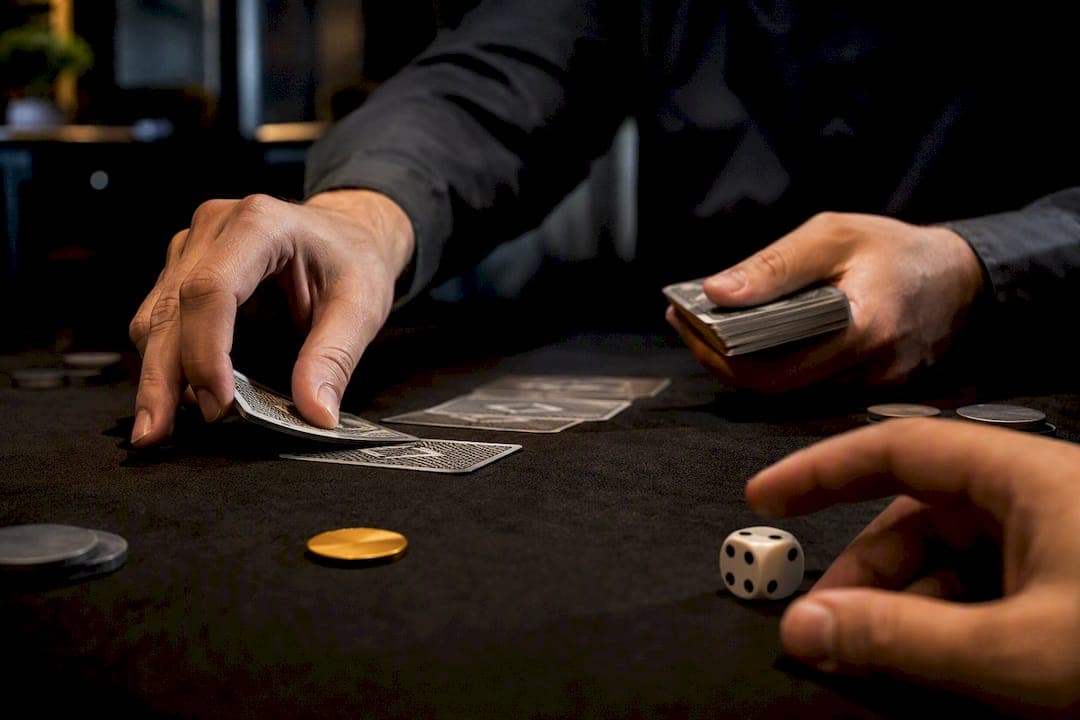
Games are not simply "skill" or "luck" games. They sit on a continuum, and modern frameworks can measure exactly where. Chess sits near the pure-skill end, roulette and slots near pure chance, and poker or backgammon land somewhere in the noisy middle. The catch: short-term results on that middle stretch can look random even when a real skill edge exists underneath.
TL;DR:
- Most games fall between pure skill and pure chance, with the ratio between decision points and randomization determining their position on the continuum.
- The Skill–Luck Index scores games from -1 (pure chance) to +1 (pure skill), with poker at about +0.33 over many hands, indicating time-dependent skill leverage.
- Large sample sizes are essential to accurately assess skill, as short-term results are heavily influenced by variance, especially in chance-heavy games.
- Randomness is a deliberate design tool that can boost engagement and fairness, with input randomness rewarding adaptation and output randomness potentially feeling unfair.
- Legal classification of a game as skill or chance influences regulation and depends on specific outcome determinants, not just player perception or surface features.
Table of Contents
- The Skill vs Luck Gaming Continuum, Mapped
- How Researchers Actually Quantify Skill vs Luck
- Why Sample Size Changes the Whole Story
- Why Game Designers Add or Remove Randomness on Purpose
- How to Estimate Skill vs Luck in Any Game Yourself
- How Luckyluxe Approaches the Skill-Chance Mix
- Why Perceived Skill Changes How Players Feel About a Game
- How the Skill vs Luck Debate Has Evolved Over Time
- Why Skill vs Chance Classification Matters Legally
- What Players Should Actually Take From This
- Where to Play a Balanced Mix of Skill and Chance
- Sources
The Skill vs Luck Gaming Continuum, Mapped
Nobody wins a game of pure chance through practice, and nobody loses chess to a bad shuffle. But most games people actually play sit somewhere between those two extremes, and treating the skill versus luck debate as a coin flip between two labels misses the point entirely.
A better way to think about it: every game has decision points (where skill acts) and randomization points (where chance acts). The ratio between them, and how much a single random event can swing the final result, determines where a game lands.
Chess and Go have no randomization points at all, which is why elite players almost never lose to weaker ones. Backgammon has dice on every turn, but enough turns per game that skilled players still out-perform over time. Poker adds hidden information on top of chance, so skill compounds slower but still wins out across enough hands. Blackjack sits closer to chance because the house edge and fixed rules limit how much a player's decisions can move outcomes. Roulette and slot machines have no decision points that affect the outcome at all.
| Game | Continuum position | Why |
|---|---|---|
| Chess / Go | Pure skill | No randomization; outcome fully determined by decisions |
| Backgammon | Skill-leaning, mixed | Dice every turn, but skill compounds over a full match |
| Poker | Mixed, skill over volume | Hidden information plus cards, but decisions dominate long-run |
| Blackjack | Chance-leaning | Player choices matter at the margins, house edge fixed |
| Roulette / slots | Pure chance | No decisions affect the outcome |
Fantasy sports and daily contests are the trickiest borderline case: they involve real skill in roster construction, but weekly variance in player performance can swamp that skill in any single contest.
How Researchers Actually Quantify Skill vs Luck
Vague statements like "poker is a skill game" are not measurements. Researchers have built actual math to settle these arguments, and the numbers are more precise than most players expect.
A recent quantitative framework introduces a Skill–Luck Index, S(G), scored from −1 (pure chance) to +1 (pure skill). The index decomposes any game into two components:
- Skill leverage (K): how much a player's decisions can shift the probability of winning.
- Luck leverage (L): how much random events can shift that same probability, independent of decisions.
The paper's case studies put chess at roughly S ≈ +1, poker around +0.33, backgammon near 0, and roulette at −1. Backgammon's numbers are particularly telling: K ≈ 0.25, L ≈ 0.25, with a volatility measure (Σ) of 1.2, meaning skill and chance pull almost equally hard on any given roll, but skill still compounds over a full match.
Statistic to watch: poker measures out at S ≈ 0.33 with K around 0.40, which sounds skill-light until you remember that number reflects a single hand. Over thousands of hands, that leverage adds up in ways a single session never reveals.
Outside academic papers, analysts lean on rougher but faster heuristics. Michael Mauboussin's well-known test asks a simple question: could a player lose on purpose? If yes, skill is present, because intentional bad decisions must be able to produce bad outcomes. Analysts also compare variance ratios between top and average players, or run a regression of outcomes against Elo-style skill ratings and check the R². A high R² means skill explains most of the variation; a low one means chance does.
Why Sample Size Changes the Whole Story
A single hand of poker, a single round of blackjack, or even one backgammon game tells you almost nothing about who is actually better. Statistical noise scales down with the square root of the number of trials, not linearly, so doubling your sample size does not cut the noise in half. It takes four times as many trials to cut noise in half.
That is why:
- Recreational poker players rarely see their real edge. A player with a modest 5 bb/100 edge typically needs tens of thousands of hands before that edge becomes statistically visible above the noise.
- Match length is a design lever, not an accident. Backgammon tournaments use multi-game matches specifically because a single game leaves too much room for the dice to override skill.
- Short samples lie in both directions. A weak player can look brilliant over one session, and a strong one can look broken over the same stretch, purely from variance.
If you are judging skill from a handful of results, in any game, you are mostly reading noise dressed up as signal.
Why Game Designers Add or Remove Randomness on Purpose
Randomness in games is not a bug developers tolerate. It's a design decision, and pulling it out entirely often makes a game worse, not better.
Chance acts as an equalizer. A new player can occasionally beat a veteran because of a lucky roll or draw, which keeps casual players in the game long enough to build interest. Design commentary on this exact issue argues that randomness adds tension and keeps games fresh, functioning as a retention tool as much as a fairness one.
There's an important split designers work with:
- Input randomness happens before a decision (the cards you're dealt, the dice roll setting up a turn), and players can still play skillfully around it.
- Output randomness happens after a decision (a 20% chance an attack misses despite the correct choice), and too much of it can make skillful play feel pointless.
Too much output randomness, and skilled players walk away feeling cheated. Too little randomness of any kind, and new players get steamrolled until they quit.
Pro Tip: If a game feels "unfair" after one bad result, check whether the randomness is happening before or after your decisions. Input randomness rewards adapting your strategy; output randomness rewards nothing but resubmitting the same choice and hoping.
How to Estimate Skill vs Luck in Any Game Yourself
You don't need an academic paper to get a real read on a game. A rough version of the researchers' method works with a spreadsheet and some patience.
- Collect outcomes and ratings. Track results across as many sessions or matches as you can, alongside some independent skill measure (an Elo rating, a ranking, or even self-reported experience level).
- Compute the spread. Look at variance in outcomes and the win-rate spread between your strongest and weakest tracked players.
- Run a regression. Regress outcomes against skill ratings and check the R². Closer to 1 means skill dominates; closer to 0 means chance does.
- Interpret with caution. Small samples, rule variations, and differing player pools can all skew the result, so treat any single estimate as a starting point, not a verdict.
How Luckyluxe Approaches the Skill-Chance Mix
Some gaming platforms offer a library that spans slots, fishing games, and arcade titles, with each category sitting in a different spot on the continuum. Slots run almost entirely on chance by design, which is exactly what makes them fast and low-pressure. Fishing games and arcade titles bring in reaction time, aim, and pattern recognition, shifting more of the outcome toward player input. Knowing which category leans which way helps you set expectations before you play, rather than after a rough session.
For a closer look at how those mechanics differ in practice, the breakdown of fishing games versus slot games and the comparison of arcade versus slot games both walk through the mechanical differences in detail. If fairness signals matter to you, Luckyluxe's explainer on what fair play actually means in a gaming context is worth reading before you dive into any chance-driven title.
Why Perceived Skill Changes How Players Feel About a Game
Players don't just care about winning. They care about why they won, and that distinction shapes whether a game feels satisfying or hollow.
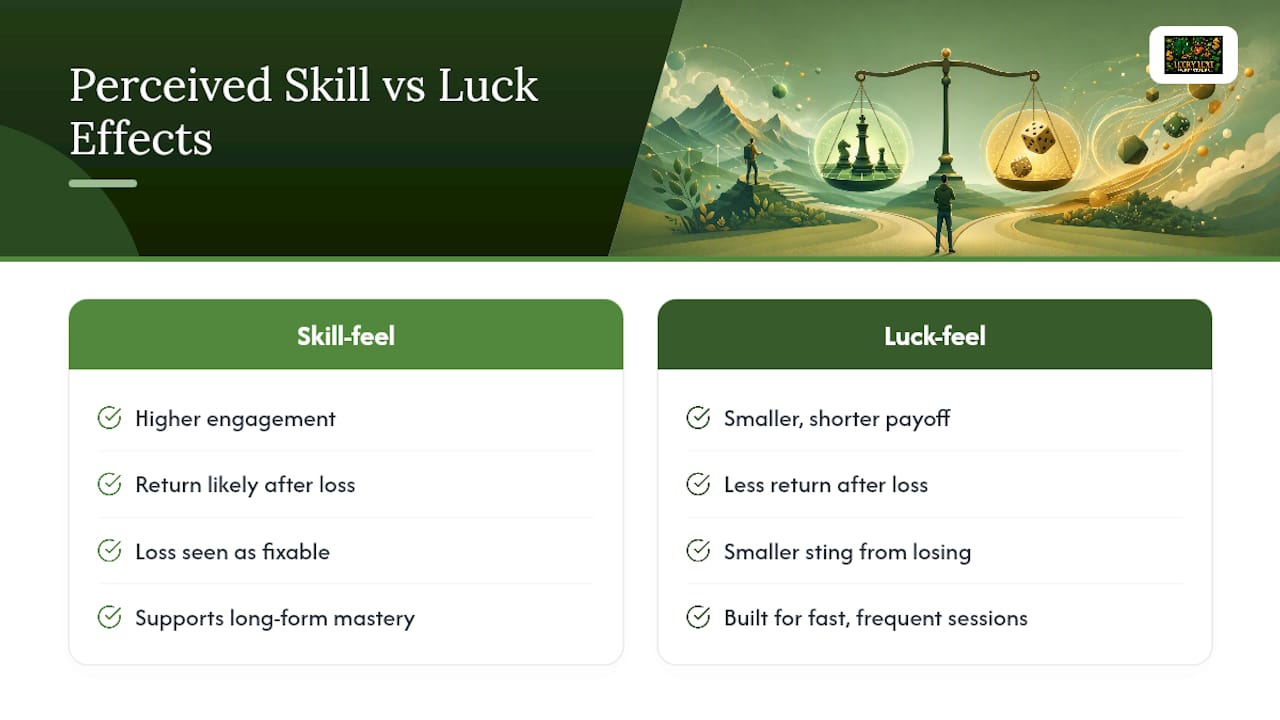
When a win feels earned, through a read, a combo, or a well-timed decision, players report higher engagement and are more likely to return after a loss, because a loss reads as something fixable next time. When a win feels handed to them by chance, the emotional payoff is smaller and shorter, but so is the sting of losing. That is precisely why high-chance games like slots are built around fast, frequent sessions rather than long-form mastery. There's less to be frustrated about, but also less to come back and improve.
The flip side matters just as much. Design analysis on this exact tension points out that players routinely misread ordinary variance as unfairness, especially in games that mix skill and chance. A poker player who loses with the statistically better hand feels cheated in the moment, even though that outcome is expected a meaningful percentage of the time. A single 5% event happening once is not evidence of a broken system. It's exactly what a 5% chance is supposed to do occasionally.
This perception gap is why some competitive game communities are famously toxic about "luck" complaints. The player experiencing the bad beat lived through one data point. The system operated on thousands.
How the Skill vs Luck Debate Has Evolved Over Time
The skill versus luck debate is not new. It has been reshaped by whatever technology and legal pressure happened to be dominant at the time.
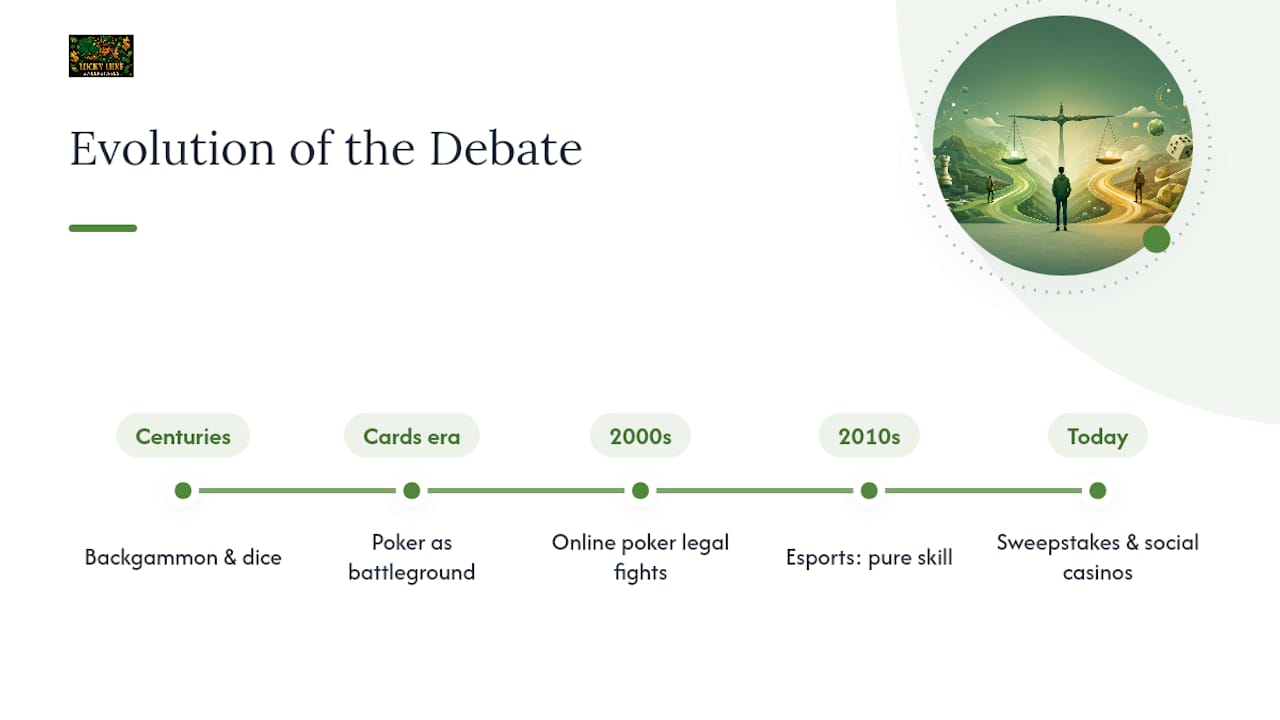
Backgammon and dice games have carried this argument for centuries, largely because courts and lawmakers needed to decide whether they counted as gambling. Chess never had this problem. No dice, no cards, no argument. Card games like poker became the real battleground, because they blend hidden information, betting psychology, and randomized deals in a way that resists a clean answer.
The rise of online poker in the 2000s pushed the debate into courtrooms and legislatures directly, as operators argued for skill classification and regulators pushed back with chance-dominance arguments. Esports added a new wrinkle in the 2010s: games built entirely around player mechanics and decision-making, with no randomization at all, forcing a fresh look at how "gaming" and "gambling" get defined once money and skill both scale up.
Sweepstakes and social casino platforms represent the current chapter. These platforms separate entertainment currency from prize-eligible currency, which sidesteps some of the older skill-versus-chance legal fights entirely by changing the underlying question from "how much skill is involved" to "how is the prize structured." The debate has not resolved so much as moved to new terrain every time the games or the money involved changed shape.
Why Skill vs Chance Classification Matters Legally
Whether a game counts legally as "skill" or "chance" is not academic. It determines what regulatory category the game falls into.
Industry and legal definitions generally treat a game as skill-based when outcomes are predominantly determined by player physical or mental ability rather than by randomized events. Testing labs and regulators use similarly outcome-focused criteria, defining skill-based games around player-controlled factors like reaction time, strategic choice, or trivia knowledge, as opposed to games where a random-number generator or physical randomizer decides the result.
This distinction is exactly why some games (trivia contests, certain arcade formats) can operate under different rules than games built around dice, cards, or slot-style outcomes. It is also why sweepstakes-model platforms structure their prize mechanics carefully: separating free entertainment play from any promotional sweepstakes entry changes which regulatory framework applies, and that framework varies by jurisdiction and by exactly how the prize structure is built. None of this is a substitute for reading the specific rules that apply to a specific game in a specific state. The classification depends on details, not vibes, and the details are what regulators actually look at.
What Players Should Actually Take From This
Most arguments about whether a game is "rigged" or "skill-based" are really arguments about sample size. Play enough hands, matches, or spins, and the truth about a game's real skill leverage shows up on its own. Play too few, and every outcome looks like a referendum on fairness that it never was. Approach chance-heavy games as entertainment first, set a session budget before you start, and save the skill-building energy for the games actually built to reward it.
— Skyline
Where to Play a Balanced Mix of Skill and Chance
If this continuum has you curious about where your favorite game types actually land, Luckyluxe gives you a direct way to find out, without committing a whole afternoon to one genre. The platform runs slots, fishing games, and arcade titles side by side, so you can move from a fast, chance-driven slot round to an arcade game that rewards timing and reaction, all in the same session.
A few resources make that easier to plan:
- Regular promotional highlights on featured games help players know which titles have bonus offers before they dive in.
- A session planning guide for setting realistic time and budget expectations before you start.
- Some platforms offer referral programs and support resources for players who want more than just a single session.
If you're a casual gamer looking for low-pressure play, start with a game that matches how much control you actually want over the outcome, then explore the rest of the library from there. Check out the current game lineup and promotions at Luckyluxe to see which titles fit the balance you're after.
Sources
- Quantifying skill and chance: A unified framework for the geometry of games — arXiv
- Luck Vs Skill: The False Dichotomy — Game Developer
- Online skill-based game — Wikipedia