

Social gaming communities are organized groups of players who gather around shared games and shared time, not just shared matches, using tools like Discord servers, forums, and dedicated community sites to sustain friendships between play sessions. Gartner's own definition of social gaming frames it as an interaction layer connecting players across games and platforms, and communities like Gaiscioch, running since 2001, prove the model works long term. Start by picking one platform category and watching how an active group actually behaves before you commit.
TL;DR:
- Active social gaming communities rely on recurring events, clear onboarding, and trusted roles to sustain long-term engagement rather than just focusing on member quantity.
- Finding a durable community involves checking recent activity signals like recent messages, voice activity, and moderation responsiveness, not just group size.
- Well-maintained communities enforce rules through transparent moderation, trusted member roles, and organized structures like event calendars and mentorship.
- Success depends on spreading responsibility early, consolidating activity in few platforms, and maintaining visible, updated event schedules to prevent slow decline.
- Platforms like Lucky Luxe support social play by providing recurring events, game highlights, and low-pressure participation without requiring long-term commitments.
Table of Contents
- What Makes a Social Gaming Community Different From a Random Match
- Where to Find Gaming Friends Online and How to Judge a Community Fast
- How Roles, Moderation, and Retention Keep a Community Alive
- The Real Benefits of Joining a Gaming Social Network
- A Step-by-Step Path to Joining and Contributing
- Lucky Luxe and Building Social Hooks Into Everyday Play
- Why Communities Struggle and How the Good Ones Fix It
- What Actually Matters When You're Choosing or Building a Community
- Try Social Play on Lucky Luxe Without Any Commitment
- Sources
What Makes a Social Gaming Community Different From a Random Match
A pickup group that disbands after one match isn't a community. A community is a group that persists, that has structure, and that gives members a reason to come back even when nobody is actively playing. That distinction sounds obvious until you try to find one, because most gaming spaces online blur the line on purpose.
Four structures dominate the space right now. Discord-first servers built around a single game or a genre cluster, often spun off from a streamer or a subreddit. Forum and clan hubs, the older model, still popular in strategy games, MMOs, and sim communities where long threads beat fast chat. LFG and matchmaking apps like GameTree, which use bots and profile matching to slot you into a session without you having to build relationships from scratch. And dedicated community websites, standalone hubs that host their own forums, calendars, and voice infrastructure independent of any single platform.
What separates a real community from a Discord server that will die in three months comes down to a handful of structural features:
- A clear onboarding path, usually a "start here" channel or a welcome thread that tells new members what to do first
- Visible roles and badges that show who has earned trust and who's brand new
- A public event calendar, not just a pinned message from two months ago
- Persistent voice and text channels that stay active outside of scheduled events
- Some form of governance, even informal, that handles disputes before they explode
Recurring events matter more than raw member count. A server with 200 people and a Saturday raid night that's run every week for a year will outlast a server with 5,000 members and no schedule. Governance works the same way. Darkjedi, founded in 1997, has stayed volunteer run for nearly three decades precisely because it prioritized structure over growth.
Where to Find Gaming Friends Online and How to Judge a Community Fast
Finding gaming social networks worth your time starts with narrowing the search, not widening it. The instinct is to join every server that mentions your favorite game. That's the fastest way to end up in a dozen dead channels you never open again.
- Narrow by game and genre first. A community built around competitive shooters behaves nothing like one built around cozy sims or cooperative survival games. Pick the genre that matches how you actually want to play, not the game with the biggest community.
- Check activity signals before joining anything. Look at the timestamp on the last message in general chat. Look at whether voice channels show anyone connected during your usual play hours. A server that looks huge on paper but goes quiet after 6pm your time zone isn't going to work for you.
- Observe for a session or two before you post anything. Read the pinned rules, skim the last week of chat, and watch how moderators handle a disagreement if one comes up. This tells you more about the group's real culture than any "about" channel ever will.
- Use LFG filters and bots to skip the noise. Tools like Noobly use badges and schedule matching to surface compatible players directly, which beats posting an LFG message into a 10,000-member server and watching it scroll past in ten seconds. GameTree's Scout bot does something similar by spinning up temporary voice rooms for a session and cleaning them up afterward, so the group doesn't leave clutter behind.
- Cross-reference with subreddits and forums. Most active Discord communities have a companion subreddit or forum thread where members discuss the group more candidly than they will in the server itself. That's often the most honest read you'll get.
A healthy, active community tends to show the same handful of signals: events posted within the last two weeks, voice channels with actual people in them during off-peak hours, moderators who respond to reports instead of ignoring them, and an onboarding thread that's been updated recently rather than left to rot. If a server is missing all four, keep looking. Our guide to online gaming categories breaks down which genres tend to produce the most durable groups if you're still deciding where to start.
How Roles, Moderation, and Retention Keep a Community Alive
Every gaming social network that lasts more than a year has figured out roles and moderation, usually the hard way, usually after a blowup nobody wants to repeat. The structure looks almost identical across genres once you know what to look for.
A founder or core admin team sets the tone and handles the big decisions. Moderators enforce the code of conduct day to day, often with escalating tiers of trust, a newer mod might only handle chat warnings, while a senior one can issue bans. Event hosts run the recurring sessions, whether that's a weekly raid, a Friday game night, or a monthly tournament. Mentors, often informal, pair with new members to answer questions and reduce the awkward first-week silence that kills a lot of new memberships before they start.
Moderation patterns that actually work share common traits:
- A written code of conduct that's linked, not just implied
- A reporting mechanism that doesn't require publicly calling someone out in general chat
- Trusted-member roles that unlock private channels only after a waiting period or activity threshold
- Separate spaces for casual chat versus serious event coordination, so the two don't collide
Retention comes down to low-pressure design more than anything flashy. Scheduled events beat spontaneous ones because members can plan around them. Mentorship pairings reduce the churn that happens in the first two weeks, when a new member either finds their footing or quietly leaves. Progression that doesn't punish casual players, letting someone show up once a month without losing status, keeps the group from becoming an exclusive clique.
Pro Tip: Before joining, ask in the general channel how the group handles a scheduling conflict during a major event. A well-run community has an actual answer. A disorganized one gets defensive or just doesn't respond.
Red flags worth walking away from: no visible moderation activity, a code of conduct that exists but is never enforced, or an inner circle that clearly runs the show while newer members get ignored.
The Real Benefits of Joining a Gaming Social Network
The most underrated benefit of joining a stable community isn't better teammates, it's not having to rebuild your social circle from zero every time you start a new game. You already have people who show up, who know your schedule, and who will play the weird cooperative game nobody else wants to try.
Research from Michigan State University Extension found that social network games help adults strengthen relationships, reinforcing what most long-term community members already know from experience: the social layer often outlasts interest in any single game. Members teach each other strategies, trade builds, and collaborate on creative projects, fan wikis, mod packs, community tournaments, that never would have happened in a solo queue.
Gaiscioch's retrospective on its own 23 years credits flexible participation and recurring events with making the group function like a family rather than a fan club.
The cultural ripple effects go further than most players notice. Communities drive trend diffusion, a build or strategy that starts in one Discord server can spread across an entire game's playerbase within weeks. Many groups run charity streams and fundraising events tied to their favorite games. Creator ecosystems, streamers, guide writers, mod developers, often grow directly out of community feedback loops rather than top down from the game's publisher.
A Step-by-Step Path to Joining and Contributing
Joining a community and actually sticking around are two different skills. Most people manage the first one and fail at the second because they skip the middle steps.
- Research before you commit. Read the server's rules channel, check its event calendar, and look at how many people are online during your typical play window.
- Lurk for a few days. Don't post anything yet. Watch how members talk to each other and how moderators handle friction.
- Introduce yourself with something specific. Skip "hey, new here." Say what you play, when you're usually online, and one thing you're looking for, teammates, a raid group, casual chat. Specificity gets responses.
- Attend one scheduled event before judging the group. A single session tells you more than a week of reading chat logs.
- Volunteer for something small. Offer to help run a session, moderate a channel, or organize a one-off tournament. This is how casual members become core members.
A short checklist before you commit to any group: read the full rules, not just the summary; set clear expectations on your profile about your time zone and availability; use LFG filters or bots instead of raw posts when the server supports them; run a two-week trial before deciding it's your main community; and keep basic safety boundaries, no sharing financial details, no meeting up in person without a public location and a friend along.
If a community stops fitting your schedule or interests, leave the way you'd want someone to leave your own group: a short note in the appropriate channel, no drama, no burning bridges. Most well-run communities have seen dozens of people come and go, and a clean exit keeps the door open if you ever want to come back. Our casual gaming session planning guide covers scheduling etiquette in more detail if you're planning to host rather than just attend.
Lucky Luxe and Building Social Hooks Into Everyday Play
Lucky Luxe isn't a Discord server or a guild, but the same principles that keep gaming social networks alive, recurring events, clear features, and a sense of shared momentum, show up in how the platform is built. Regular promotional cycles and hot game highlights function a lot like an event calendar: they give players a reason to check back on a schedule instead of drifting away.
A few features worth knowing about if you're evaluating how a platform supports social, recurring play:
- A referral program that turns individual play into a shared activity between friends
- Regularly refreshed game highlights that mimic the "event calendar" structure communities rely on for retention
- Support resources built to keep the experience straightforward rather than confusing for newer players
- Fair play standards that mirror the code-of-conduct expectations serious communities enforce internally
If responsible play is part of what you're evaluating, Lucky Luxe's Responsible Online Gaming Best Practices: 2026 Guide lays out the kind of safety-first thinking that the best player-run communities also build into their own rules.
Why Communities Struggle and How the Good Ones Fix It
Every gaming social network eventually hits the same wall: burnout among the volunteers who keep it running. Moderators quit, event hosts stop showing up, and nobody notices until the calendar goes stale. The fix that actually works is spreading responsibility early, giving trusted members small jobs before the core team burns out, instead of scrambling for replacements after the fact.

Toxicity is the second recurring problem, and it scales with server size faster than most founders expect. A group of 50 can self-police through social pressure alone. A group of 5,000 needs written rules, active reporting tools, and moderators who actually enforce consequences instead of looking away. Communities that skip this step tend to lose their most valuable members first, the reliable, low-drama players who simply leave rather than deal with the mess.
Platform fragmentation causes quieter damage. When a community splits its activity across five apps, Discord for chat, a forum for guides, a separate app for scheduling, engagement drops because nobody wants to check five places to find out what's happening. The stronger groups consolidate around one or two tools and make that choice loudly known to new members.
And then there's the slow fade: a community that never officially dies but just stops feeling worth checking. The only real defense is a visible, honest event calendar and a moderation team willing to prune inactive channels instead of letting them pile up as digital debris nobody wants to clean.
What Actually Matters When You're Choosing or Building a Community
Most advice about gaming communities focuses on size, biggest server, most active subreddit, when fit matters more than scale almost every time. A tight group of twelve people who play at the same time every week will give you a better social experience than a 10,000 member server where you're a name nobody recognizes.
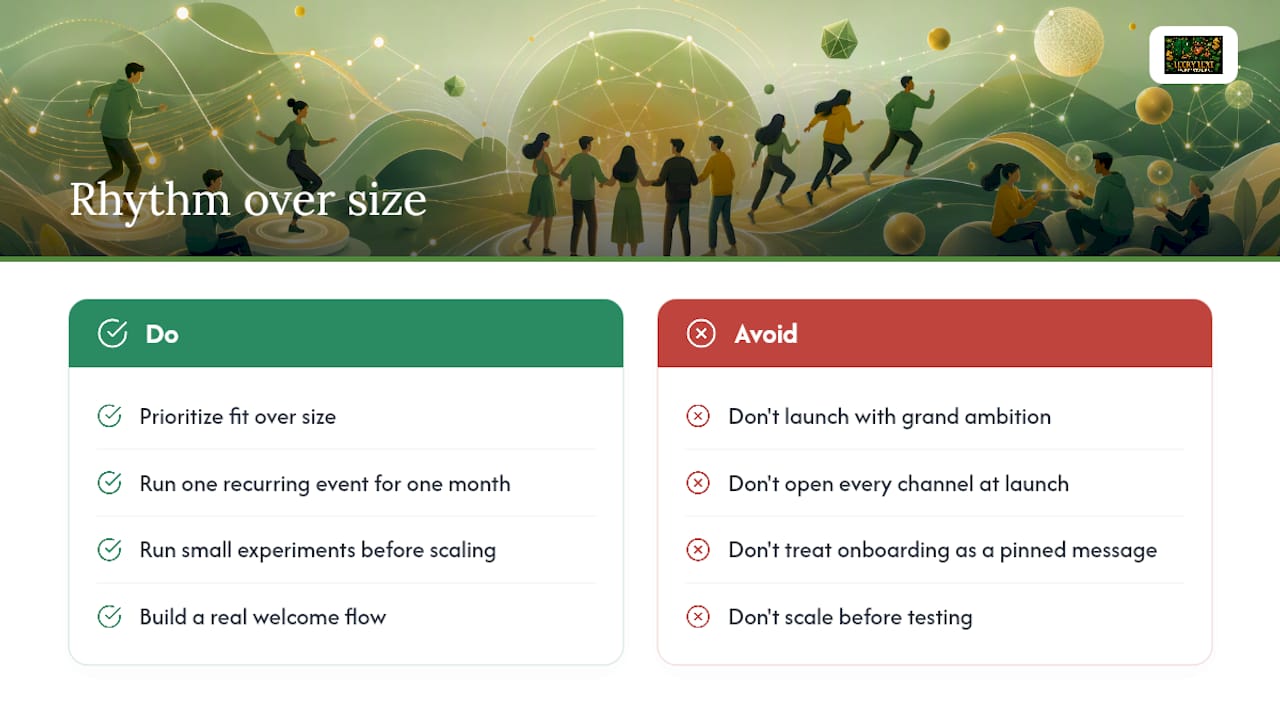
The mistake I see community builders make most often is launching with ambition instead of rhythm. They want a thriving hub on day one, so they open every channel, invite everyone they know, and skip the boring part: setting a single recurring event and actually running it, on time, for a month straight, before adding anything else. Onboarding gets treated as an afterthought too, a pinned message instead of a real welcome flow, which is exactly why so many new members vanish in their first week.
If you're building rather than joining, run small experiments before scaling anything. Host one event and see who shows up twice. Test a "start here" channel for two weeks and track how many new members actually use it. Add a calendar before you add a second Discord server. The groups that last aren't the ones that grew fastest. They're the ones that kept showing up on schedule.
— Skyline
Try Social Play on Lucky Luxe Without Any Commitment
Lucky Luxe gives you the recurring-event structure that keeps gaming communities alive, without requiring you to join a server, learn a group's internal rules, or wait for a scheduled session to start playing. Promotions and hot game highlights refresh regularly, so there's always something new to check without any pressure to commit long term.
Between the referral program, the rotating game lineup of slots, fishing, and arcade titles, and the support resources built for newer players, Lucky Luxe works as a low-friction way to experience social-style gaming hooks on your own schedule. If responsible play matters to you, the platform's guide to safe and structured play is worth a look before you dive in. Head to Luckyluxe to browse the current lineup and see which games are featured this week.
Sources
- Gartner — Social gaming (glossary)
- Gaiscioch — community site
- Darkjedi
- MSU Extension — Social network games help grown-ups' relationships
- Medium — The Gaiscioch community: celebrating 23 years